

7.5 Droop Effect
145
=
B
A S R H /n + B + C Auger n + Dn 2
(7.23)
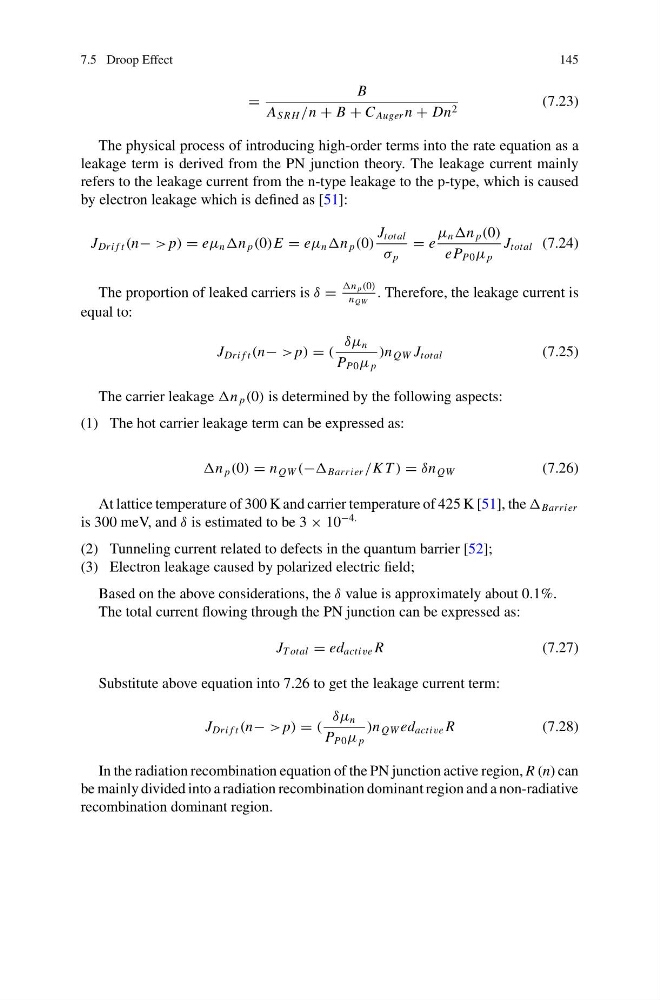
The physical process of introducing high-order terms into the rate equation as a
leakage term is derived from the PN junction theory. The leakage current mainly
refers to the leakage current from the n-type leakage to the p-type, which is caused
by electron leakage which is defined as [51]:
J Dri f t (n− > p) = eμ n n p (0)E = eμ n n p (0)
J total
σ p
= e
μ n n p (0)
eP P0 μ p
J total (7.24)
The proportion of leaked carriers is δ =
n p (0)
n QW
. Therefore, the leakage current is
equal to:
J Dri f t (n− > p) = (
δμ n
P P0 μ p
)n QW J total
(7.25)
The carrier leakage n p (0) is determined by the following aspects:
(1) The hot carrier leakage term can be expressed as:
n p (0) = n QW (− Barrier /K T ) = δn QW
(7.26)
At lattice temperature of 300 K and carrier temperature of 425 K [51], the Barrier
is 300 meV, and δ is estimated to be 3 × 10
−4.
(2) Tunneling current related to defects in the quantum barrier [52];
(3) Electron leakage caused by polarized electric field;
Based on the above considerations, the δ value is approximately about 0.1%.
The total current flowing through the PN junction can be expressed as:
J T otal = ed active R
(7.27)
Substitute above equation into 7.26 to get the leakage current term:
J Dri f t (n− > p) = (
δμ n
P P0 μ p
)n QW ed active R
(7.28)
In the radiation recombination equation of the PN junction active region, R (n) can
be mainly divided into a radiation recombination dominant region and a non-radiative
recombination dominant region.
145
=
B
A S R H /n + B + C Auger n + Dn 2
(7.23)
The physical process of introducing high-order terms into the rate equation as a
leakage term is derived from the PN junction theory. The leakage current mainly
refers to the leakage current from the n-type leakage to the p-type, which is caused
by electron leakage which is defined as [51]:
J Dri f t (n− > p) = eμ n n p (0)E = eμ n n p (0)
J total
σ p
= e
μ n n p (0)
eP P0 μ p
J total (7.24)
The proportion of leaked carriers is δ =
n p (0)
n QW
. Therefore, the leakage current is
equal to:
J Dri f t (n− > p) = (
δμ n
P P0 μ p
)n QW J total
(7.25)
The carrier leakage n p (0) is determined by the following aspects:
(1) The hot carrier leakage term can be expressed as:
n p (0) = n QW (− Barrier /K T ) = δn QW
(7.26)
At lattice temperature of 300 K and carrier temperature of 425 K [51], the Barrier
is 300 meV, and δ is estimated to be 3 × 10
−4.
(2) Tunneling current related to defects in the quantum barrier [52];
(3) Electron leakage caused by polarized electric field;
Based on the above considerations, the δ value is approximately about 0.1%.
The total current flowing through the PN junction can be expressed as:
J T otal = ed active R
(7.27)
Substitute above equation into 7.26 to get the leakage current term:
J Dri f t (n− > p) = (
δμ n
P P0 μ p
)n QW ed active R
(7.28)
In the radiation recombination equation of the PN junction active region, R (n) can
be mainly divided into a radiation recombination dominant region and a non-radiative
recombination dominant region.