

130
7 III-Nitride LED Quantum Efficiency Improvement Technology
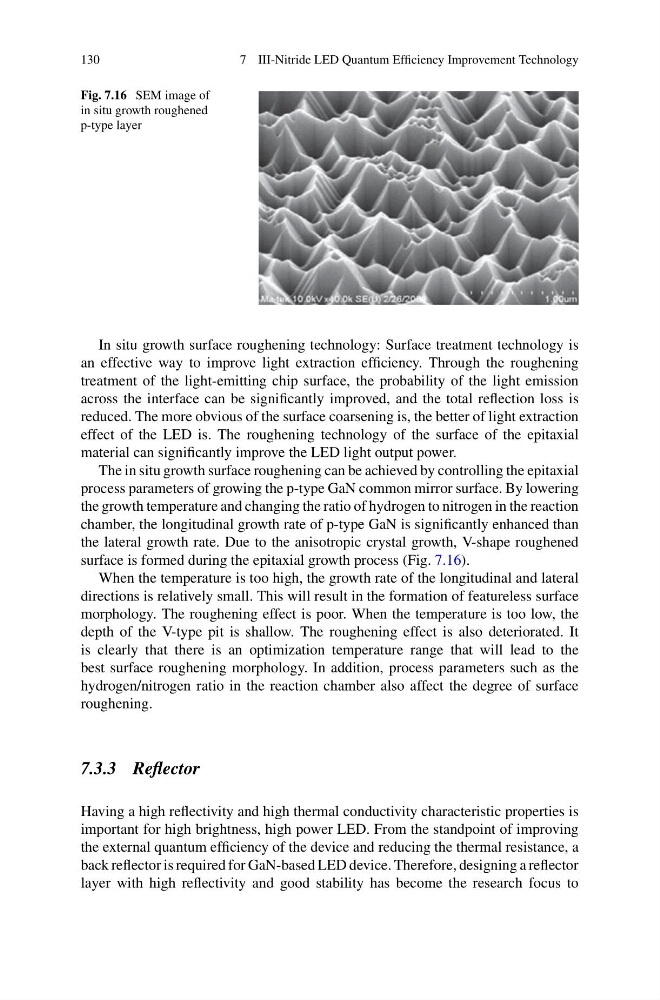
Fig. 7.16 SEM image of
in situ growth roughened
p-type layer
In situ growth surface roughening technology: Surface treatment technology is
an effective way to improve light extraction efficiency. Through the roughening
treatment of the light-emitting chip surface, the probability of the light emission
across the interface can be significantly improved, and the total reflection loss is
reduced. The more obvious of the surface coarsening is, the better of light extraction
effect of the LED is. The roughening technology of the surface of the epitaxial
material can significantly improve the LED light output power.
The in situ growth surface roughening can be achieved by controlling the epitaxial
process parameters of growing the p-type GaN common mirror surface. By lowering
the growth temperature and changing the ratio of hydrogen to nitrogen in the reaction
chamber, the longitudinal growth rate of p-type GaN is significantly enhanced than
the lateral growth rate. Due to the anisotropic crystal growth, V-shape roughened
surface is formed during the epitaxial growth process (Fig. 7.16).
When the temperature is too high, the growth rate of the longitudinal and lateral
directions is relatively small. This will result in the formation of featureless surface
morphology. The roughening effect is poor. When the temperature is too low, the
depth of the V-type pit is shallow. The roughening effect is also deteriorated. It
is clearly that there is an optimization temperature range that will lead to the
best surface roughening morphology. In addition, process parameters such as the
hydrogen/nitrogen ratio in the reaction chamber also affect the degree of surface
roughening.
7.3.3 Reflector
Having a high reflectivity and high thermal conductivity characteristic properties is
important for high brightness, high power LED. From the standpoint of improving
the external quantum efficiency of the device and reducing the thermal resistance, a
back reflector is required for GaN-based LED device. Therefore, designing a reflector
layer with high reflectivity and good stability has become the research focus to
7 III-Nitride LED Quantum Efficiency Improvement Technology
Fig. 7.16 SEM image of
in situ growth roughened
p-type layer
In situ growth surface roughening technology: Surface treatment technology is
an effective way to improve light extraction efficiency. Through the roughening
treatment of the light-emitting chip surface, the probability of the light emission
across the interface can be significantly improved, and the total reflection loss is
reduced. The more obvious of the surface coarsening is, the better of light extraction
effect of the LED is. The roughening technology of the surface of the epitaxial
material can significantly improve the LED light output power.
The in situ growth surface roughening can be achieved by controlling the epitaxial
process parameters of growing the p-type GaN common mirror surface. By lowering
the growth temperature and changing the ratio of hydrogen to nitrogen in the reaction
chamber, the longitudinal growth rate of p-type GaN is significantly enhanced than
the lateral growth rate. Due to the anisotropic crystal growth, V-shape roughened
surface is formed during the epitaxial growth process (Fig. 7.16).
When the temperature is too high, the growth rate of the longitudinal and lateral
directions is relatively small. This will result in the formation of featureless surface
morphology. The roughening effect is poor. When the temperature is too low, the
depth of the V-type pit is shallow. The roughening effect is also deteriorated. It
is clearly that there is an optimization temperature range that will lead to the
best surface roughening morphology. In addition, process parameters such as the
hydrogen/nitrogen ratio in the reaction chamber also affect the degree of surface
roughening.
7.3.3 Reflector
Having a high reflectivity and high thermal conductivity characteristic properties is
important for high brightness, high power LED. From the standpoint of improving
the external quantum efficiency of the device and reducing the thermal resistance, a
back reflector is required for GaN-based LED device. Therefore, designing a reflector
layer with high reflectivity and good stability has become the research focus to