

128
7 III-Nitride LED Quantum Efficiency Improvement Technology
Compared to typical growth method, overall penetration density of dislocations has
been substantially reduced [23].
For micro-nano patterned sapphire substrate (NPSS) technology, a nickel film is
first deposited on the prepared micro-pattern substrate. Rapid thermal annealing
under high temperature conditions is then carried out to form a nickel ball of
nanometer size as a mask. A micro-nano mixed patterned sapphire substrate is
obtained by dry etching or acid etching.
XRD and SEM analysis shows that the micro-nano pattern substrate has a close
influence on the quality of GaN materials. From FDTD simulation, it has found that
LEDs with the micro and nano patterned substrate, in comparison with the micro
PSS, have higher light extraction efficiency.
7.3.2 Surface Roughening
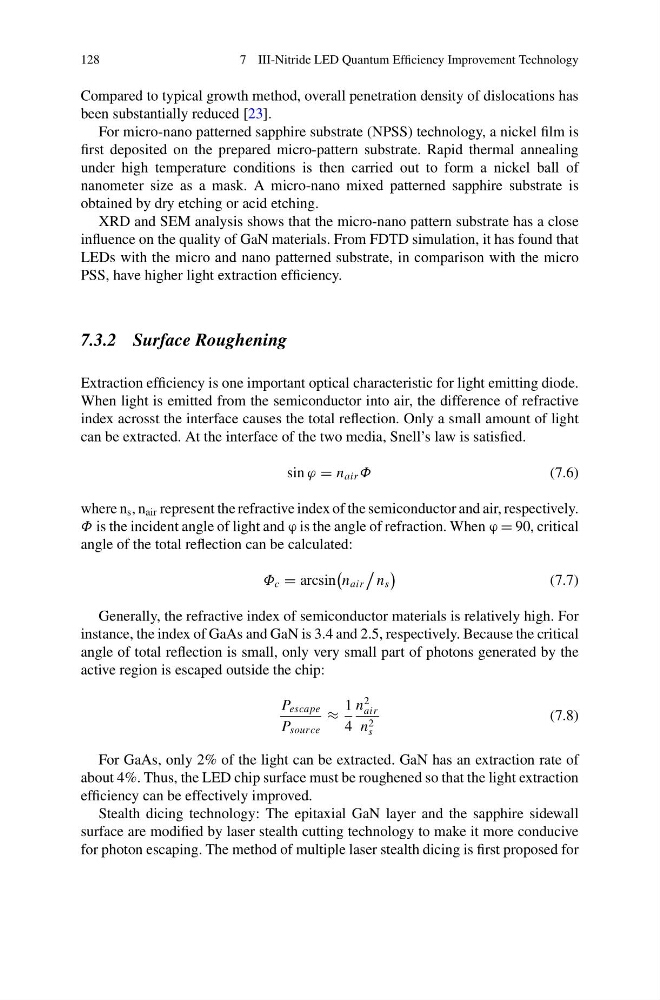
Extraction efficiency is one important optical characteristic for light emitting diode.
When light is emitted from the semiconductor into air, the difference of refractive
index acrosst the interface causes the total reflection. Only a small amount of light
can be extracted. At the interface of the two media, Snell’s law is satisfied.
sin ϕ = n air Φ
(7.6)
where n s , n air represent the refractive index of the semiconductor and air, respectively.
Φ is the incident angle of light and ϕ is the angle of refraction. When ϕ = 90, critical
angle of the total reflection can be calculated:
Φ c = arcsin
n air
n s
(7.7)
Generally, the refractive index of semiconductor materials is relatively high. For
instance, the index of GaAs and GaN is 3.4 and 2.5, respectively. Because the critical
angle of total reflection is small, only very small part of photons generated by the
active region is escaped outside the chip:
P escape
P source
≈
1
4
n
2
air
n 2
s
(7.8)
For GaAs, only 2% of the light can be extracted. GaN has an extraction rate of
about 4%. Thus, the LED chip surface must be roughened so that the light extraction
efficiency can be effectively improved.
Stealth dicing technology: The epitaxial GaN layer and the sapphire sidewall
surface are modified by laser stealth cutting technology to make it more conducive
for photon escaping. The method of multiple laser stealth dicing is first proposed for
7 III-Nitride LED Quantum Efficiency Improvement Technology
Compared to typical growth method, overall penetration density of dislocations has
been substantially reduced [23].
For micro-nano patterned sapphire substrate (NPSS) technology, a nickel film is
first deposited on the prepared micro-pattern substrate. Rapid thermal annealing
under high temperature conditions is then carried out to form a nickel ball of
nanometer size as a mask. A micro-nano mixed patterned sapphire substrate is
obtained by dry etching or acid etching.
XRD and SEM analysis shows that the micro-nano pattern substrate has a close
influence on the quality of GaN materials. From FDTD simulation, it has found that
LEDs with the micro and nano patterned substrate, in comparison with the micro
PSS, have higher light extraction efficiency.
7.3.2 Surface Roughening
Extraction efficiency is one important optical characteristic for light emitting diode.
When light is emitted from the semiconductor into air, the difference of refractive
index acrosst the interface causes the total reflection. Only a small amount of light
can be extracted. At the interface of the two media, Snell’s law is satisfied.
sin ϕ = n air Φ
(7.6)
where n s , n air represent the refractive index of the semiconductor and air, respectively.
Φ is the incident angle of light and ϕ is the angle of refraction. When ϕ = 90, critical
angle of the total reflection can be calculated:
Φ c = arcsin
n air
n s
(7.7)
Generally, the refractive index of semiconductor materials is relatively high. For
instance, the index of GaAs and GaN is 3.4 and 2.5, respectively. Because the critical
angle of total reflection is small, only very small part of photons generated by the
active region is escaped outside the chip:
P escape
P source
≈
1
4
n
2
air
n 2
s
(7.8)
For GaAs, only 2% of the light can be extracted. GaN has an extraction rate of
about 4%. Thus, the LED chip surface must be roughened so that the light extraction
efficiency can be effectively improved.
Stealth dicing technology: The epitaxial GaN layer and the sapphire sidewall
surface are modified by laser stealth cutting technology to make it more conducive
for photon escaping. The method of multiple laser stealth dicing is first proposed for