

116
7 III-Nitride LED Quantum Efficiency Improvement Technology
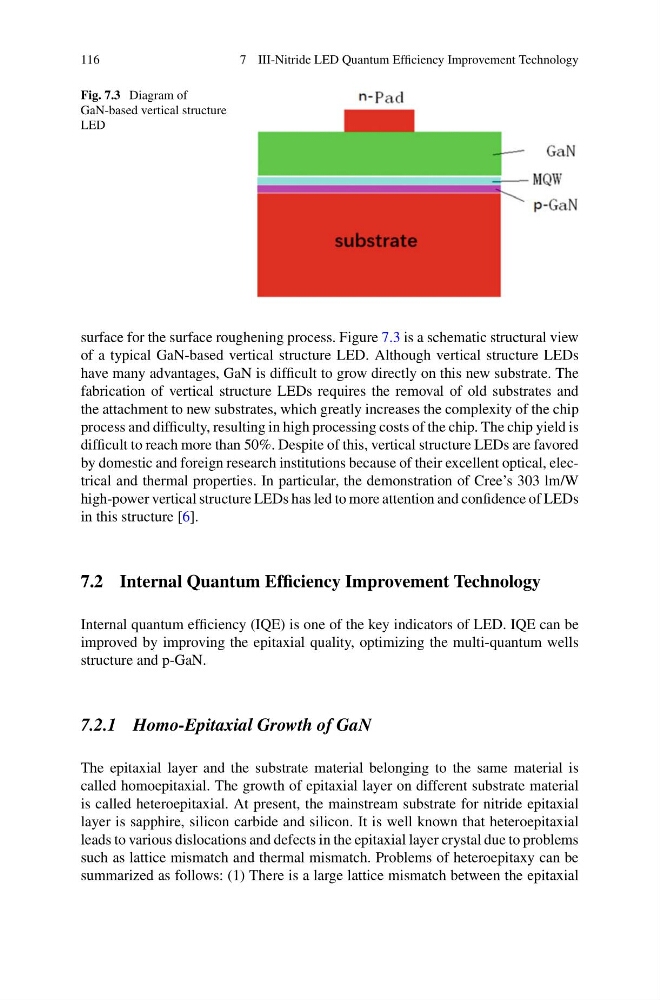
Fig. 7.3 Diagram of
GaN-based vertical structure
LED
surface for the surface roughening process. Figure 7.3 is a schematic structural view
of a typical GaN-based vertical structure LED. Although vertical structure LEDs
have many advantages, GaN is difficult to grow directly on this new substrate. The
fabrication of vertical structure LEDs requires the removal of old substrates and
the attachment to new substrates, which greatly increases the complexity of the chip
process and difficulty, resulting in high processing costs of the chip. The chip yield is
difficult to reach more than 50%. Despite of this, vertical structure LEDs are favored
by domestic and foreign research institutions because of their excellent optical, electrical and thermal properties. In particular, the demonstration of Cree’s 303 lm/W
high-power vertical structure LEDs has led to more attention and confidence of LEDs
in this structure [6].
7.2 Internal Quantum Efficiency Improvement Technology
Internal quantum efficiency (IQE) is one of the key indicators of LED. IQE can be
improved by improving the epitaxial quality, optimizing the multi-quantum wells
structure and p-GaN.
7.2.1 Homo-Epitaxial Growth of GaN
The epitaxial layer and the substrate material belonging to the same material is
called homoepitaxial. The growth of epitaxial layer on different substrate material
is called heteroepitaxial. At present, the mainstream substrate for nitride epitaxial
layer is sapphire, silicon carbide and silicon. It is well known that heteroepitaxial
leads to various dislocations and defects in the epitaxial layer crystal due to problems
such as lattice mismatch and thermal mismatch. Problems of heteroepitaxy can be
summarized as follows: (1) There is a large lattice mismatch between the epitaxial
7 III-Nitride LED Quantum Efficiency Improvement Technology
Fig. 7.3 Diagram of
GaN-based vertical structure
LED
surface for the surface roughening process. Figure 7.3 is a schematic structural view
of a typical GaN-based vertical structure LED. Although vertical structure LEDs
have many advantages, GaN is difficult to grow directly on this new substrate. The
fabrication of vertical structure LEDs requires the removal of old substrates and
the attachment to new substrates, which greatly increases the complexity of the chip
process and difficulty, resulting in high processing costs of the chip. The chip yield is
difficult to reach more than 50%. Despite of this, vertical structure LEDs are favored
by domestic and foreign research institutions because of their excellent optical, electrical and thermal properties. In particular, the demonstration of Cree’s 303 lm/W
high-power vertical structure LEDs has led to more attention and confidence of LEDs
in this structure [6].
7.2 Internal Quantum Efficiency Improvement Technology
Internal quantum efficiency (IQE) is one of the key indicators of LED. IQE can be
improved by improving the epitaxial quality, optimizing the multi-quantum wells
structure and p-GaN.
7.2.1 Homo-Epitaxial Growth of GaN
The epitaxial layer and the substrate material belonging to the same material is
called homoepitaxial. The growth of epitaxial layer on different substrate material
is called heteroepitaxial. At present, the mainstream substrate for nitride epitaxial
layer is sapphire, silicon carbide and silicon. It is well known that heteroepitaxial
leads to various dislocations and defects in the epitaxial layer crystal due to problems
such as lattice mismatch and thermal mismatch. Problems of heteroepitaxy can be
summarized as follows: (1) There is a large lattice mismatch between the epitaxial