

4 Crystal Nucleation of Proteins Induced by Surface …
73
Two molecules meet and a bimolecular cluster is formed by intermolecular force
due to hydrogen bonding or van der Waals force. Small clusters are unstable and do
not grow spontaneously, but they grow spontaneously when they grow larger than
the critical radius. In the case of a molecule such as a protein, even if the degree of
supersaturation is large, the small clusters are often unstable and nucleation does not
occur.
Imagine adding a stable bimolecular cluster bound covalently to the solution. The
bimolecular cluster was the most unstable and easily dissociated, making it difficult
to grow into a trimolecular cluster. However, if the bimolecular cluster is stable, it
is easy to grow and a critical nucleus is easily formed. The protein crystallization
method triggered by a photochemical reaction is to create a stable protein dimer in
the system.
4.2 Photochemical Reaction of Proteins
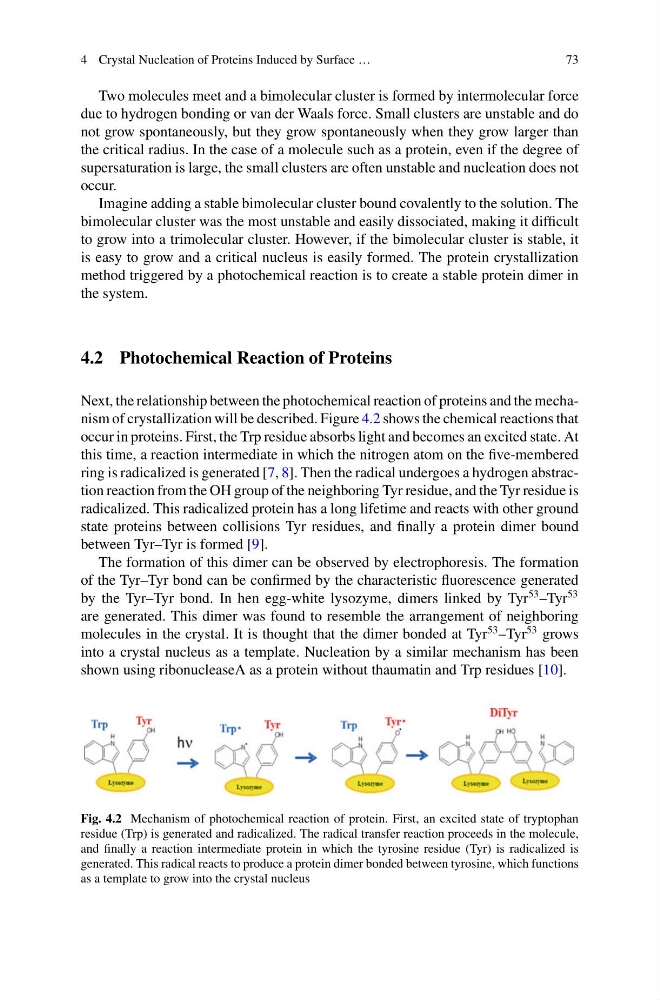
Next, the relationship between the photochemical reaction of proteins and the mechanism of crystallization will be described. Figure 4.2 shows the chemical reactions that
occur in proteins. First, the Trp residue absorbs light and becomes an excited state. At
this time, a reaction intermediate in which the nitrogen atom on the five-membered
ring is radicalized is generated [7, 8]. Then the radical undergoes a hydrogen abstraction reaction from the OH group of the neighboring Tyr residue, and the Tyr residue is
radicalized. This radicalized protein has a long lifetime and reacts with other ground
state proteins between collisions Tyr residues, and finally a protein dimer bound
between Tyr–Tyr is formed [9].
The formation of this dimer can be observed by electrophoresis. The formation
of the Tyr–Tyr bond can be confirmed by the characteristic fluorescence generated
by the Tyr–Tyr bond. In hen egg-white lysozyme, dimers linked by Tyr
53 –Tyr
53
are generated. This dimer was found to resemble the arrangement of neighboring
molecules in the crystal. It is thought that the dimer bonded at Tyr
53 –Tyr
53 grows
into a crystal nucleus as a template. Nucleation by a similar mechanism has been
shown using ribonucleaseA as a protein without thaumatin and Trp residues [10].
Fig. 4.2 Mechanism of photochemical reaction of protein. First, an excited state of tryptophan
residue (Trp) is generated and radicalized. The radical transfer reaction proceeds in the molecule,
and finally a reaction intermediate protein in which the tyrosine residue (Tyr) is radicalized is
generated. This radical reacts to produce a protein dimer bonded between tyrosine, which functions
as a template to grow into the crystal nucleus
73
Two molecules meet and a bimolecular cluster is formed by intermolecular force
due to hydrogen bonding or van der Waals force. Small clusters are unstable and do
not grow spontaneously, but they grow spontaneously when they grow larger than
the critical radius. In the case of a molecule such as a protein, even if the degree of
supersaturation is large, the small clusters are often unstable and nucleation does not
occur.
Imagine adding a stable bimolecular cluster bound covalently to the solution. The
bimolecular cluster was the most unstable and easily dissociated, making it difficult
to grow into a trimolecular cluster. However, if the bimolecular cluster is stable, it
is easy to grow and a critical nucleus is easily formed. The protein crystallization
method triggered by a photochemical reaction is to create a stable protein dimer in
the system.
4.2 Photochemical Reaction of Proteins
Next, the relationship between the photochemical reaction of proteins and the mechanism of crystallization will be described. Figure 4.2 shows the chemical reactions that
occur in proteins. First, the Trp residue absorbs light and becomes an excited state. At
this time, a reaction intermediate in which the nitrogen atom on the five-membered
ring is radicalized is generated [7, 8]. Then the radical undergoes a hydrogen abstraction reaction from the OH group of the neighboring Tyr residue, and the Tyr residue is
radicalized. This radicalized protein has a long lifetime and reacts with other ground
state proteins between collisions Tyr residues, and finally a protein dimer bound
between Tyr–Tyr is formed [9].
The formation of this dimer can be observed by electrophoresis. The formation
of the Tyr–Tyr bond can be confirmed by the characteristic fluorescence generated
by the Tyr–Tyr bond. In hen egg-white lysozyme, dimers linked by Tyr
53 –Tyr
53
are generated. This dimer was found to resemble the arrangement of neighboring
molecules in the crystal. It is thought that the dimer bonded at Tyr
53 –Tyr
53 grows
into a crystal nucleus as a template. Nucleation by a similar mechanism has been
shown using ribonucleaseA as a protein without thaumatin and Trp residues [10].
Fig. 4.2 Mechanism of photochemical reaction of protein. First, an excited state of tryptophan
residue (Trp) is generated and radicalized. The radical transfer reaction proceeds in the molecule,
and finally a reaction intermediate protein in which the tyrosine residue (Tyr) is radicalized is
generated. This radical reacts to produce a protein dimer bonded between tyrosine, which functions
as a template to grow into the crystal nucleus