

72
T. Okutsu
structure analysis has been advanced. At the same time, advances in science and
technology to make crystals are desired.
Crystal growth of proteins is carried out by researchers in the field of drug
discovery and biology using experience and intuition based on information in the literature and data base. On the other hand, basic research on crystal growth of proteins
has been made from the viewpoint of crystal growth science regarding nucleation
and growth mechanism [2]. In addition, researchers specializing in crystal growth
have come into the business of crystallizing proteins for drug discovery [3].
There are several reasons why protein crystallization is more difficult than smallmolecule substances. First, although proteins have large molecular weight, they
aggregate with small intermolecular force such as van der Waals force and hydrogen
bond, and therefore they have the property of being hard to crystallize. Protein
is a colloidal particle with charge repulsion, and when it crystallizes, salting out
cancels the charge and causes mild aggregation to crystallize. If the charge is roughly
canceled, it will easily become an amorphous precipitate. Second, proteins have
large molecular anisotropy and no symmetry. For this reason, there is a problem
that when incorporated into the crystal phase, the crystal phase is entered only when
approaching in a specific direction. Therefore, even in a supersaturation, small clusters are easily separated, so it is difficult to form a critical nucleus, and a supersaturated solution with a concentration many times that of the solubility still exists.
Research to obtain protein crystals is to address these issues.
In recent years, as a method of crystal growth, a phenomenon that induces crystallization by the perturbation of light has been found and noted [4]. The action of light
is roughly divided into physical perturbations and methods using chemical actions.
Research using physical perturbations has been developed with a focus on groups in
the United States and Osaka University. The Osaka University group has successfully
commercialized protein crystallization as a venture business [5].
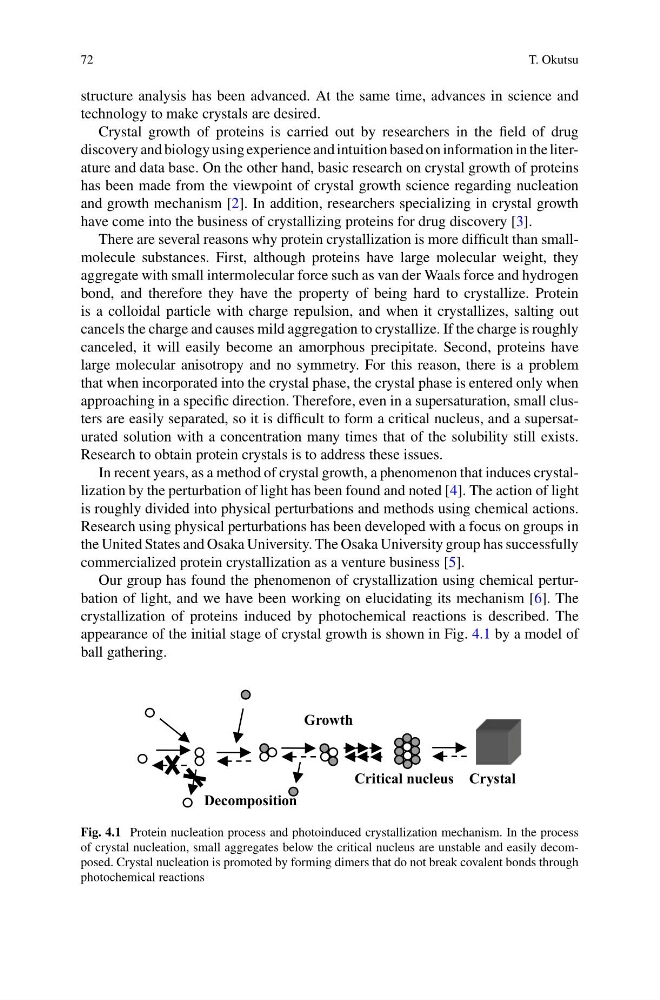
Our group has found the phenomenon of crystallization using chemical perturbation of light, and we have been working on elucidating its mechanism [6]. The
crystallization of proteins induced by photochemical reactions is described. The
appearance of the initial stage of crystal growth is shown in Fig. 4.1 by a model of
ball gathering.
Decomposition
Critical nucleus Crystal
Growth
Fig. 4.1 Protein nucleation process and photoinduced crystallization mechanism. In the process
of crystal nucleation, small aggregates below the critical nucleus are unstable and easily decomposed. Crystal nucleation is promoted by forming dimers that do not break covalent bonds through
photochemical reactions
T. Okutsu
structure analysis has been advanced. At the same time, advances in science and
technology to make crystals are desired.
Crystal growth of proteins is carried out by researchers in the field of drug
discovery and biology using experience and intuition based on information in the literature and data base. On the other hand, basic research on crystal growth of proteins
has been made from the viewpoint of crystal growth science regarding nucleation
and growth mechanism [2]. In addition, researchers specializing in crystal growth
have come into the business of crystallizing proteins for drug discovery [3].
There are several reasons why protein crystallization is more difficult than smallmolecule substances. First, although proteins have large molecular weight, they
aggregate with small intermolecular force such as van der Waals force and hydrogen
bond, and therefore they have the property of being hard to crystallize. Protein
is a colloidal particle with charge repulsion, and when it crystallizes, salting out
cancels the charge and causes mild aggregation to crystallize. If the charge is roughly
canceled, it will easily become an amorphous precipitate. Second, proteins have
large molecular anisotropy and no symmetry. For this reason, there is a problem
that when incorporated into the crystal phase, the crystal phase is entered only when
approaching in a specific direction. Therefore, even in a supersaturation, small clusters are easily separated, so it is difficult to form a critical nucleus, and a supersaturated solution with a concentration many times that of the solubility still exists.
Research to obtain protein crystals is to address these issues.
In recent years, as a method of crystal growth, a phenomenon that induces crystallization by the perturbation of light has been found and noted [4]. The action of light
is roughly divided into physical perturbations and methods using chemical actions.
Research using physical perturbations has been developed with a focus on groups in
the United States and Osaka University. The Osaka University group has successfully
commercialized protein crystallization as a venture business [5].
Our group has found the phenomenon of crystallization using chemical perturbation of light, and we have been working on elucidating its mechanism [6]. The
crystallization of proteins induced by photochemical reactions is described. The
appearance of the initial stage of crystal growth is shown in Fig. 4.1 by a model of
ball gathering.
Decomposition
Critical nucleus Crystal
Growth
Fig. 4.1 Protein nucleation process and photoinduced crystallization mechanism. In the process
of crystal nucleation, small aggregates below the critical nucleus are unstable and easily decomposed. Crystal nucleation is promoted by forming dimers that do not break covalent bonds through
photochemical reactions