

68
H. Takiyama
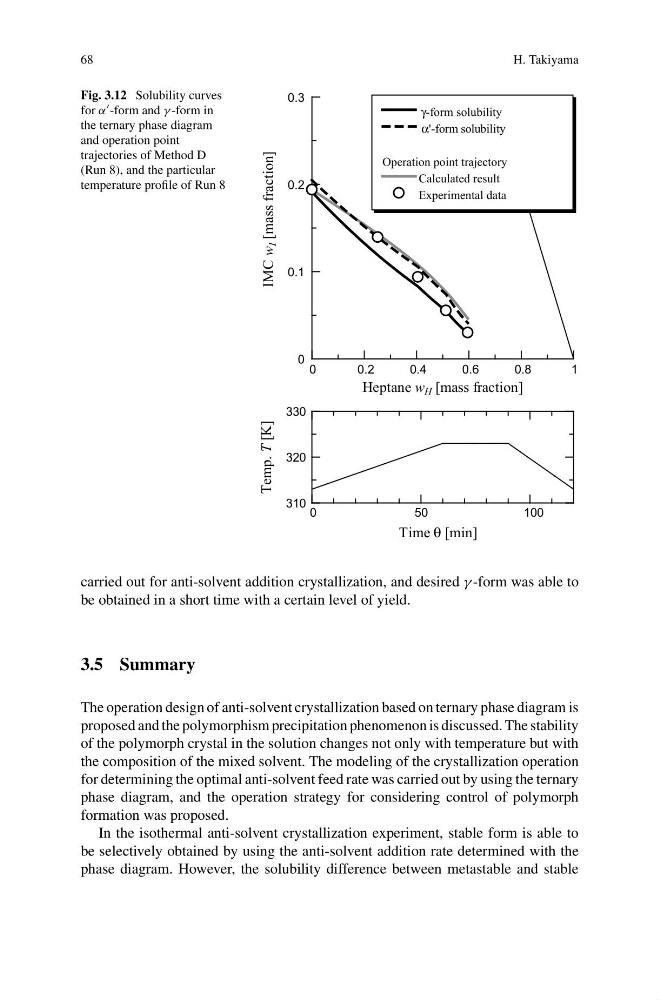
Fig. 3.12 Solubility curves
for α -form and γ -form in
the ternary phase diagram
and operation point
trajectories of Method D
(Run 8), and the particular
temperature profile of Run 8
0
0.2
0.4
0.6
0.8
1
0
0.1
0.2
0.3
Heptane w H [mass fraction]
IMC w
I [mass fraction]
γ-form solubility
α'-form solubility
Operation point trajectory
Calculated result
Experimental data
0
50
100
310
320
330
Time θ [min]
Temp. T
[K]
carried out for anti-solvent addition crystallization, and desired γ -form was able to
be obtained in a short time with a certain level of yield.
3.5 Summary
The operation design of anti-solvent crystallization based on ternary phase diagram is
proposed and the polymorphism precipitation phenomenon is discussed. The stability
of the polymorph crystal in the solution changes not only with temperature but with
the composition of the mixed solvent. The modeling of the crystallization operation
for determining the optimal anti-solvent feed rate was carried out by using the ternary
phase diagram, and the operation strategy for considering control of polymorph
formation was proposed.
In the isothermal anti-solvent crystallization experiment, stable form is able to
be selectively obtained by using the anti-solvent addition rate determined with the
phase diagram. However, the solubility difference between metastable and stable
H. Takiyama
Fig. 3.12 Solubility curves
for α -form and γ -form in
the ternary phase diagram
and operation point
trajectories of Method D
(Run 8), and the particular
temperature profile of Run 8
0
0.2
0.4
0.6
0.8
1
0
0.1
0.2
0.3
Heptane w H [mass fraction]
IMC w
I [mass fraction]
γ-form solubility
α'-form solubility
Operation point trajectory
Calculated result
Experimental data
0
50
100
310
320
330
Time θ [min]
Temp. T
[K]
carried out for anti-solvent addition crystallization, and desired γ -form was able to
be obtained in a short time with a certain level of yield.
3.5 Summary
The operation design of anti-solvent crystallization based on ternary phase diagram is
proposed and the polymorphism precipitation phenomenon is discussed. The stability
of the polymorph crystal in the solution changes not only with temperature but with
the composition of the mixed solvent. The modeling of the crystallization operation
for determining the optimal anti-solvent feed rate was carried out by using the ternary
phase diagram, and the operation strategy for considering control of polymorph
formation was proposed.
In the isothermal anti-solvent crystallization experiment, stable form is able to
be selectively obtained by using the anti-solvent addition rate determined with the
phase diagram. However, the solubility difference between metastable and stable