

48
F. Ito
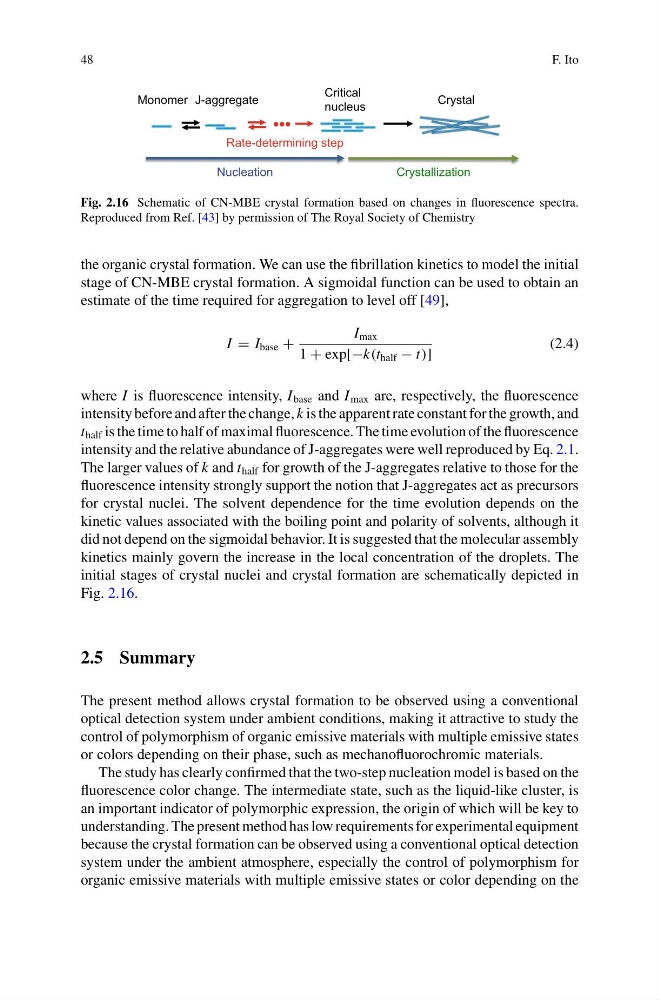
Monomer J-aggregate
Critical
nucleus
Crystal
Nucleation
Crystallization
Rate-determining step
Fig. 2.16 Schematic of CN-MBE crystal formation based on changes in fluorescence spectra.
Reproduced from Ref. [43] by permission of The Royal Society of Chemistry
the organic crystal formation. We can use the fibrillation kinetics to model the initial
stage of CN-MBE crystal formation. A sigmoidal function can be used to obtain an
estimate of the time required for aggregation to level off [49],
I = I base +
I max
1 + exp[−k(t half − t)]
(2.4)
where I is fluorescence intensity, I base and I max are, respectively, the fluorescence
intensity before and after the change, k is the apparent rate constant for the growth, and
t half is the time to half of maximal fluorescence. The time evolution of the fluorescence
intensity and the relative abundance of J-aggregates were well reproduced by Eq. 2.1.
The larger values of k and t half for growth of the J-aggregates relative to those for the
fluorescence intensity strongly support the notion that J-aggregates act as precursors
for crystal nuclei. The solvent dependence for the time evolution depends on the
kinetic values associated with the boiling point and polarity of solvents, although it
did not depend on the sigmoidal behavior. It is suggested that the molecular assembly
kinetics mainly govern the increase in the local concentration of the droplets. The
initial stages of crystal nuclei and crystal formation are schematically depicted in
Fig. 2.16.
2.5 Summary
The present method allows crystal formation to be observed using a conventional
optical detection system under ambient conditions, making it attractive to study the
control of polymorphism of organic emissive materials with multiple emissive states
or colors depending on their phase, such as mechanofluorochromic materials.
The study has clearly confirmed that the two-step nucleation model is based on the
fluorescence color change. The intermediate state, such as the liquid-like cluster, is
an important indicator of polymorphic expression, the origin of which will be key to
understanding. The present method has low requirements for experimental equipment
because the crystal formation can be observed using a conventional optical detection
system under the ambient atmosphere, especially the control of polymorphism for
organic emissive materials with multiple emissive states or color depending on the
F. Ito
Monomer J-aggregate
Critical
nucleus
Crystal
Nucleation
Crystallization
Rate-determining step
Fig. 2.16 Schematic of CN-MBE crystal formation based on changes in fluorescence spectra.
Reproduced from Ref. [43] by permission of The Royal Society of Chemistry
the organic crystal formation. We can use the fibrillation kinetics to model the initial
stage of CN-MBE crystal formation. A sigmoidal function can be used to obtain an
estimate of the time required for aggregation to level off [49],
I = I base +
I max
1 + exp[−k(t half − t)]
(2.4)
where I is fluorescence intensity, I base and I max are, respectively, the fluorescence
intensity before and after the change, k is the apparent rate constant for the growth, and
t half is the time to half of maximal fluorescence. The time evolution of the fluorescence
intensity and the relative abundance of J-aggregates were well reproduced by Eq. 2.1.
The larger values of k and t half for growth of the J-aggregates relative to those for the
fluorescence intensity strongly support the notion that J-aggregates act as precursors
for crystal nuclei. The solvent dependence for the time evolution depends on the
kinetic values associated with the boiling point and polarity of solvents, although it
did not depend on the sigmoidal behavior. It is suggested that the molecular assembly
kinetics mainly govern the increase in the local concentration of the droplets. The
initial stages of crystal nuclei and crystal formation are schematically depicted in
Fig. 2.16.
2.5 Summary
The present method allows crystal formation to be observed using a conventional
optical detection system under ambient conditions, making it attractive to study the
control of polymorphism of organic emissive materials with multiple emissive states
or colors depending on their phase, such as mechanofluorochromic materials.
The study has clearly confirmed that the two-step nucleation model is based on the
fluorescence color change. The intermediate state, such as the liquid-like cluster, is
an important indicator of polymorphic expression, the origin of which will be key to
understanding. The present method has low requirements for experimental equipment
because the crystal formation can be observed using a conventional optical detection
system under the ambient atmosphere, especially the control of polymorphism for
organic emissive materials with multiple emissive states or color depending on the