

518
S. Okada et al.
(b)
(a)
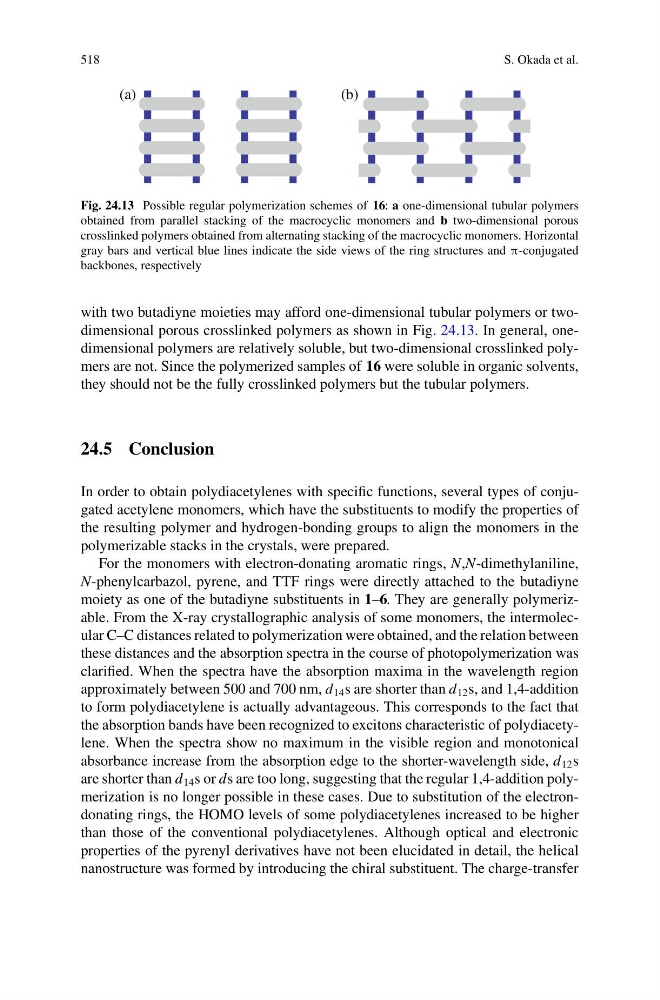
Fig. 24.13 Possible regular polymerization schemes of 16: a one-dimensional tubular polymers
obtained from parallel stacking of the macrocyclic monomers and b two-dimensional porous
crosslinked polymers obtained from alternating stacking of the macrocyclic monomers. Horizontal
gray bars and vertical blue lines indicate the side views of the ring structures and π-conjugated
backbones, respectively
with two butadiyne moieties may afford one-dimensional tubular polymers or twodimensional porous crosslinked polymers as shown in Fig. 24.13. In general, onedimensional polymers are relatively soluble, but two-dimensional crosslinked polymers are not. Since the polymerized samples of 16 were soluble in organic solvents,
they should not be the fully crosslinked polymers but the tubular polymers.
24.5 Conclusion
In order to obtain polydiacetylenes with specific functions, several types of conjugated acetylene monomers, which have the substituents to modify the properties of
the resulting polymer and hydrogen-bonding groups to align the monomers in the
polymerizable stacks in the crystals, were prepared.
For the monomers with electron-donating aromatic rings, N,N-dimethylaniline,
N-phenylcarbazol, pyrene, and TTF rings were directly attached to the butadiyne
moiety as one of the butadiyne substituents in 1–6. They are generally polymerizable. From the X-ray crystallographic analysis of some monomers, the intermolecular C–C distances related to polymerization were obtained, and the relation between
these distances and the absorption spectra in the course of photopolymerization was
clarified. When the spectra have the absorption maxima in the wavelength region
approximately between 500 and 700 nm, d 14 s are shorter than d 12 s, and 1,4-addition
to form polydiacetylene is actually advantageous. This corresponds to the fact that
the absorption bands have been recognized to excitons characteristic of polydiacetylene. When the spectra show no maximum in the visible region and monotonical
absorbance increase from the absorption edge to the shorter-wavelength side, d 12 s
are shorter than d 14 s or ds are too long, suggesting that the regular 1,4-addition polymerization is no longer possible in these cases. Due to substitution of the electrondonating rings, the HOMO levels of some polydiacetylenes increased to be higher
than those of the conventional polydiacetylenes. Although optical and electronic
properties of the pyrenyl derivatives have not been elucidated in detail, the helical
nanostructure was formed by introducing the chiral substituent. The charge-transfer
S. Okada et al.
(b)
(a)
Fig. 24.13 Possible regular polymerization schemes of 16: a one-dimensional tubular polymers
obtained from parallel stacking of the macrocyclic monomers and b two-dimensional porous
crosslinked polymers obtained from alternating stacking of the macrocyclic monomers. Horizontal
gray bars and vertical blue lines indicate the side views of the ring structures and π-conjugated
backbones, respectively
with two butadiyne moieties may afford one-dimensional tubular polymers or twodimensional porous crosslinked polymers as shown in Fig. 24.13. In general, onedimensional polymers are relatively soluble, but two-dimensional crosslinked polymers are not. Since the polymerized samples of 16 were soluble in organic solvents,
they should not be the fully crosslinked polymers but the tubular polymers.
24.5 Conclusion
In order to obtain polydiacetylenes with specific functions, several types of conjugated acetylene monomers, which have the substituents to modify the properties of
the resulting polymer and hydrogen-bonding groups to align the monomers in the
polymerizable stacks in the crystals, were prepared.
For the monomers with electron-donating aromatic rings, N,N-dimethylaniline,
N-phenylcarbazol, pyrene, and TTF rings were directly attached to the butadiyne
moiety as one of the butadiyne substituents in 1–6. They are generally polymerizable. From the X-ray crystallographic analysis of some monomers, the intermolecular C–C distances related to polymerization were obtained, and the relation between
these distances and the absorption spectra in the course of photopolymerization was
clarified. When the spectra have the absorption maxima in the wavelength region
approximately between 500 and 700 nm, d 14 s are shorter than d 12 s, and 1,4-addition
to form polydiacetylene is actually advantageous. This corresponds to the fact that
the absorption bands have been recognized to excitons characteristic of polydiacetylene. When the spectra show no maximum in the visible region and monotonical
absorbance increase from the absorption edge to the shorter-wavelength side, d 12 s
are shorter than d 14 s or ds are too long, suggesting that the regular 1,4-addition polymerization is no longer possible in these cases. Due to substitution of the electrondonating rings, the HOMO levels of some polydiacetylenes increased to be higher
than those of the conventional polydiacetylenes. Although optical and electronic
properties of the pyrenyl derivatives have not been elucidated in detail, the helical
nanostructure was formed by introducing the chiral substituent. The charge-transfer