

24 Solid-State Polymerization of Conjugated …
517
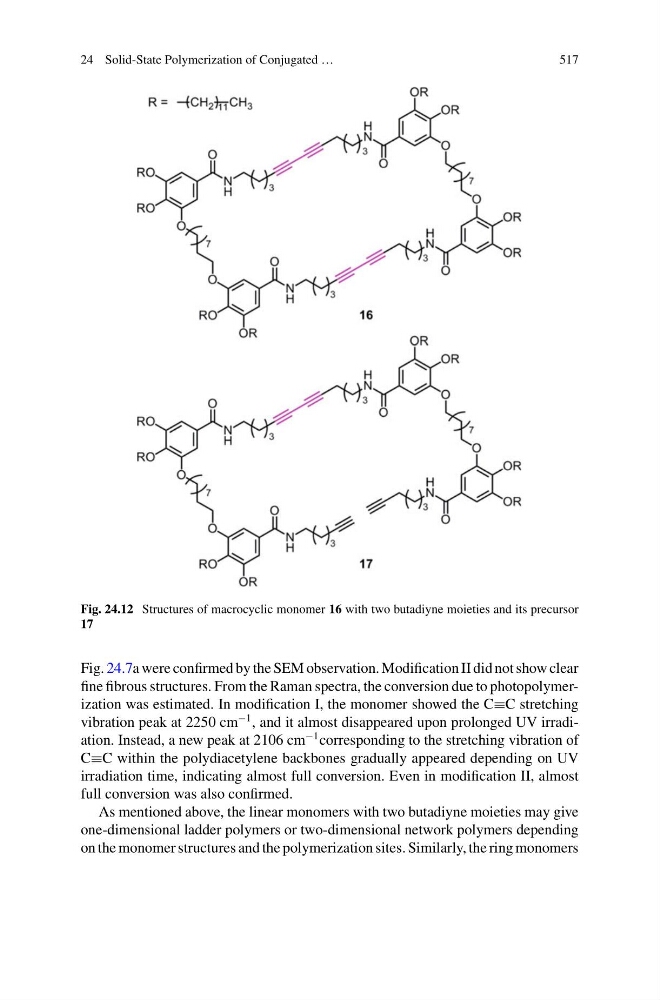
Fig. 24.12 Structures of macrocyclic monomer 16 with two butadiyne moieties and its precursor
17
Fig. 24.7a were confirmed by the SEM observation. Modification II did not show clear
fine fibrous structures. From the Raman spectra, the conversion due to photopolymerization was estimated. In modification I, the monomer showed the C≡C stretching
vibration peak at 2250 cm
−1 , and it almost disappeared upon prolonged UV irradiation. Instead, a new peak at 2106 cm
−1 corresponding to the stretching vibration of
C≡C within the polydiacetylene backbones gradually appeared depending on UV
irradiation time, indicating almost full conversion. Even in modification II, almost
full conversion was also confirmed.
As mentioned above, the linear monomers with two butadiyne moieties may give
one-dimensional ladder polymers or two-dimensional network polymers depending
on the monomer structures and the polymerization sites. Similarly, the ring monomers
517
Fig. 24.12 Structures of macrocyclic monomer 16 with two butadiyne moieties and its precursor
17
Fig. 24.7a were confirmed by the SEM observation. Modification II did not show clear
fine fibrous structures. From the Raman spectra, the conversion due to photopolymerization was estimated. In modification I, the monomer showed the C≡C stretching
vibration peak at 2250 cm
−1 , and it almost disappeared upon prolonged UV irradiation. Instead, a new peak at 2106 cm
−1 corresponding to the stretching vibration of
C≡C within the polydiacetylene backbones gradually appeared depending on UV
irradiation time, indicating almost full conversion. Even in modification II, almost
full conversion was also confirmed.
As mentioned above, the linear monomers with two butadiyne moieties may give
one-dimensional ladder polymers or two-dimensional network polymers depending
on the monomer structures and the polymerization sites. Similarly, the ring monomers