

24 Solid-State Polymerization of Conjugated …
509
4 is longer than 400 nm, photopolymerization can be stimulated even by UV light
at 302 and 365 nm, which is contrast to the polymerization of the conventional
butadiyne monomers. This clearly indicates the conjugation effect of the pyrenyl
group to the butadiyne moiety. Since the absorption spectra of the polymers obtained
by irradiation of the UV light at different wavelengths almost coincided, the polymer
structures were found to be the same irrespective of the irradiated wavelength.
Synthesis of compounds 5a and 5b with the alanine residue at the end was inspired
by the butadiyne derivatives with an alkyl group instead of the pyrenyl group of 5a
and 5b, which formed nanoassembled structures [32]. Upon irradiation of UV light at
254 or 365 nm, 5a polymerized to be the polydiacetylene with absorption maximum
at 624 nm while 5b polymerized in irregular manner [33]. For these compounds,
the reprecipitation method [34], in which acetone solution of the compound was
injected into pure water with vigorous stirring, was applied to form nanoaggregates.
The sizes of nanoaggregates prepared at ambient temperature were approximately
105 nm for 5a and 50 nm for 5b, which increased by elevating temperature. When
the preparation temperature was set at 60 °C, a part of 5a coagulated to form helical
nanoribbon structures with the typical width and length of approximately 100 nm and
more than 1 μm, respectively. The origin of the helicity is considered to be chirality
of the alanine residue. For 5b, circle domain structures with the size of hundreds
of nanometers were observed. Upon UV irradiation, both aggregates did not show
characteristic bands of polydiacetylene suggesting that the main reaction was not
1,4-addition. Namely, monomer stacking structures of 5a are different between the
crystals and the nanoaggregates.
24.2.3 Tetrathiafulvalene Derivative
Tetrathiafulvalene (TTF) is a strong electron donor, which is often used to prepare
charge-transfer complexes by combining with electron acceptors like TCNQ. Thus,
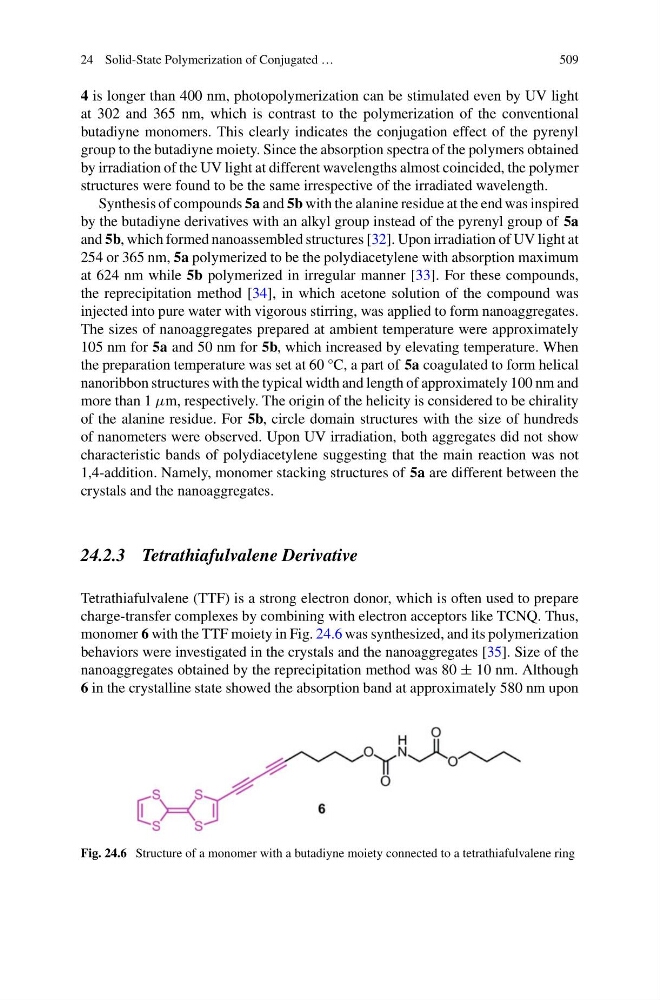
monomer 6 with the TTF moiety in Fig. 24.6 was synthesized, and its polymerization
behaviors were investigated in the crystals and the nanoaggregates [35]. Size of the
nanoaggregates obtained by the reprecipitation method was 80 ± 10 nm. Although
6 in the crystalline state showed the absorption band at approximately 580 nm upon
Fig. 24.6 Structure of a monomer with a butadiyne moiety connected to a tetrathiafulvalene ring
509
4 is longer than 400 nm, photopolymerization can be stimulated even by UV light
at 302 and 365 nm, which is contrast to the polymerization of the conventional
butadiyne monomers. This clearly indicates the conjugation effect of the pyrenyl
group to the butadiyne moiety. Since the absorption spectra of the polymers obtained
by irradiation of the UV light at different wavelengths almost coincided, the polymer
structures were found to be the same irrespective of the irradiated wavelength.
Synthesis of compounds 5a and 5b with the alanine residue at the end was inspired
by the butadiyne derivatives with an alkyl group instead of the pyrenyl group of 5a
and 5b, which formed nanoassembled structures [32]. Upon irradiation of UV light at
254 or 365 nm, 5a polymerized to be the polydiacetylene with absorption maximum
at 624 nm while 5b polymerized in irregular manner [33]. For these compounds,
the reprecipitation method [34], in which acetone solution of the compound was
injected into pure water with vigorous stirring, was applied to form nanoaggregates.
The sizes of nanoaggregates prepared at ambient temperature were approximately
105 nm for 5a and 50 nm for 5b, which increased by elevating temperature. When
the preparation temperature was set at 60 °C, a part of 5a coagulated to form helical
nanoribbon structures with the typical width and length of approximately 100 nm and
more than 1 μm, respectively. The origin of the helicity is considered to be chirality
of the alanine residue. For 5b, circle domain structures with the size of hundreds
of nanometers were observed. Upon UV irradiation, both aggregates did not show
characteristic bands of polydiacetylene suggesting that the main reaction was not
1,4-addition. Namely, monomer stacking structures of 5a are different between the
crystals and the nanoaggregates.
24.2.3 Tetrathiafulvalene Derivative
Tetrathiafulvalene (TTF) is a strong electron donor, which is often used to prepare
charge-transfer complexes by combining with electron acceptors like TCNQ. Thus,
monomer 6 with the TTF moiety in Fig. 24.6 was synthesized, and its polymerization
behaviors were investigated in the crystals and the nanoaggregates [35]. Size of the
nanoaggregates obtained by the reprecipitation method was 80 ± 10 nm. Although
6 in the crystalline state showed the absorption band at approximately 580 nm upon
Fig. 24.6 Structure of a monomer with a butadiyne moiety connected to a tetrathiafulvalene ring