

24 Solid-State Polymerization of Conjugated …
507
(a)
(b)
C3•••C4
C1•••C2
C1•••C4
4
3
2
1
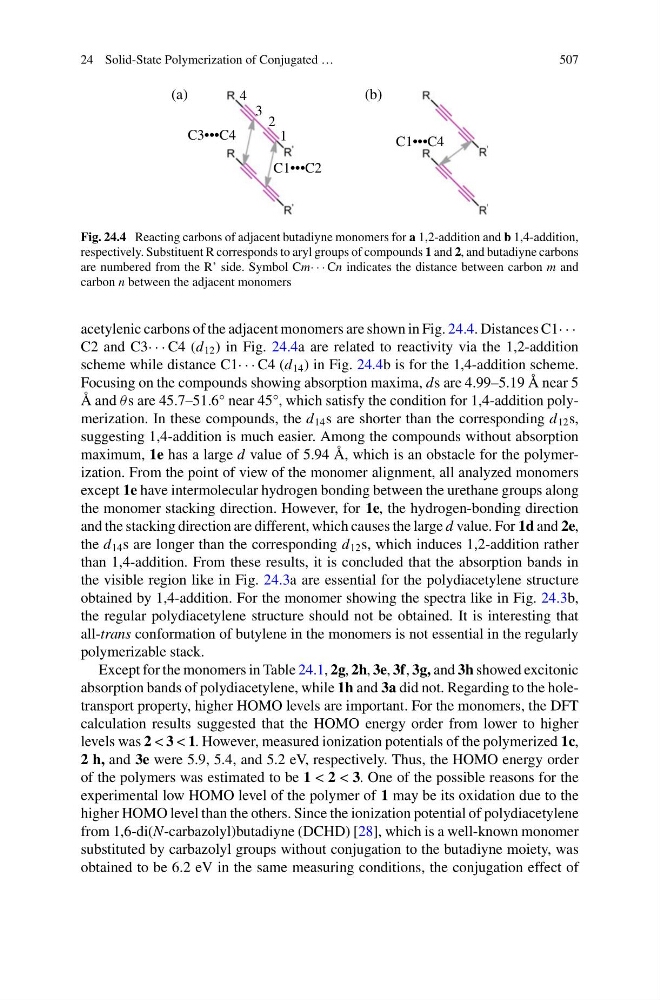
Fig. 24.4 Reacting carbons of adjacent butadiyne monomers for a 1,2-addition and b 1,4-addition,
respectively. Substituent R corresponds to aryl groups of compounds 1 and 2, and butadiyne carbons
are numbered from the R’ side. Symbol Cm· · · Cn indicates the distance between carbon m and
carbon n between the adjacent monomers
acetylenic carbons of the adjacent monomers are shown in Fig. 24.4. Distances C1· · ·
C2 and C3· · · C4 (d 12 ) in Fig. 24.4a are related to reactivity via the 1,2-addition
scheme while distance C1· · · C4 (d 14 ) in Fig. 24.4b is for the 1,4-addition scheme.
Focusing on the compounds showing absorption maxima, ds are 4.99–5.19 Å near 5
Å and θ s are 45.7–51.6° near 45°, which satisfy the condition for 1,4-addition polymerization. In these compounds, the d 14 s are shorter than the corresponding d 12 s,
suggesting 1,4-addition is much easier. Among the compounds without absorption
maximum, 1e has a large d value of 5.94 Å, which is an obstacle for the polymerization. From the point of view of the monomer alignment, all analyzed monomers
except 1e have intermolecular hydrogen bonding between the urethane groups along
the monomer stacking direction. However, for 1e, the hydrogen-bonding direction
and the stacking direction are different, which causes the large d value. For 1d and 2e,
the d 14 s are longer than the corresponding d 12 s, which induces 1,2-addition rather
than 1,4-addition. From these results, it is concluded that the absorption bands in
the visible region like in Fig. 24.3a are essential for the polydiacetylene structure
obtained by 1,4-addition. For the monomer showing the spectra like in Fig. 24.3b,
the regular polydiacetylene structure should not be obtained. It is interesting that
all-trans conformation of butylene in the monomers is not essential in the regularly
polymerizable stack.
Except for the monomers in Table 24.1, 2g, 2h, 3e, 3f, 3g, and 3h showed excitonic
absorption bands of polydiacetylene, while 1h and 3a did not. Regarding to the holetransport property, higher HOMO levels are important. For the monomers, the DFT
calculation results suggested that the HOMO energy order from lower to higher
levels was 2 < 3 < 1. However, measured ionization potentials of the polymerized 1c,
2 h, and 3e were 5.9, 5.4, and 5.2 eV, respectively. Thus, the HOMO energy order
of the polymers was estimated to be 1 < 2 < 3. One of the possible reasons for the
experimental low HOMO level of the polymer of 1 may be its oxidation due to the
higher HOMO level than the others. Since the ionization potential of polydiacetylene
from 1,6-di(N-carbazolyl)butadiyne (DCHD) [28], which is a well-known monomer
substituted by carbazolyl groups without conjugation to the butadiyne moiety, was
obtained to be 6.2 eV in the same measuring conditions, the conjugation effect of
507
(a)
(b)
C3•••C4
C1•••C2
C1•••C4
4
3
2
1
Fig. 24.4 Reacting carbons of adjacent butadiyne monomers for a 1,2-addition and b 1,4-addition,
respectively. Substituent R corresponds to aryl groups of compounds 1 and 2, and butadiyne carbons
are numbered from the R’ side. Symbol Cm· · · Cn indicates the distance between carbon m and
carbon n between the adjacent monomers
acetylenic carbons of the adjacent monomers are shown in Fig. 24.4. Distances C1· · ·
C2 and C3· · · C4 (d 12 ) in Fig. 24.4a are related to reactivity via the 1,2-addition
scheme while distance C1· · · C4 (d 14 ) in Fig. 24.4b is for the 1,4-addition scheme.
Focusing on the compounds showing absorption maxima, ds are 4.99–5.19 Å near 5
Å and θ s are 45.7–51.6° near 45°, which satisfy the condition for 1,4-addition polymerization. In these compounds, the d 14 s are shorter than the corresponding d 12 s,
suggesting 1,4-addition is much easier. Among the compounds without absorption
maximum, 1e has a large d value of 5.94 Å, which is an obstacle for the polymerization. From the point of view of the monomer alignment, all analyzed monomers
except 1e have intermolecular hydrogen bonding between the urethane groups along
the monomer stacking direction. However, for 1e, the hydrogen-bonding direction
and the stacking direction are different, which causes the large d value. For 1d and 2e,
the d 14 s are longer than the corresponding d 12 s, which induces 1,2-addition rather
than 1,4-addition. From these results, it is concluded that the absorption bands in
the visible region like in Fig. 24.3a are essential for the polydiacetylene structure
obtained by 1,4-addition. For the monomer showing the spectra like in Fig. 24.3b,
the regular polydiacetylene structure should not be obtained. It is interesting that
all-trans conformation of butylene in the monomers is not essential in the regularly
polymerizable stack.
Except for the monomers in Table 24.1, 2g, 2h, 3e, 3f, 3g, and 3h showed excitonic
absorption bands of polydiacetylene, while 1h and 3a did not. Regarding to the holetransport property, higher HOMO levels are important. For the monomers, the DFT
calculation results suggested that the HOMO energy order from lower to higher
levels was 2 < 3 < 1. However, measured ionization potentials of the polymerized 1c,
2 h, and 3e were 5.9, 5.4, and 5.2 eV, respectively. Thus, the HOMO energy order
of the polymers was estimated to be 1 < 2 < 3. One of the possible reasons for the
experimental low HOMO level of the polymer of 1 may be its oxidation due to the
higher HOMO level than the others. Since the ionization potential of polydiacetylene
from 1,6-di(N-carbazolyl)butadiyne (DCHD) [28], which is a well-known monomer
substituted by carbazolyl groups without conjugation to the butadiyne moiety, was
obtained to be 6.2 eV in the same measuring conditions, the conjugation effect of