

22 Molecular Recognition by Inclusion …
471
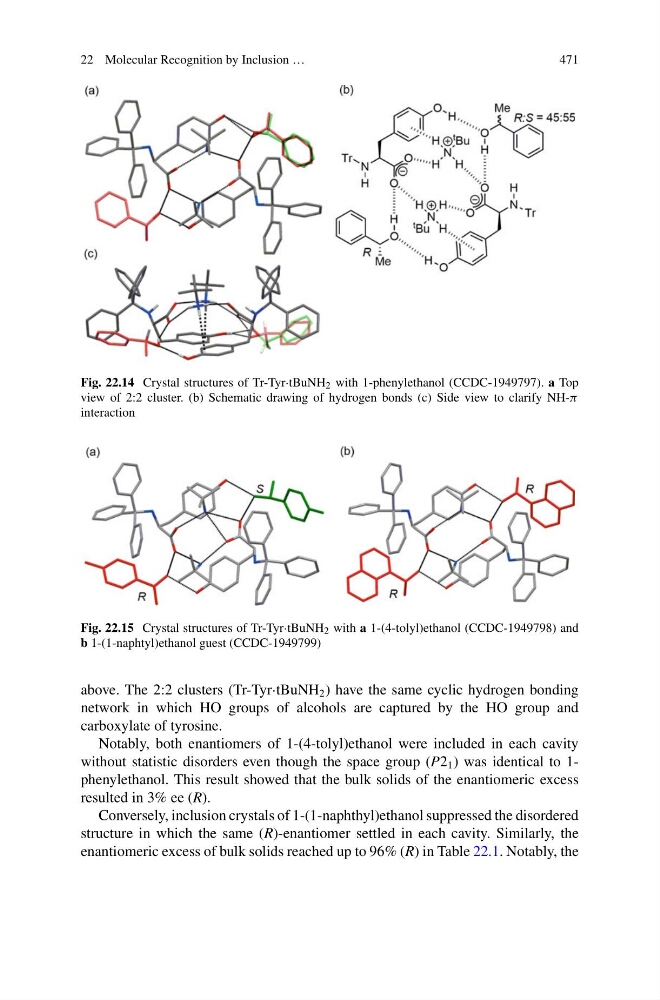
Fig. 22.14 Crystal structures of Tr-Tyr·tBuNH 2 with 1-phenylethanol (CCDC-1949797). a Top
view of 2:2 cluster. (b) Schematic drawing of hydrogen bonds (c) Side view to clarify NH-π
interaction
Fig. 22.15 Crystal structures of Tr-Tyr·tBuNH 2 with a 1-(4-tolyl)ethanol (CCDC-1949798) and
b 1-(1-naphtyl)ethanol guest (CCDC-1949799)
above. The 2:2 clusters (Tr-Tyr·tBuNH 2 ) have the same cyclic hydrogen bonding
network in which HO groups of alcohols are captured by the HO group and
carboxylate of tyrosine.
Notably, both enantiomers of 1-(4-tolyl)ethanol were included in each cavity
without statistic disorders even though the space group (P2 1 ) was identical to 1phenylethanol. This result showed that the bulk solids of the enantiomeric excess
resulted in 3% ee (R).
Conversely, inclusion crystals of 1-(1-naphthyl)ethanol suppressed the disordered
structure in which the same (R)-enantiomer settled in each cavity. Similarly, the
enantiomeric excess of bulk solids reached up to 96% (R) in Table 22.1. Notably, the
471
Fig. 22.14 Crystal structures of Tr-Tyr·tBuNH 2 with 1-phenylethanol (CCDC-1949797). a Top
view of 2:2 cluster. (b) Schematic drawing of hydrogen bonds (c) Side view to clarify NH-π
interaction
Fig. 22.15 Crystal structures of Tr-Tyr·tBuNH 2 with a 1-(4-tolyl)ethanol (CCDC-1949798) and
b 1-(1-naphtyl)ethanol guest (CCDC-1949799)
above. The 2:2 clusters (Tr-Tyr·tBuNH 2 ) have the same cyclic hydrogen bonding
network in which HO groups of alcohols are captured by the HO group and
carboxylate of tyrosine.
Notably, both enantiomers of 1-(4-tolyl)ethanol were included in each cavity
without statistic disorders even though the space group (P2 1 ) was identical to 1phenylethanol. This result showed that the bulk solids of the enantiomeric excess
resulted in 3% ee (R).
Conversely, inclusion crystals of 1-(1-naphthyl)ethanol suppressed the disordered
structure in which the same (R)-enantiomer settled in each cavity. Similarly, the
enantiomeric excess of bulk solids reached up to 96% (R) in Table 22.1. Notably, the