

22 Molecular Recognition by Inclusion …
465
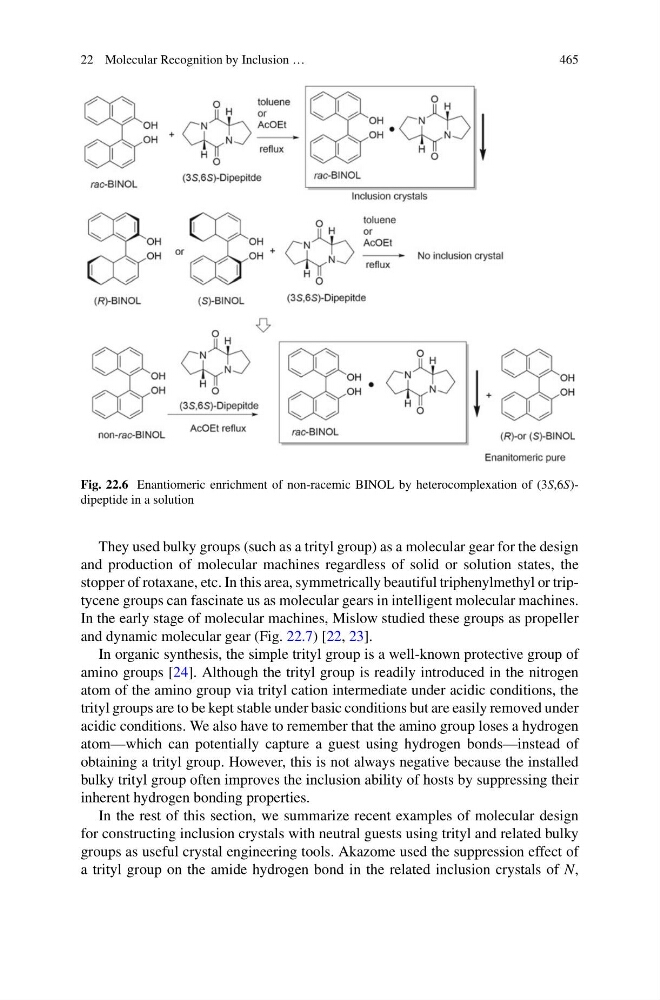
Fig. 22.6 Enantiomeric enrichment of non-racemic BINOL by heterocomplexation of (3S,6S)dipeptide in a solution
They used bulky groups (such as a trityl group) as a molecular gear for the design
and production of molecular machines regardless of solid or solution states, the
stopper of rotaxane, etc. In this area, symmetrically beautiful triphenylmethyl or triptycene groups can fascinate us as molecular gears in intelligent molecular machines.
In the early stage of molecular machines, Mislow studied these groups as propeller
and dynamic molecular gear (Fig. 22.7) [22, 23].
In organic synthesis, the simple trityl group is a well-known protective group of
amino groups [24]. Although the trityl group is readily introduced in the nitrogen
atom of the amino group via trityl cation intermediate under acidic conditions, the
trityl groups are to be kept stable under basic conditions but are easily removed under
acidic conditions. We also have to remember that the amino group loses a hydrogen
atom—which can potentially capture a guest using hydrogen bonds—instead of
obtaining a trityl group. However, this is not always negative because the installed
bulky trityl group often improves the inclusion ability of hosts by suppressing their
inherent hydrogen bonding properties.
In the rest of this section, we summarize recent examples of molecular design
for constructing inclusion crystals with neutral guests using trityl and related bulky
groups as useful crystal engineering tools. Akazome used the suppression effect of
a trityl group on the amide hydrogen bond in the related inclusion crystals of N,
465
Fig. 22.6 Enantiomeric enrichment of non-racemic BINOL by heterocomplexation of (3S,6S)dipeptide in a solution
They used bulky groups (such as a trityl group) as a molecular gear for the design
and production of molecular machines regardless of solid or solution states, the
stopper of rotaxane, etc. In this area, symmetrically beautiful triphenylmethyl or triptycene groups can fascinate us as molecular gears in intelligent molecular machines.
In the early stage of molecular machines, Mislow studied these groups as propeller
and dynamic molecular gear (Fig. 22.7) [22, 23].
In organic synthesis, the simple trityl group is a well-known protective group of
amino groups [24]. Although the trityl group is readily introduced in the nitrogen
atom of the amino group via trityl cation intermediate under acidic conditions, the
trityl groups are to be kept stable under basic conditions but are easily removed under
acidic conditions. We also have to remember that the amino group loses a hydrogen
atom—which can potentially capture a guest using hydrogen bonds—instead of
obtaining a trityl group. However, this is not always negative because the installed
bulky trityl group often improves the inclusion ability of hosts by suppressing their
inherent hydrogen bonding properties.
In the rest of this section, we summarize recent examples of molecular design
for constructing inclusion crystals with neutral guests using trityl and related bulky
groups as useful crystal engineering tools. Akazome used the suppression effect of
a trityl group on the amide hydrogen bond in the related inclusion crystals of N,