

460
M. Akazome and S. Matsumoto
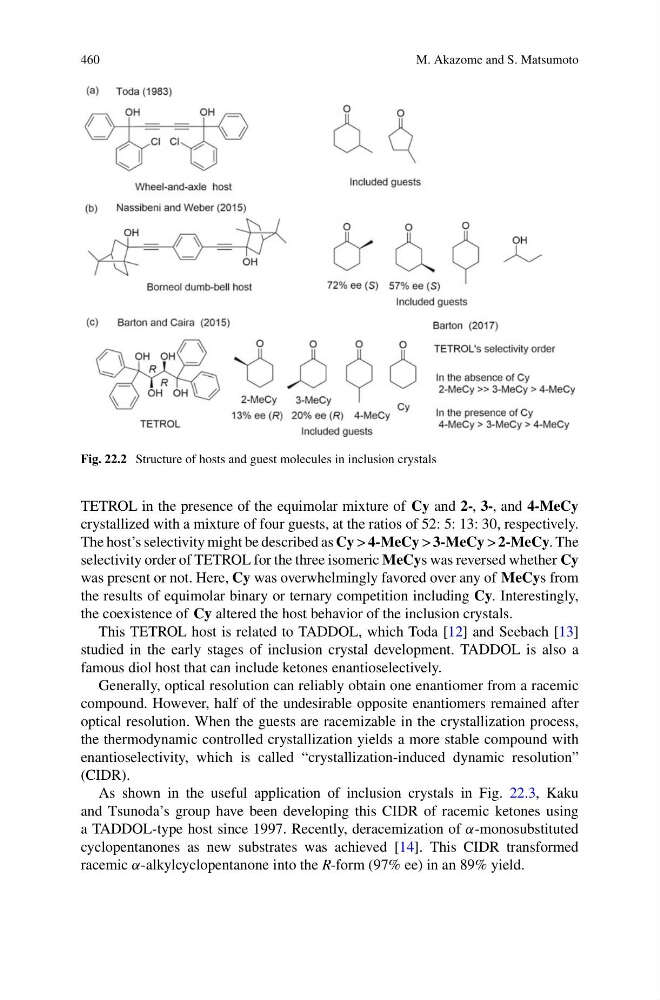
Fig. 22.2 Structure of hosts and guest molecules in inclusion crystals
TETROL in the presence of the equimolar mixture of Cy and 2-, 3-, and 4-MeCy
crystallized with a mixture of four guests, at the ratios of 52: 5: 13: 30, respectively.
The host’s selectivity might be described as Cy > 4-MeCy > 3-MeCy > 2-MeCy. The
selectivity order of TETROL for the three isomeric MeCys was reversed whether Cy
was present or not. Here, Cy was overwhelmingly favored over any of MeCys from
the results of equimolar binary or ternary competition including Cy. Interestingly,
the coexistence of Cy altered the host behavior of the inclusion crystals.
This TETROL host is related to TADDOL, which Toda [12] and Seebach [13]
studied in the early stages of inclusion crystal development. TADDOL is also a
famous diol host that can include ketones enantioselectively.
Generally, optical resolution can reliably obtain one enantiomer from a racemic
compound. However, half of the undesirable opposite enantiomers remained after
optical resolution. When the guests are racemizable in the crystallization process,
the thermodynamic controlled crystallization yields a more stable compound with
enantioselectivity, which is called “crystallization-induced dynamic resolution”
(CIDR).
As shown in the useful application of inclusion crystals in Fig. 22.3, Kaku
and Tsunoda’s group have been developing this CIDR of racemic ketones using
a TADDOL-type host since 1997. Recently, deracemization of α-monosubstituted
cyclopentanones as new substrates was achieved [14]. This CIDR transformed
racemic α-alkylcyclopentanone into the R-form (97% ee) in an 89% yield.
M. Akazome and S. Matsumoto
Fig. 22.2 Structure of hosts and guest molecules in inclusion crystals
TETROL in the presence of the equimolar mixture of Cy and 2-, 3-, and 4-MeCy
crystallized with a mixture of four guests, at the ratios of 52: 5: 13: 30, respectively.
The host’s selectivity might be described as Cy > 4-MeCy > 3-MeCy > 2-MeCy. The
selectivity order of TETROL for the three isomeric MeCys was reversed whether Cy
was present or not. Here, Cy was overwhelmingly favored over any of MeCys from
the results of equimolar binary or ternary competition including Cy. Interestingly,
the coexistence of Cy altered the host behavior of the inclusion crystals.
This TETROL host is related to TADDOL, which Toda [12] and Seebach [13]
studied in the early stages of inclusion crystal development. TADDOL is also a
famous diol host that can include ketones enantioselectively.
Generally, optical resolution can reliably obtain one enantiomer from a racemic
compound. However, half of the undesirable opposite enantiomers remained after
optical resolution. When the guests are racemizable in the crystallization process,
the thermodynamic controlled crystallization yields a more stable compound with
enantioselectivity, which is called “crystallization-induced dynamic resolution”
(CIDR).
As shown in the useful application of inclusion crystals in Fig. 22.3, Kaku
and Tsunoda’s group have been developing this CIDR of racemic ketones using
a TADDOL-type host since 1997. Recently, deracemization of α-monosubstituted
cyclopentanones as new substrates was achieved [14]. This CIDR transformed
racemic α-alkylcyclopentanone into the R-form (97% ee) in an 89% yield.