

2 Direct Visualization of Crystal Formation and Growth …
39
role in crystallization [28, 29]. Tsarfati et al. mentioned the crystallization paths
involving the three main stages—initial densification from the solvent-rich precursor,
early ordering, and concurrent evolution of order and morphology [30]. This finding
indicates that the liquid-like cluster state contains the solvent in the solution. It is
unknown that the orange emission of BF 2 DBM originates from the amorphous phase
as either highly dense solvent-rich state or solid aggregates. Based on the above
background, we focus on the changes in optical and mechanical properties during
evaporative crystallization in real time, particularly to clarify the orange emissive
state as the intermediate phase [31].
To assess the optical and mechanical properties of the mutual state during evaporative crystallization in real time, we considered the droplet observation under the
crossed Nicol condition [32]. The quartz crystal microbalance (QCM) is a tool that
is used to perform real-time monitoring of the mass and the viscoelastic changes
based on the change in the frequency (f ) and resistance (R) from the adsorption
onto the quartz substrate [33]. It is utilized in the evaluation of the deposited film
thickness in the vacuum deposition.
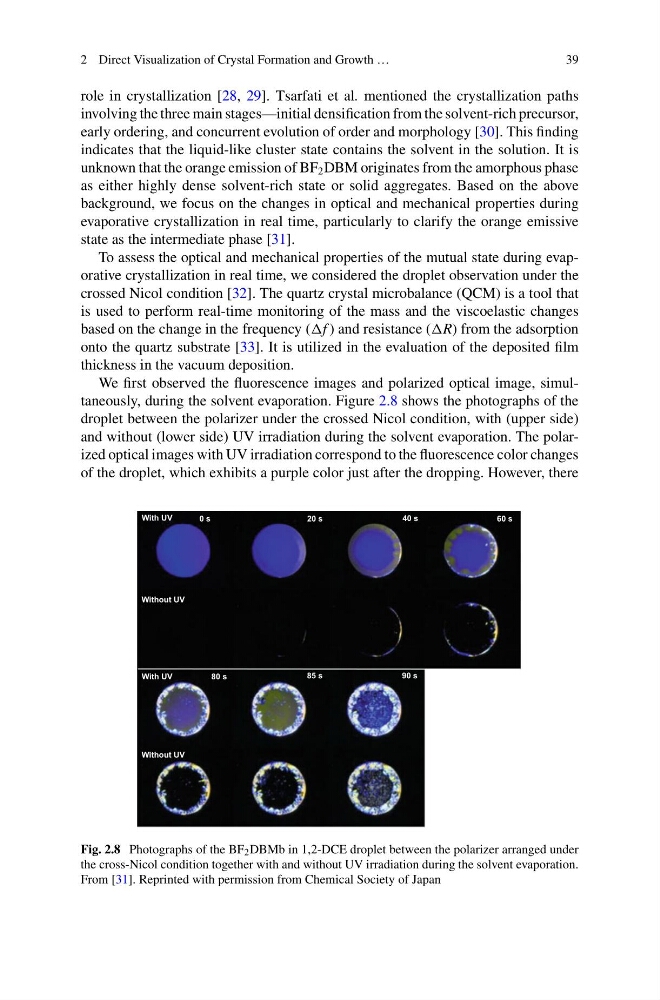
We first observed the fluorescence images and polarized optical image, simultaneously, during the solvent evaporation. Figure 2.8 shows the photographs of the
droplet between the polarizer under the crossed Nicol condition, with (upper side)
and without (lower side) UV irradiation during the solvent evaporation. The polarized optical images with UV irradiation correspond to the fluorescence color changes
of the droplet, which exhibits a purple color just after the dropping. However, there
0 s
20 s
40 s
60 s
With UV
Without UV
80 s
85 s
90 s
With UV
Without UV
Fig. 2.8 Photographs of the BF 2 DBMb in 1,2-DCE droplet between the polarizer arranged under
the cross-Nicol condition together with and without UV irradiation during the solvent evaporation.
From [31]. Reprinted with permission from Chemical Society of Japan
39
role in crystallization [28, 29]. Tsarfati et al. mentioned the crystallization paths
involving the three main stages—initial densification from the solvent-rich precursor,
early ordering, and concurrent evolution of order and morphology [30]. This finding
indicates that the liquid-like cluster state contains the solvent in the solution. It is
unknown that the orange emission of BF 2 DBM originates from the amorphous phase
as either highly dense solvent-rich state or solid aggregates. Based on the above
background, we focus on the changes in optical and mechanical properties during
evaporative crystallization in real time, particularly to clarify the orange emissive
state as the intermediate phase [31].
To assess the optical and mechanical properties of the mutual state during evaporative crystallization in real time, we considered the droplet observation under the
crossed Nicol condition [32]. The quartz crystal microbalance (QCM) is a tool that
is used to perform real-time monitoring of the mass and the viscoelastic changes
based on the change in the frequency (f ) and resistance (R) from the adsorption
onto the quartz substrate [33]. It is utilized in the evaluation of the deposited film
thickness in the vacuum deposition.
We first observed the fluorescence images and polarized optical image, simultaneously, during the solvent evaporation. Figure 2.8 shows the photographs of the
droplet between the polarizer under the crossed Nicol condition, with (upper side)
and without (lower side) UV irradiation during the solvent evaporation. The polarized optical images with UV irradiation correspond to the fluorescence color changes
of the droplet, which exhibits a purple color just after the dropping. However, there
0 s
20 s
40 s
60 s
With UV
Without UV
80 s
85 s
90 s
With UV
Without UV
Fig. 2.8 Photographs of the BF 2 DBMb in 1,2-DCE droplet between the polarizer arranged under
the cross-Nicol condition together with and without UV irradiation during the solvent evaporation.
From [31]. Reprinted with permission from Chemical Society of Japan