

38
F. Ito
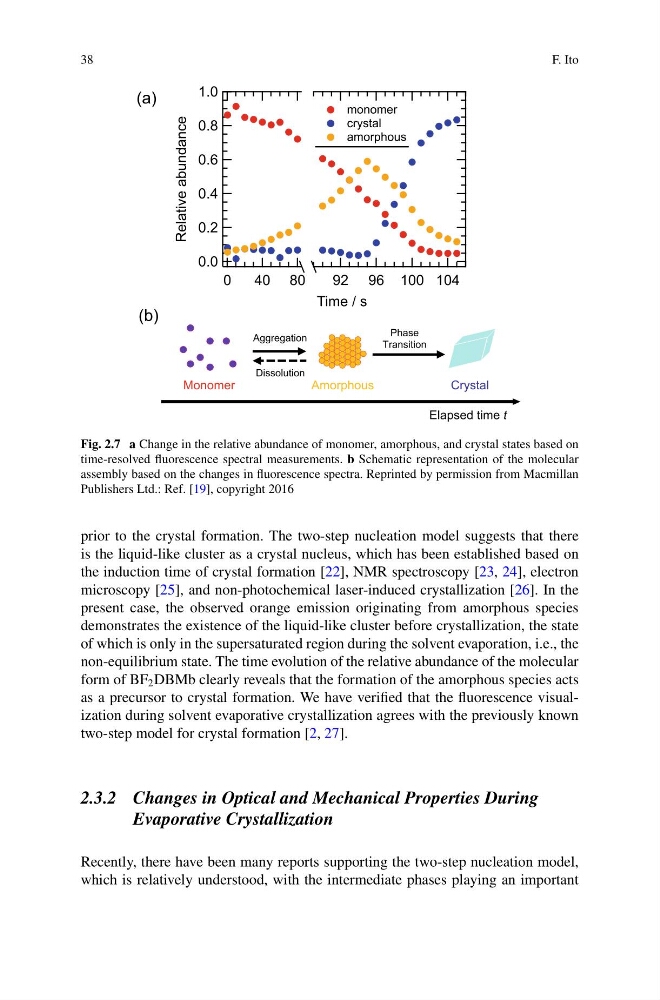
Fig. 2.7 a Change in the relative abundance of monomer, amorphous, and crystal states based on
time-resolved fluorescence spectral measurements. b Schematic representation of the molecular
assembly based on the changes in fluorescence spectra. Reprinted by permission from Macmillan
Publishers Ltd.: Ref. [19], copyright 2016
prior to the crystal formation. The two-step nucleation model suggests that there
is the liquid-like cluster as a crystal nucleus, which has been established based on
the induction time of crystal formation [22], NMR spectroscopy [23, 24], electron
microscopy [25], and non-photochemical laser-induced crystallization [26]. In the
present case, the observed orange emission originating from amorphous species
demonstrates the existence of the liquid-like cluster before crystallization, the state
of which is only in the supersaturated region during the solvent evaporation, i.e., the
non-equilibrium state. The time evolution of the relative abundance of the molecular
form of BF 2 DBMb clearly reveals that the formation of the amorphous species acts
as a precursor to crystal formation. We have verified that the fluorescence visualization during solvent evaporative crystallization agrees with the previously known
two-step model for crystal formation [2, 27].
2.3.2 Changes in Optical and Mechanical Properties During
Evaporative Crystallization
Recently, there have been many reports supporting the two-step nucleation model,
which is relatively understood, with the intermediate phases playing an important
F. Ito
Fig. 2.7 a Change in the relative abundance of monomer, amorphous, and crystal states based on
time-resolved fluorescence spectral measurements. b Schematic representation of the molecular
assembly based on the changes in fluorescence spectra. Reprinted by permission from Macmillan
Publishers Ltd.: Ref. [19], copyright 2016
prior to the crystal formation. The two-step nucleation model suggests that there
is the liquid-like cluster as a crystal nucleus, which has been established based on
the induction time of crystal formation [22], NMR spectroscopy [23, 24], electron
microscopy [25], and non-photochemical laser-induced crystallization [26]. In the
present case, the observed orange emission originating from amorphous species
demonstrates the existence of the liquid-like cluster before crystallization, the state
of which is only in the supersaturated region during the solvent evaporation, i.e., the
non-equilibrium state. The time evolution of the relative abundance of the molecular
form of BF 2 DBMb clearly reveals that the formation of the amorphous species acts
as a precursor to crystal formation. We have verified that the fluorescence visualization during solvent evaporative crystallization agrees with the previously known
two-step model for crystal formation [2, 27].
2.3.2 Changes in Optical and Mechanical Properties During
Evaporative Crystallization
Recently, there have been many reports supporting the two-step nucleation model,
which is relatively understood, with the intermediate phases playing an important