

21 Asymmetric Synthesis Involving Dynamic Enantioselective …
443
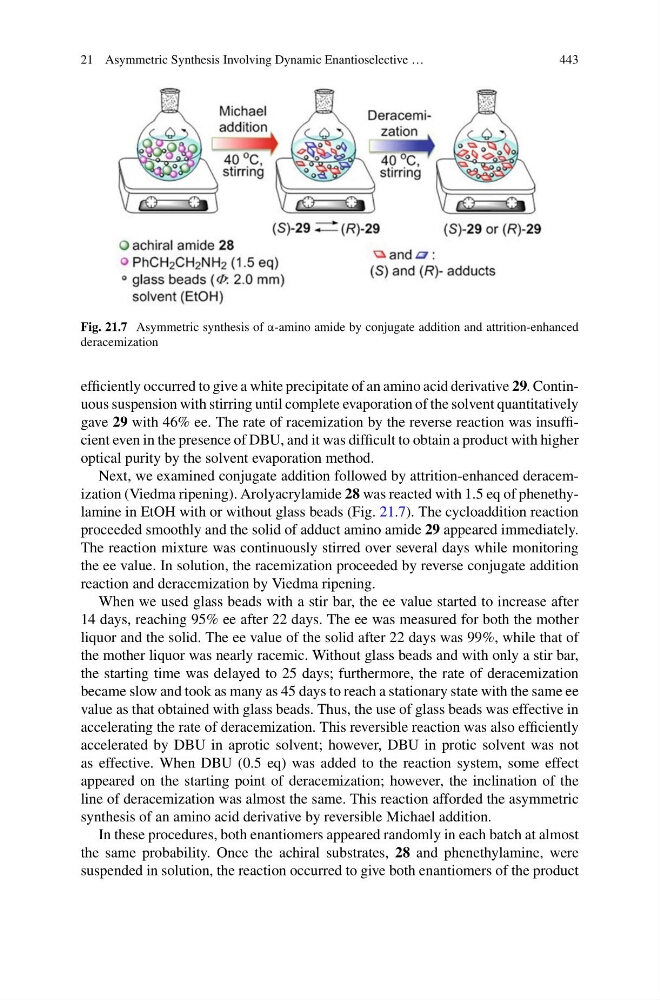
Fig. 21.7 Asymmetric synthesis of α-amino amide by conjugate addition and attrition-enhanced
deracemization
efficiently occurred to give a white precipitate of an amino acid derivative 29. Continuous suspension with stirring until complete evaporation of the solvent quantitatively
gave 29 with 46% ee. The rate of racemization by the reverse reaction was insufficient even in the presence of DBU, and it was difficult to obtain a product with higher
optical purity by the solvent evaporation method.
Next, we examined conjugate addition followed by attrition-enhanced deracemization (Viedma ripening). Arolyacrylamide 28 was reacted with 1.5 eq of phenethylamine in EtOH with or without glass beads (Fig. 21.7). The cycloaddition reaction
proceeded smoothly and the solid of adduct amino amide 29 appeared immediately.
The reaction mixture was continuously stirred over several days while monitoring
the ee value. In solution, the racemization proceeded by reverse conjugate addition
reaction and deracemization by Viedma ripening.
When we used glass beads with a stir bar, the ee value started to increase after
14 days, reaching 95% ee after 22 days. The ee was measured for both the mother
liquor and the solid. The ee value of the solid after 22 days was 99%, while that of
the mother liquor was nearly racemic. Without glass beads and with only a stir bar,
the starting time was delayed to 25 days; furthermore, the rate of deracemization
became slow and took as many as 45 days to reach a stationary state with the same ee
value as that obtained with glass beads. Thus, the use of glass beads was effective in
accelerating the rate of deracemization. This reversible reaction was also efficiently
accelerated by DBU in aprotic solvent; however, DBU in protic solvent was not
as effective. When DBU (0.5 eq) was added to the reaction system, some effect
appeared on the starting point of deracemization; however, the inclination of the
line of deracemization was almost the same. This reaction afforded the asymmetric
synthesis of an amino acid derivative by reversible Michael addition.
In these procedures, both enantiomers appeared randomly in each batch at almost
the same probability. Once the achiral substrates, 28 and phenethylamine, were
suspended in solution, the reaction occurred to give both enantiomers of the product
443
Fig. 21.7 Asymmetric synthesis of α-amino amide by conjugate addition and attrition-enhanced
deracemization
efficiently occurred to give a white precipitate of an amino acid derivative 29. Continuous suspension with stirring until complete evaporation of the solvent quantitatively
gave 29 with 46% ee. The rate of racemization by the reverse reaction was insufficient even in the presence of DBU, and it was difficult to obtain a product with higher
optical purity by the solvent evaporation method.
Next, we examined conjugate addition followed by attrition-enhanced deracemization (Viedma ripening). Arolyacrylamide 28 was reacted with 1.5 eq of phenethylamine in EtOH with or without glass beads (Fig. 21.7). The cycloaddition reaction
proceeded smoothly and the solid of adduct amino amide 29 appeared immediately.
The reaction mixture was continuously stirred over several days while monitoring
the ee value. In solution, the racemization proceeded by reverse conjugate addition
reaction and deracemization by Viedma ripening.
When we used glass beads with a stir bar, the ee value started to increase after
14 days, reaching 95% ee after 22 days. The ee was measured for both the mother
liquor and the solid. The ee value of the solid after 22 days was 99%, while that of
the mother liquor was nearly racemic. Without glass beads and with only a stir bar,
the starting time was delayed to 25 days; furthermore, the rate of deracemization
became slow and took as many as 45 days to reach a stationary state with the same ee
value as that obtained with glass beads. Thus, the use of glass beads was effective in
accelerating the rate of deracemization. This reversible reaction was also efficiently
accelerated by DBU in aprotic solvent; however, DBU in protic solvent was not
as effective. When DBU (0.5 eq) was added to the reaction system, some effect
appeared on the starting point of deracemization; however, the inclination of the
line of deracemization was almost the same. This reaction afforded the asymmetric
synthesis of an amino acid derivative by reversible Michael addition.
In these procedures, both enantiomers appeared randomly in each batch at almost
the same probability. Once the achiral substrates, 28 and phenethylamine, were
suspended in solution, the reaction occurred to give both enantiomers of the product