

420
R. Tamura et al.
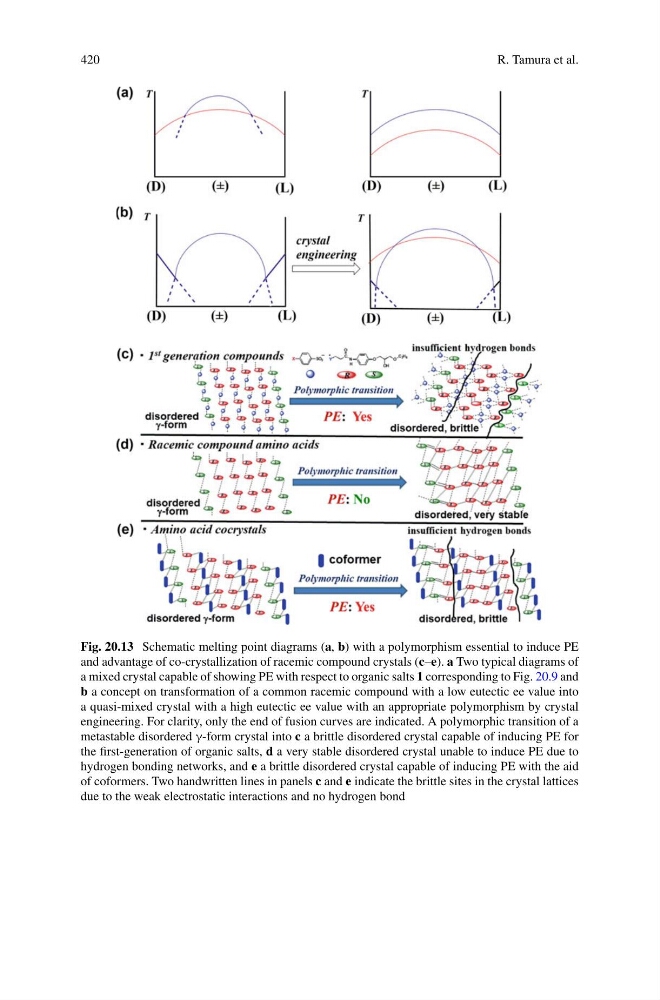
Fig. 20.13 Schematic melting point diagrams (a, b) with a polymorphism essential to induce PE
and advantage of co-crystallization of racemic compound crystals (c–e). a Two typical diagrams of
a mixed crystal capable of showing PE with respect to organic salts 1 corresponding to Fig. 20.9 and
b a concept on transformation of a common racemic compound with a low eutectic ee value into
a quasi-mixed crystal with a high eutectic ee value with an appropriate polymorphism by crystal
engineering. For clarity, only the end of fusion curves are indicated. A polymorphic transition of a
metastable disordered γ-form crystal into c a brittle disordered crystal capable of inducing PE for
the first-generation of organic salts, d a very stable disordered crystal unable to induce PE due to
hydrogen bonding networks, and e a brittle disordered crystal capable of inducing PE with the aid
of coformers. Two handwritten lines in panels c and e indicate the brittle sites in the crystal lattices
due to the weak electrostatic interactions and no hydrogen bond
R. Tamura et al.
Fig. 20.13 Schematic melting point diagrams (a, b) with a polymorphism essential to induce PE
and advantage of co-crystallization of racemic compound crystals (c–e). a Two typical diagrams of
a mixed crystal capable of showing PE with respect to organic salts 1 corresponding to Fig. 20.9 and
b a concept on transformation of a common racemic compound with a low eutectic ee value into
a quasi-mixed crystal with a high eutectic ee value with an appropriate polymorphism by crystal
engineering. For clarity, only the end of fusion curves are indicated. A polymorphic transition of a
metastable disordered γ-form crystal into c a brittle disordered crystal capable of inducing PE for
the first-generation of organic salts, d a very stable disordered crystal unable to induce PE due to
hydrogen bonding networks, and e a brittle disordered crystal capable of inducing PE with the aid
of coformers. Two handwritten lines in panels c and e indicate the brittle sites in the crystal lattices
due to the weak electrostatic interactions and no hydrogen bond