

20 Twenty-Five Years’ History, Mechanism, and Generality …
419
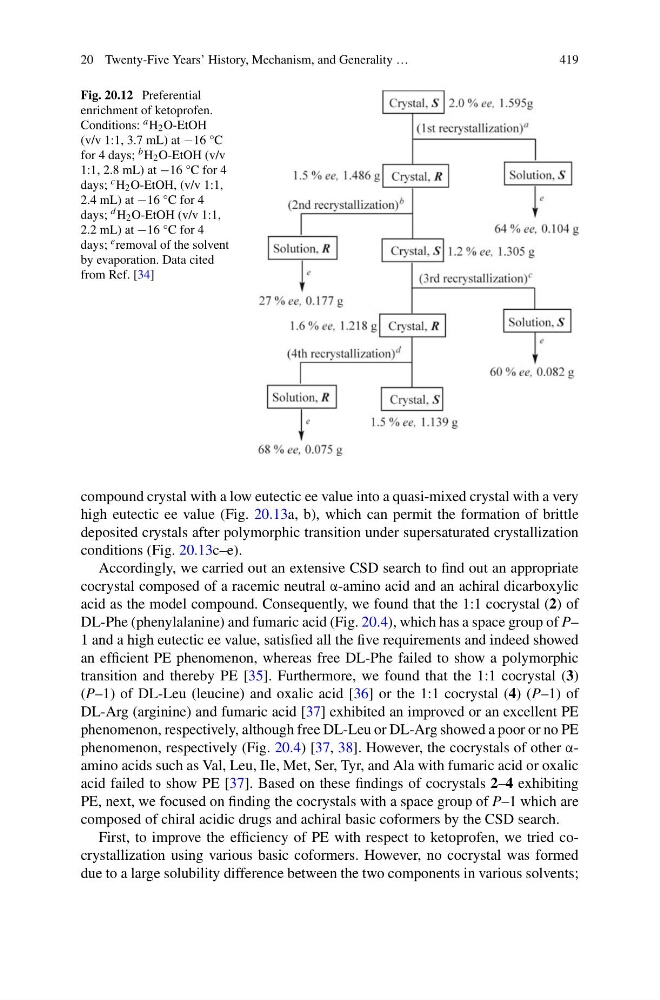
Fig. 20.12 Preferential
enrichment of ketoprofen.
Conditions: a H 2 O-EtOH
(v/v 1:1, 3.7 mL) at −16 °C
for 4 days; b H 2 O-EtOH (v/v
1:1, 2.8 mL) at −16 °C for 4
days; c H 2 O-EtOH, (v/v 1:1,
2.4 mL) at −16 °C for 4
days; d H 2 O-EtOH (v/v 1:1,
2.2 mL) at −16 °C for 4
days; e removal of the solvent
by evaporation. Data cited
from Ref. [34]
compound crystal with a low eutectic ee value into a quasi-mixed crystal with a very
high eutectic ee value (Fig. 20.13a, b), which can permit the formation of brittle
deposited crystals after polymorphic transition under supersaturated crystallization
conditions (Fig. 20.13c–e).
Accordingly, we carried out an extensive CSD search to find out an appropriate
cocrystal composed of a racemic neutral α-amino acid and an achiral dicarboxylic
acid as the model compound. Consequently, we found that the 1:1 cocrystal (2) of
DL-Phe (phenylalanine) and fumaric acid (Fig. 20.4), which has a space group of P–
1 and a high eutectic ee value, satisfied all the five requirements and indeed showed
an efficient PE phenomenon, whereas free DL-Phe failed to show a polymorphic
transition and thereby PE [35]. Furthermore, we found that the 1:1 cocrystal (3)
(P–1) of DL-Leu (leucine) and oxalic acid [36] or the 1:1 cocrystal (4) (P–1) of
DL-Arg (arginine) and fumaric acid [37] exhibited an improved or an excellent PE
phenomenon, respectively, although free DL-Leu or DL-Arg showed a poor or no PE
phenomenon, respectively (Fig. 20.4) [37, 38]. However, the cocrystals of other αamino acids such as Val, Leu, Ile, Met, Ser, Tyr, and Ala with fumaric acid or oxalic
acid failed to show PE [37]. Based on these findings of cocrystals 2–4 exhibiting
PE, next, we focused on finding the cocrystals with a space group of P–1 which are
composed of chiral acidic drugs and achiral basic coformers by the CSD search.
First, to improve the efficiency of PE with respect to ketoprofen, we tried cocrystallization using various basic coformers. However, no cocrystal was formed
due to a large solubility difference between the two components in various solvents;
419
Fig. 20.12 Preferential
enrichment of ketoprofen.
Conditions: a H 2 O-EtOH
(v/v 1:1, 3.7 mL) at −16 °C
for 4 days; b H 2 O-EtOH (v/v
1:1, 2.8 mL) at −16 °C for 4
days; c H 2 O-EtOH, (v/v 1:1,
2.4 mL) at −16 °C for 4
days; d H 2 O-EtOH (v/v 1:1,
2.2 mL) at −16 °C for 4
days; e removal of the solvent
by evaporation. Data cited
from Ref. [34]
compound crystal with a low eutectic ee value into a quasi-mixed crystal with a very
high eutectic ee value (Fig. 20.13a, b), which can permit the formation of brittle
deposited crystals after polymorphic transition under supersaturated crystallization
conditions (Fig. 20.13c–e).
Accordingly, we carried out an extensive CSD search to find out an appropriate
cocrystal composed of a racemic neutral α-amino acid and an achiral dicarboxylic
acid as the model compound. Consequently, we found that the 1:1 cocrystal (2) of
DL-Phe (phenylalanine) and fumaric acid (Fig. 20.4), which has a space group of P–
1 and a high eutectic ee value, satisfied all the five requirements and indeed showed
an efficient PE phenomenon, whereas free DL-Phe failed to show a polymorphic
transition and thereby PE [35]. Furthermore, we found that the 1:1 cocrystal (3)
(P–1) of DL-Leu (leucine) and oxalic acid [36] or the 1:1 cocrystal (4) (P–1) of
DL-Arg (arginine) and fumaric acid [37] exhibited an improved or an excellent PE
phenomenon, respectively, although free DL-Leu or DL-Arg showed a poor or no PE
phenomenon, respectively (Fig. 20.4) [37, 38]. However, the cocrystals of other αamino acids such as Val, Leu, Ile, Met, Ser, Tyr, and Ala with fumaric acid or oxalic
acid failed to show PE [37]. Based on these findings of cocrystals 2–4 exhibiting
PE, next, we focused on finding the cocrystals with a space group of P–1 which are
composed of chiral acidic drugs and achiral basic coformers by the CSD search.
First, to improve the efficiency of PE with respect to ketoprofen, we tried cocrystallization using various basic coformers. However, no cocrystal was formed
due to a large solubility difference between the two components in various solvents;