

20 Twenty-Five Years’ History, Mechanism, and Generality …
411
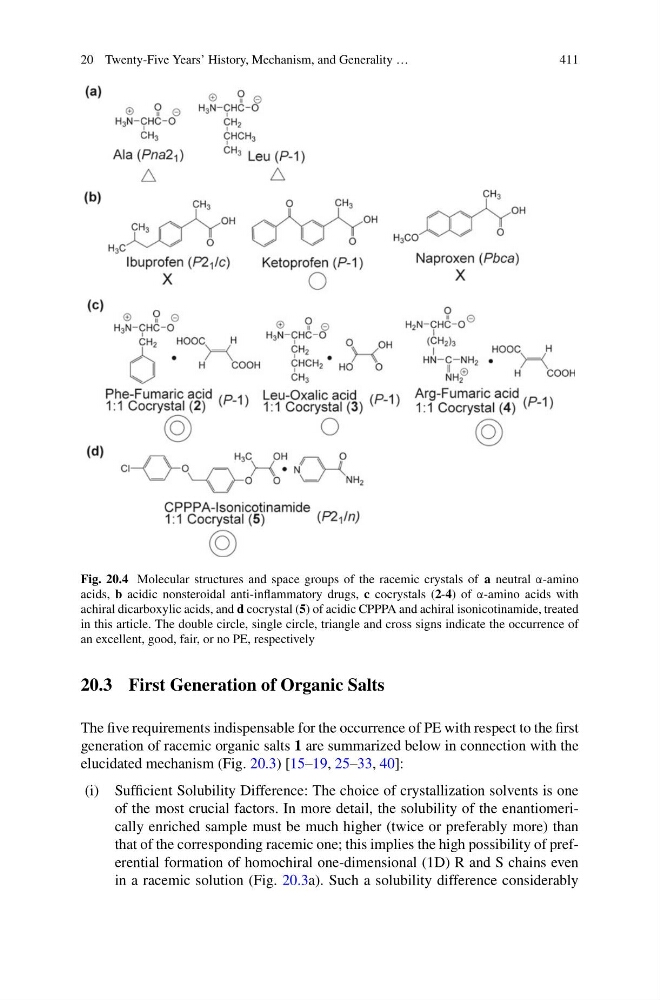
Fig. 20.4 Molecular structures and space groups of the racemic crystals of a neutral α-amino
acids, b acidic nonsteroidal anti-inflammatory drugs, c cocrystals (2-4) of α-amino acids with
achiral dicarboxylic acids, and d cocrystal (5) of acidic CPPPA and achiral isonicotinamide, treated
in this article. The double circle, single circle, triangle and cross signs indicate the occurrence of
an excellent, good, fair, or no PE, respectively
20.3 First Generation of Organic Salts
The five requirements indispensable for the occurrence of PE with respect to the first
generation of racemic organic salts 1 are summarized below in connection with the
elucidated mechanism (Fig. 20.3) [15–19, 25–33, 40]:
(i) Sufficient Solubility Difference: The choice of crystallization solvents is one
of the most crucial factors. In more detail, the solubility of the enantiomerically enriched sample must be much higher (twice or preferably more) than
that of the corresponding racemic one; this implies the high possibility of preferential formation of homochiral one-dimensional (1D) R and S chains even
in a racemic solution (Fig. 20.3a). Such a solubility difference considerably
411
Fig. 20.4 Molecular structures and space groups of the racemic crystals of a neutral α-amino
acids, b acidic nonsteroidal anti-inflammatory drugs, c cocrystals (2-4) of α-amino acids with
achiral dicarboxylic acids, and d cocrystal (5) of acidic CPPPA and achiral isonicotinamide, treated
in this article. The double circle, single circle, triangle and cross signs indicate the occurrence of
an excellent, good, fair, or no PE, respectively
20.3 First Generation of Organic Salts
The five requirements indispensable for the occurrence of PE with respect to the first
generation of racemic organic salts 1 are summarized below in connection with the
elucidated mechanism (Fig. 20.3) [15–19, 25–33, 40]:
(i) Sufficient Solubility Difference: The choice of crystallization solvents is one
of the most crucial factors. In more detail, the solubility of the enantiomerically enriched sample must be much higher (twice or preferably more) than
that of the corresponding racemic one; this implies the high possibility of preferential formation of homochiral one-dimensional (1D) R and S chains even
in a racemic solution (Fig. 20.3a). Such a solubility difference considerably