

392
E. R. T. Tiekink
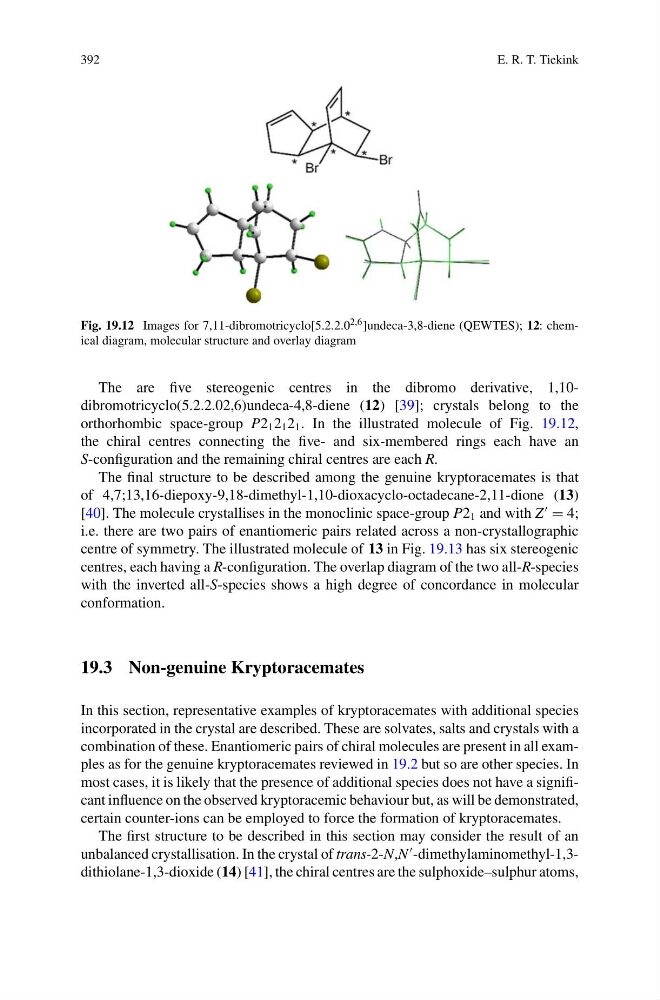
Fig. 19.12 Images for 7,11-dibromotricyclo[5.2.2.0 2,6 ]undeca-3,8-diene (QEWTES); 12: chemical diagram, molecular structure and overlay diagram
The are five stereogenic centres in the dibromo derivative, 1,10dibromotricyclo(5.2.2.02,6)undeca-4,8-diene (12) [39]; crystals belong to the
orthorhombic space-group P2 1 2 1 2 1 . In the illustrated molecule of Fig. 19.12,
the chiral centres connecting the five- and six-membered rings each have an
S-configuration and the remaining chiral centres are each R.
The final structure to be described among the genuine kryptoracemates is that
of 4,7;13,16-diepoxy-9,18-dimethyl-1,10-dioxacyclo-octadecane-2,11-dione (13)
[40]. The molecule crystallises in the monoclinic space-group P2 1 and with Z
= 4;
i.e. there are two pairs of enantiomeric pairs related across a non-crystallographic
centre of symmetry. The illustrated molecule of 13 in Fig. 19.13 has six stereogenic
centres, each having a R-configuration. The overlap diagram of the two all-R-species
with the inverted all-S-species shows a high degree of concordance in molecular
conformation.
19.3 Non-genuine Kryptoracemates
In this section, representative examples of kryptoracemates with additional species
incorporated in the crystal are described. These are solvates, salts and crystals with a
combination of these. Enantiomeric pairs of chiral molecules are present in all examples as for the genuine kryptoracemates reviewed in 19.2 but so are other species. In
most cases, it is likely that the presence of additional species does not have a significant influence on the observed kryptoracemic behaviour but, as will be demonstrated,
certain counter-ions can be employed to force the formation of kryptoracemates.
The first structure to be described in this section may consider the result of an
unbalanced crystallisation. In the crystal of trans-2-N,N
-dimethylaminomethyl-1,3dithiolane-1,3-dioxide (14) [41], the chiral centres are the sulphoxide–sulphur atoms,
E. R. T. Tiekink
Fig. 19.12 Images for 7,11-dibromotricyclo[5.2.2.0 2,6 ]undeca-3,8-diene (QEWTES); 12: chemical diagram, molecular structure and overlay diagram
The are five stereogenic centres in the dibromo derivative, 1,10dibromotricyclo(5.2.2.02,6)undeca-4,8-diene (12) [39]; crystals belong to the
orthorhombic space-group P2 1 2 1 2 1 . In the illustrated molecule of Fig. 19.12,
the chiral centres connecting the five- and six-membered rings each have an
S-configuration and the remaining chiral centres are each R.
The final structure to be described among the genuine kryptoracemates is that
of 4,7;13,16-diepoxy-9,18-dimethyl-1,10-dioxacyclo-octadecane-2,11-dione (13)
[40]. The molecule crystallises in the monoclinic space-group P2 1 and with Z
= 4;
i.e. there are two pairs of enantiomeric pairs related across a non-crystallographic
centre of symmetry. The illustrated molecule of 13 in Fig. 19.13 has six stereogenic
centres, each having a R-configuration. The overlap diagram of the two all-R-species
with the inverted all-S-species shows a high degree of concordance in molecular
conformation.
19.3 Non-genuine Kryptoracemates
In this section, representative examples of kryptoracemates with additional species
incorporated in the crystal are described. These are solvates, salts and crystals with a
combination of these. Enantiomeric pairs of chiral molecules are present in all examples as for the genuine kryptoracemates reviewed in 19.2 but so are other species. In
most cases, it is likely that the presence of additional species does not have a significant influence on the observed kryptoracemic behaviour but, as will be demonstrated,
certain counter-ions can be employed to force the formation of kryptoracemates.
The first structure to be described in this section may consider the result of an
unbalanced crystallisation. In the crystal of trans-2-N,N
-dimethylaminomethyl-1,3dithiolane-1,3-dioxide (14) [41], the chiral centres are the sulphoxide–sulphur atoms,