

372
M. Funahashi
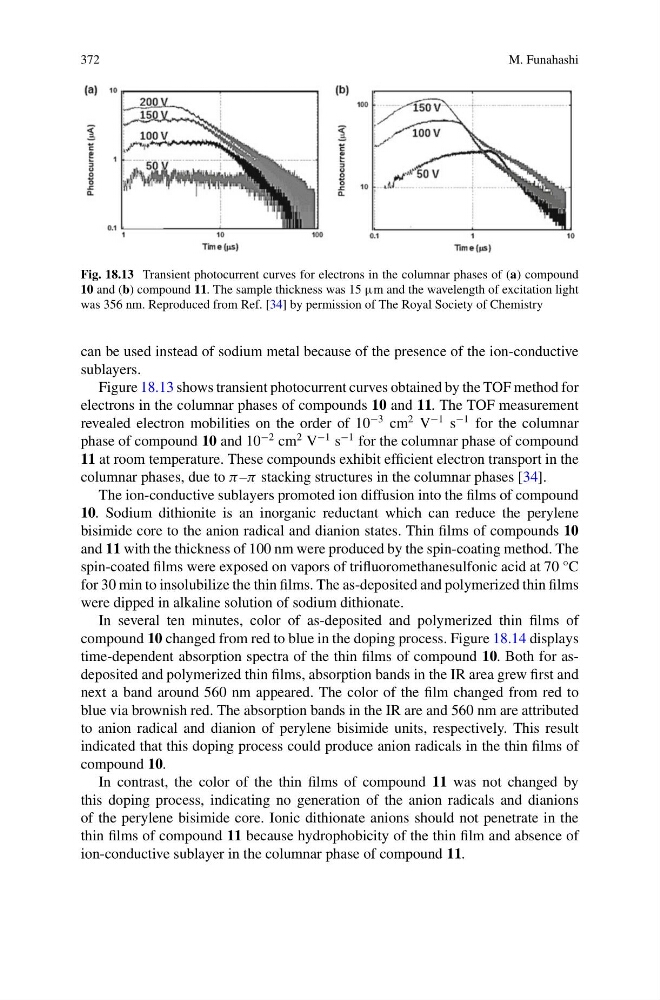
Fig. 18.13 Transient photocurrent curves for electrons in the columnar phases of (a) compound
10 and (b) compound 11. The sample thickness was 15 μm and the wavelength of excitation light
was 356 nm. Reproduced from Ref. [34] by permission of The Royal Society of Chemistry
can be used instead of sodium metal because of the presence of the ion-conductive
sublayers.
Figure 18.13 shows transient photocurrent curves obtained by the TOF method for
electrons in the columnar phases of compounds 10 and 11. The TOF measurement
revealed electron mobilities on the order of 10
−3 cm
2 V
−1 s
−1 for the columnar
phase of compound 10 and 10
−2 cm
2 V
−1 s
−1 for the columnar phase of compound
11 at room temperature. These compounds exhibit efficient electron transport in the
columnar phases, due to π –π stacking structures in the columnar phases [34].
The ion-conductive sublayers promoted ion diffusion into the films of compound
10. Sodium dithionite is an inorganic reductant which can reduce the perylene
bisimide core to the anion radical and dianion states. Thin films of compounds 10
and 11 with the thickness of 100 nm were produced by the spin-coating method. The
spin-coated films were exposed on vapors of trifluoromethanesulfonic acid at 70 °C
for 30 min to insolubilize the thin films. The as-deposited and polymerized thin films
were dipped in alkaline solution of sodium dithionate.
In several ten minutes, color of as-deposited and polymerized thin films of
compound 10 changed from red to blue in the doping process. Figure 18.14 displays
time-dependent absorption spectra of the thin films of compound 10. Both for asdeposited and polymerized thin films, absorption bands in the IR area grew first and
next a band around 560 nm appeared. The color of the film changed from red to
blue via brownish red. The absorption bands in the IR are and 560 nm are attributed
to anion radical and dianion of perylene bisimide units, respectively. This result
indicated that this doping process could produce anion radicals in the thin films of
compound 10.
In contrast, the color of the thin films of compound 11 was not changed by
this doping process, indicating no generation of the anion radicals and dianions
of the perylene bisimide core. Ionic dithionate anions should not penetrate in the
thin films of compound 11 because hydrophobicity of the thin film and absence of
ion-conductive sublayer in the columnar phase of compound 11.
M. Funahashi
Fig. 18.13 Transient photocurrent curves for electrons in the columnar phases of (a) compound
10 and (b) compound 11. The sample thickness was 15 μm and the wavelength of excitation light
was 356 nm. Reproduced from Ref. [34] by permission of The Royal Society of Chemistry
can be used instead of sodium metal because of the presence of the ion-conductive
sublayers.
Figure 18.13 shows transient photocurrent curves obtained by the TOF method for
electrons in the columnar phases of compounds 10 and 11. The TOF measurement
revealed electron mobilities on the order of 10
−3 cm
2 V
−1 s
−1 for the columnar
phase of compound 10 and 10
−2 cm
2 V
−1 s
−1 for the columnar phase of compound
11 at room temperature. These compounds exhibit efficient electron transport in the
columnar phases, due to π –π stacking structures in the columnar phases [34].
The ion-conductive sublayers promoted ion diffusion into the films of compound
10. Sodium dithionite is an inorganic reductant which can reduce the perylene
bisimide core to the anion radical and dianion states. Thin films of compounds 10
and 11 with the thickness of 100 nm were produced by the spin-coating method. The
spin-coated films were exposed on vapors of trifluoromethanesulfonic acid at 70 °C
for 30 min to insolubilize the thin films. The as-deposited and polymerized thin films
were dipped in alkaline solution of sodium dithionate.
In several ten minutes, color of as-deposited and polymerized thin films of
compound 10 changed from red to blue in the doping process. Figure 18.14 displays
time-dependent absorption spectra of the thin films of compound 10. Both for asdeposited and polymerized thin films, absorption bands in the IR area grew first and
next a band around 560 nm appeared. The color of the film changed from red to
blue via brownish red. The absorption bands in the IR are and 560 nm are attributed
to anion radical and dianion of perylene bisimide units, respectively. This result
indicated that this doping process could produce anion radicals in the thin films of
compound 10.
In contrast, the color of the thin films of compound 11 was not changed by
this doping process, indicating no generation of the anion radicals and dianions
of the perylene bisimide core. Ionic dithionate anions should not penetrate in the
thin films of compound 11 because hydrophobicity of the thin film and absence of
ion-conductive sublayer in the columnar phase of compound 11.