

18 Electrochemical Functions of Nanostructured Liquid Crystals …
371
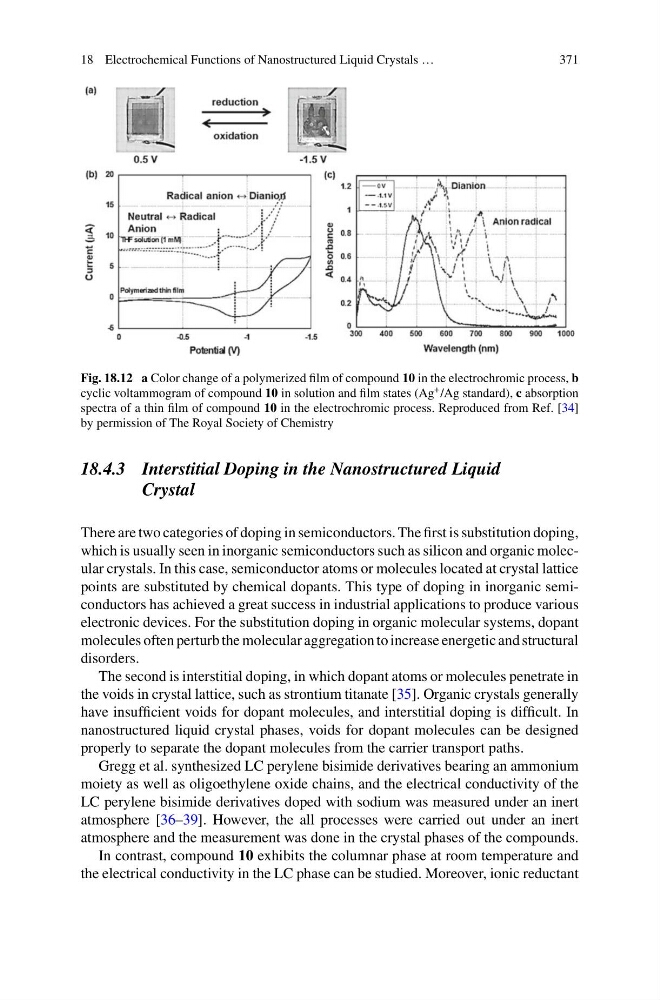
Fig. 18.12 a Color change of a polymerized film of compound 10 in the electrochromic process, b
cyclic voltammogram of compound 10 in solution and film states (Ag + /Ag standard), c absorption
spectra of a thin film of compound 10 in the electrochromic process. Reproduced from Ref. [34]
by permission of The Royal Society of Chemistry
18.4.3 Interstitial Doping in the Nanostructured Liquid
Crystal
There are two categories of doping in semiconductors. The first is substitution doping,
which is usually seen in inorganic semiconductors such as silicon and organic molecular crystals. In this case, semiconductor atoms or molecules located at crystal lattice
points are substituted by chemical dopants. This type of doping in inorganic semiconductors has achieved a great success in industrial applications to produce various
electronic devices. For the substitution doping in organic molecular systems, dopant
molecules often perturb the molecular aggregation to increase energetic and structural
disorders.
The second is interstitial doping, in which dopant atoms or molecules penetrate in
the voids in crystal lattice, such as strontium titanate [35]. Organic crystals generally
have insufficient voids for dopant molecules, and interstitial doping is difficult. In
nanostructured liquid crystal phases, voids for dopant molecules can be designed
properly to separate the dopant molecules from the carrier transport paths.
Gregg et al. synthesized LC perylene bisimide derivatives bearing an ammonium
moiety as well as oligoethylene oxide chains, and the electrical conductivity of the
LC perylene bisimide derivatives doped with sodium was measured under an inert
atmosphere [36–39]. However, the all processes were carried out under an inert
atmosphere and the measurement was done in the crystal phases of the compounds.
In contrast, compound 10 exhibits the columnar phase at room temperature and
the electrical conductivity in the LC phase can be studied. Moreover, ionic reductant
371
Fig. 18.12 a Color change of a polymerized film of compound 10 in the electrochromic process, b
cyclic voltammogram of compound 10 in solution and film states (Ag + /Ag standard), c absorption
spectra of a thin film of compound 10 in the electrochromic process. Reproduced from Ref. [34]
by permission of The Royal Society of Chemistry
18.4.3 Interstitial Doping in the Nanostructured Liquid
Crystal
There are two categories of doping in semiconductors. The first is substitution doping,
which is usually seen in inorganic semiconductors such as silicon and organic molecular crystals. In this case, semiconductor atoms or molecules located at crystal lattice
points are substituted by chemical dopants. This type of doping in inorganic semiconductors has achieved a great success in industrial applications to produce various
electronic devices. For the substitution doping in organic molecular systems, dopant
molecules often perturb the molecular aggregation to increase energetic and structural
disorders.
The second is interstitial doping, in which dopant atoms or molecules penetrate in
the voids in crystal lattice, such as strontium titanate [35]. Organic crystals generally
have insufficient voids for dopant molecules, and interstitial doping is difficult. In
nanostructured liquid crystal phases, voids for dopant molecules can be designed
properly to separate the dopant molecules from the carrier transport paths.
Gregg et al. synthesized LC perylene bisimide derivatives bearing an ammonium
moiety as well as oligoethylene oxide chains, and the electrical conductivity of the
LC perylene bisimide derivatives doped with sodium was measured under an inert
atmosphere [36–39]. However, the all processes were carried out under an inert
atmosphere and the measurement was done in the crystal phases of the compounds.
In contrast, compound 10 exhibits the columnar phase at room temperature and
the electrical conductivity in the LC phase can be studied. Moreover, ionic reductant