

17 Azulene-Based Materials for Organic Field-Effect Transistors
345
the dipole moment of azulene passes through its 2-and 6-positions, we concluded
that structurally expanding azulene at these positions would lead to oligomers that
reflected the magnitude and direction of the dipole moment of a single azulene
molecule the most. In other words, structurally expanding azulene through its 2- and
6-positions uses the features of this molecule to their maximum benefit.
17.3 Azulenyl End-Capped Oligomers
17.3.1 Objective and Background
Sulfur-containing conjugated skeletons, such as bithiophene and thienothiophene,
have been widely used as the basic skeletons of organic semiconductor materials
because the large atomic radius of sulfur is advantageous for orbital overlap and intermolecular interactions. In particular, end-capping π-conjugated systems to produce
aromatic oligomers that are end-capped with optional aromatic units on each end
is an important basic strategy for the design of π-conjugated materials because a
wide range of material groups can be prepared by combining the basic skeleton with
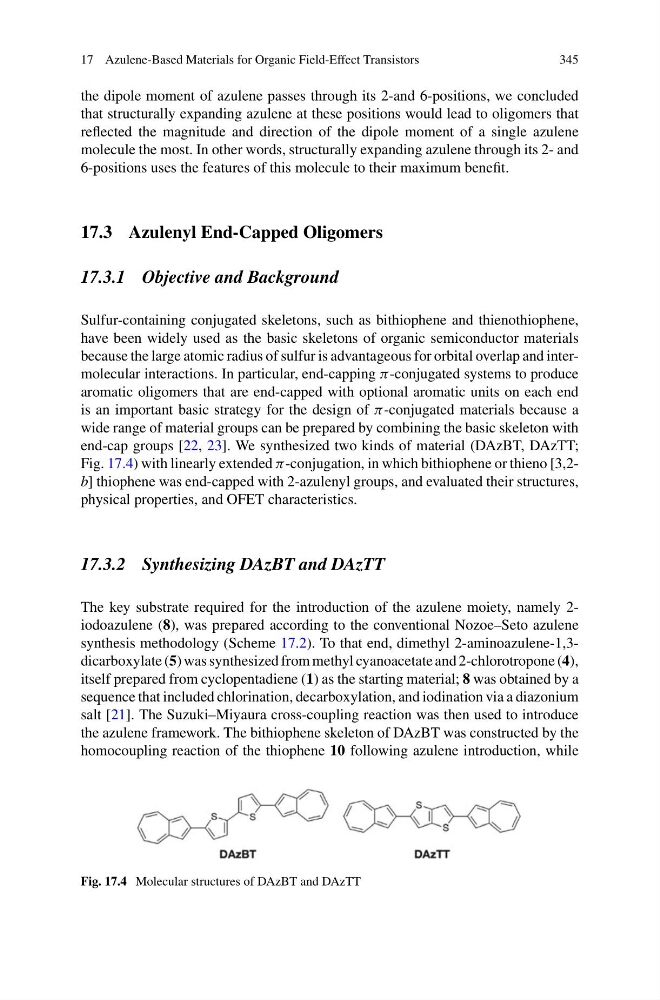
end-cap groups [22, 23]. We synthesized two kinds of material (DAzBT, DAzTT;
Fig. 17.4) with linearly extended π-conjugation, in which bithiophene or thieno [3,2b] thiophene was end-capped with 2-azulenyl groups, and evaluated their structures,
physical properties, and OFET characteristics.
17.3.2 Synthesizing DAzBT and DAzTT
The key substrate required for the introduction of the azulene moiety, namely 2iodoazulene (8), was prepared according to the conventional Nozoe–Seto azulene
synthesis methodology (Scheme 17.2). To that end, dimethyl 2-aminoazulene-1,3dicarboxylate (5) was synthesized from methyl cyanoacetate and 2-chlorotropone (4),
itself prepared from cyclopentadiene (1) as the starting material; 8 was obtained by a
sequence that included chlorination, decarboxylation, and iodination via a diazonium
salt [21]. The Suzuki–Miyaura cross-coupling reaction was then used to introduce
the azulene framework. The bithiophene skeleton of DAzBT was constructed by the
homocoupling reaction of the thiophene 10 following azulene introduction, while
Fig. 17.4 Molecular structures of DAzBT and DAzTT
345
the dipole moment of azulene passes through its 2-and 6-positions, we concluded
that structurally expanding azulene at these positions would lead to oligomers that
reflected the magnitude and direction of the dipole moment of a single azulene
molecule the most. In other words, structurally expanding azulene through its 2- and
6-positions uses the features of this molecule to their maximum benefit.
17.3 Azulenyl End-Capped Oligomers
17.3.1 Objective and Background
Sulfur-containing conjugated skeletons, such as bithiophene and thienothiophene,
have been widely used as the basic skeletons of organic semiconductor materials
because the large atomic radius of sulfur is advantageous for orbital overlap and intermolecular interactions. In particular, end-capping π-conjugated systems to produce
aromatic oligomers that are end-capped with optional aromatic units on each end
is an important basic strategy for the design of π-conjugated materials because a
wide range of material groups can be prepared by combining the basic skeleton with
end-cap groups [22, 23]. We synthesized two kinds of material (DAzBT, DAzTT;
Fig. 17.4) with linearly extended π-conjugation, in which bithiophene or thieno [3,2b] thiophene was end-capped with 2-azulenyl groups, and evaluated their structures,
physical properties, and OFET characteristics.
17.3.2 Synthesizing DAzBT and DAzTT
The key substrate required for the introduction of the azulene moiety, namely 2iodoazulene (8), was prepared according to the conventional Nozoe–Seto azulene
synthesis methodology (Scheme 17.2). To that end, dimethyl 2-aminoazulene-1,3dicarboxylate (5) was synthesized from methyl cyanoacetate and 2-chlorotropone (4),
itself prepared from cyclopentadiene (1) as the starting material; 8 was obtained by a
sequence that included chlorination, decarboxylation, and iodination via a diazonium
salt [21]. The Suzuki–Miyaura cross-coupling reaction was then used to introduce
the azulene framework. The bithiophene skeleton of DAzBT was constructed by the
homocoupling reaction of the thiophene 10 following azulene introduction, while
Fig. 17.4 Molecular structures of DAzBT and DAzTT