

344
H. Katagiri
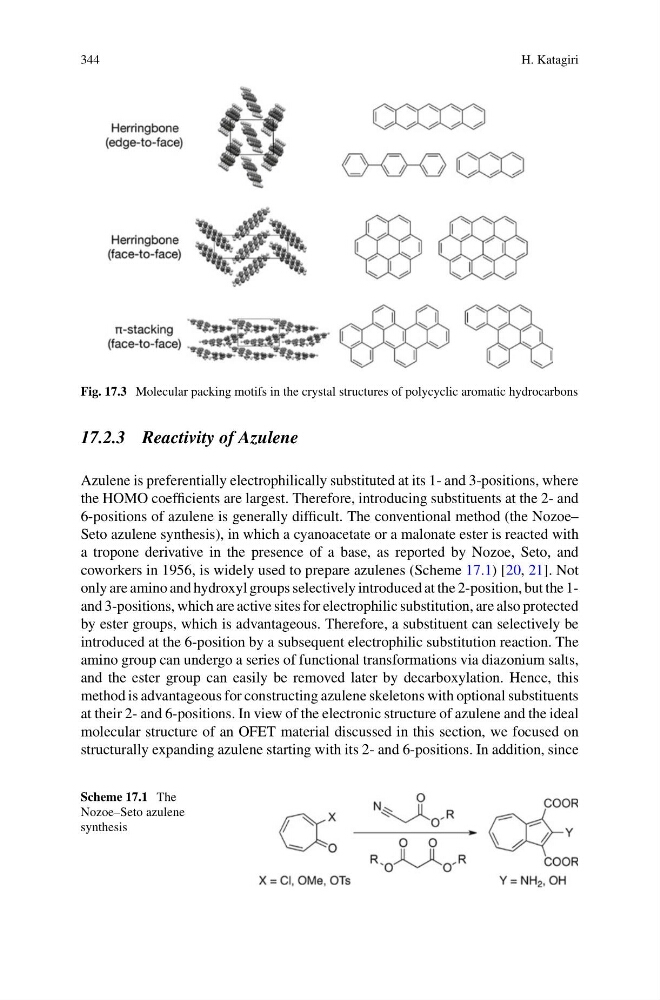
Fig. 17.3 Molecular packing motifs in the crystal structures of polycyclic aromatic hydrocarbons
17.2.3 Reactivity of Azulene
Azulene is preferentially electrophilically substituted at its 1- and 3-positions, where
the HOMO coefficients are largest. Therefore, introducing substituents at the 2- and
6-positions of azulene is generally difficult. The conventional method (the Nozoe–
Seto azulene synthesis), in which a cyanoacetate or a malonate ester is reacted with
a tropone derivative in the presence of a base, as reported by Nozoe, Seto, and
coworkers in 1956, is widely used to prepare azulenes (Scheme 17.1) [20, 21]. Not
only are amino and hydroxyl groups selectively introduced at the 2-position, but the 1and 3-positions, which are active sites for electrophilic substitution, are also protected
by ester groups, which is advantageous. Therefore, a substituent can selectively be
introduced at the 6-position by a subsequent electrophilic substitution reaction. The
amino group can undergo a series of functional transformations via diazonium salts,
and the ester group can easily be removed later by decarboxylation. Hence, this
method is advantageous for constructing azulene skeletons with optional substituents
at their 2- and 6-positions. In view of the electronic structure of azulene and the ideal
molecular structure of an OFET material discussed in this section, we focused on
structurally expanding azulene starting with its 2- and 6-positions. In addition, since
Scheme 17.1 The
Nozoe–Seto azulene
synthesis
H. Katagiri
Fig. 17.3 Molecular packing motifs in the crystal structures of polycyclic aromatic hydrocarbons
17.2.3 Reactivity of Azulene
Azulene is preferentially electrophilically substituted at its 1- and 3-positions, where
the HOMO coefficients are largest. Therefore, introducing substituents at the 2- and
6-positions of azulene is generally difficult. The conventional method (the Nozoe–
Seto azulene synthesis), in which a cyanoacetate or a malonate ester is reacted with
a tropone derivative in the presence of a base, as reported by Nozoe, Seto, and
coworkers in 1956, is widely used to prepare azulenes (Scheme 17.1) [20, 21]. Not
only are amino and hydroxyl groups selectively introduced at the 2-position, but the 1and 3-positions, which are active sites for electrophilic substitution, are also protected
by ester groups, which is advantageous. Therefore, a substituent can selectively be
introduced at the 6-position by a subsequent electrophilic substitution reaction. The
amino group can undergo a series of functional transformations via diazonium salts,
and the ester group can easily be removed later by decarboxylation. Hence, this
method is advantageous for constructing azulene skeletons with optional substituents
at their 2- and 6-positions. In view of the electronic structure of azulene and the ideal
molecular structure of an OFET material discussed in this section, we focused on
structurally expanding azulene starting with its 2- and 6-positions. In addition, since
Scheme 17.1 The
Nozoe–Seto azulene
synthesis