

16 Circularly Polarized Luminescence …
327
(a)
(b)
250
300
350
400
450
-20
-15
-10
-5
0
5
10
15
CPL / mdeg
Wavelength / nm
(S)-2/PMMA
(S)-1/PMMA
-20
-15
-10
-5
0
5
10
250
300
350
400
450
CD / mdeg
Wavelength / nm
(S)-1/PMMA
(S)-2/PMMA
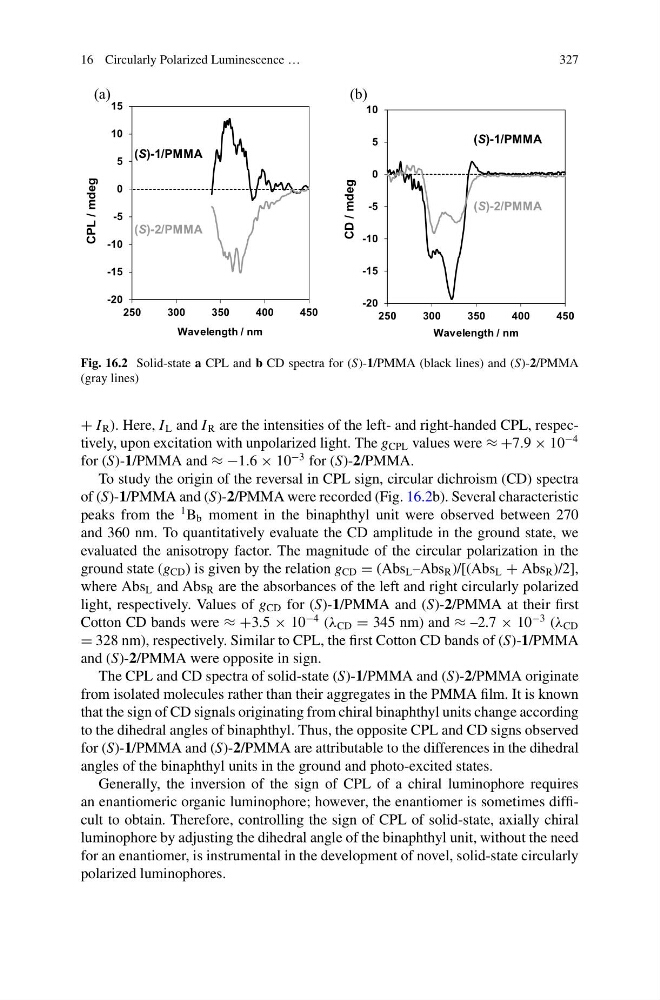
Fig. 16.2 Solid-state a CPL and b CD spectra for (S)-1/PMMA (black lines) and (S)-2/PMMA
(gray lines)
+ I R ). Here, I L and I R are the intensities of the left- and right-handed CPL, respectively, upon excitation with unpolarized light. The g CPL values were ≈ +7.9 × 10
−4
for (S)-1/PMMA and ≈ −1.6 × 10
−3 for (S)-2/PMMA.
To study the origin of the reversal in CPL sign, circular dichroism (CD) spectra
of (S)-1/PMMA and (S)-2/PMMA were recorded (Fig. 16.2b). Several characteristic
peaks from the
1 B b moment in the binaphthyl unit were observed between 270
and 360 nm. To quantitatively evaluate the CD amplitude in the ground state, we
evaluated the anisotropy factor. The magnitude of the circular polarization in the
ground state (g CD ) is given by the relation g CD = (Abs L –Abs R )/[(Abs L + Abs R )/2],
where Abs L and Abs R are the absorbances of the left and right circularly polarized
light, respectively. Values of g CD for (S)-1/PMMA and (S)-2/PMMA at their first
Cotton CD bands were ≈ +3.5 × 10
−4 (λ CD = 345 nm) and ≈ –2.7 × 10
−3 (λ CD
= 328 nm), respectively. Similar to CPL, the first Cotton CD bands of (S)-1/PMMA
and (S)-2/PMMA were opposite in sign.
The CPL and CD spectra of solid-state (S)-1/PMMA and (S)-2/PMMA originate
from isolated molecules rather than their aggregates in the PMMA film. It is known
that the sign of CD signals originating from chiral binaphthyl units change according
to the dihedral angles of binaphthyl. Thus, the opposite CPL and CD signs observed
for (S)-1/PMMA and (S)-2/PMMA are attributable to the differences in the dihedral
angles of the binaphthyl units in the ground and photo-excited states.
Generally, the inversion of the sign of CPL of a chiral luminophore requires
an enantiomeric organic luminophore; however, the enantiomer is sometimes difficult to obtain. Therefore, controlling the sign of CPL of solid-state, axially chiral
luminophore by adjusting the dihedral angle of the binaphthyl unit, without the need
for an enantiomer, is instrumental in the development of novel, solid-state circularly
polarized luminophores.
327
(a)
(b)
250
300
350
400
450
-20
-15
-10
-5
0
5
10
15
CPL / mdeg
Wavelength / nm
(S)-2/PMMA
(S)-1/PMMA
-20
-15
-10
-5
0
5
10
250
300
350
400
450
CD / mdeg
Wavelength / nm
(S)-1/PMMA
(S)-2/PMMA
Fig. 16.2 Solid-state a CPL and b CD spectra for (S)-1/PMMA (black lines) and (S)-2/PMMA
(gray lines)
+ I R ). Here, I L and I R are the intensities of the left- and right-handed CPL, respectively, upon excitation with unpolarized light. The g CPL values were ≈ +7.9 × 10
−4
for (S)-1/PMMA and ≈ −1.6 × 10
−3 for (S)-2/PMMA.
To study the origin of the reversal in CPL sign, circular dichroism (CD) spectra
of (S)-1/PMMA and (S)-2/PMMA were recorded (Fig. 16.2b). Several characteristic
peaks from the
1 B b moment in the binaphthyl unit were observed between 270
and 360 nm. To quantitatively evaluate the CD amplitude in the ground state, we
evaluated the anisotropy factor. The magnitude of the circular polarization in the
ground state (g CD ) is given by the relation g CD = (Abs L –Abs R )/[(Abs L + Abs R )/2],
where Abs L and Abs R are the absorbances of the left and right circularly polarized
light, respectively. Values of g CD for (S)-1/PMMA and (S)-2/PMMA at their first
Cotton CD bands were ≈ +3.5 × 10
−4 (λ CD = 345 nm) and ≈ –2.7 × 10
−3 (λ CD
= 328 nm), respectively. Similar to CPL, the first Cotton CD bands of (S)-1/PMMA
and (S)-2/PMMA were opposite in sign.
The CPL and CD spectra of solid-state (S)-1/PMMA and (S)-2/PMMA originate
from isolated molecules rather than their aggregates in the PMMA film. It is known
that the sign of CD signals originating from chiral binaphthyl units change according
to the dihedral angles of binaphthyl. Thus, the opposite CPL and CD signs observed
for (S)-1/PMMA and (S)-2/PMMA are attributable to the differences in the dihedral
angles of the binaphthyl units in the ground and photo-excited states.
Generally, the inversion of the sign of CPL of a chiral luminophore requires
an enantiomeric organic luminophore; however, the enantiomer is sometimes difficult to obtain. Therefore, controlling the sign of CPL of solid-state, axially chiral
luminophore by adjusting the dihedral angle of the binaphthyl unit, without the need
for an enantiomer, is instrumental in the development of novel, solid-state circularly
polarized luminophores.