

326
Y. Imai
16.2 Non-classical Control of CPL in Solid-State, Axially
Chiral Binaphthyl Luminophore Wrapped
with Organic PMMA Polymer [11]
Axially chiral binaphthyl is a fundamental chiral unit that is used to introduce chirality
in molecules and materials. This binaphthyl unit emits CPL as it is both chiral
and fluorescent. In practical applications, CPL from the solid-state luminophore
is exploited.
In this section, non-classical control of CPL by two solid-state, axially chiral
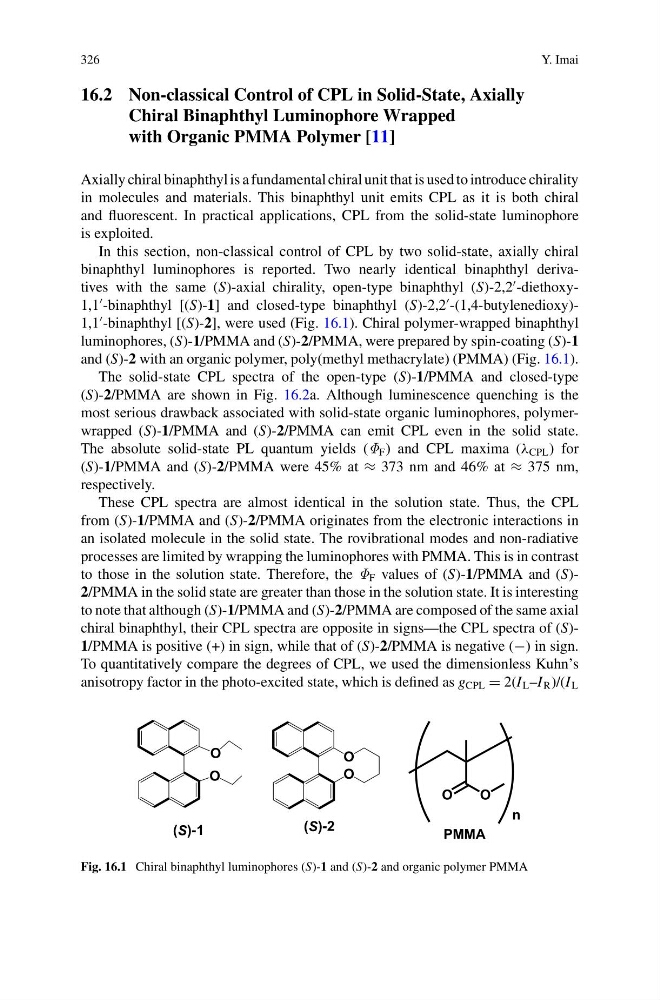
binaphthyl luminophores is reported. Two nearly identical binaphthyl derivatives with the same (S)-axial chirality, open-type binaphthyl (S)-2,2
-diethoxy1,1
-binaphthyl [(S)-1] and closed-type binaphthyl (S)-2,2
-(1,4-butylenedioxy)1,1
-binaphthyl [(S)-2], were used (Fig. 16.1). Chiral polymer-wrapped binaphthyl
luminophores, (S)-1/PMMA and (S)-2/PMMA, were prepared by spin-coating (S)-1
and (S)-2 with an organic polymer, poly(methyl methacrylate) (PMMA) (Fig. 16.1).
The solid-state CPL spectra of the open-type (S)-1/PMMA and closed-type
(S)-2/PMMA are shown in Fig. 16.2a. Although luminescence quenching is the
most serious drawback associated with solid-state organic luminophores, polymerwrapped (S)-1/PMMA and (S)-2/PMMA can emit CPL even in the solid state.
The absolute solid-state PL quantum yields (F F ) and CPL maxima (λ CPL ) for
(S)-1/PMMA and (S)-2/PMMA were 45% at ≈ 373 nm and 46% at ≈ 375 nm,
respectively.
These CPL spectra are almost identical in the solution state. Thus, the CPL
from (S)-1/PMMA and (S)-2/PMMA originates from the electronic interactions in
an isolated molecule in the solid state. The rovibrational modes and non-radiative
processes are limited by wrapping the luminophores with PMMA. This is in contrast
to those in the solution state. Therefore, the F F values of (S)-1/PMMA and (S)2/PMMA in the solid state are greater than those in the solution state. It is interesting
to note that although (S)-1/PMMA and (S)-2/PMMA are composed of the same axial
chiral binaphthyl, their CPL spectra are opposite in signs—the CPL spectra of (S)1/PMMA is positive (+) in sign, while that of (S)-2/PMMA is negative (−) in sign.
To quantitatively compare the degrees of CPL, we used the dimensionless Kuhn’s
anisotropy factor in the photo-excited state, which is defined as g CPL = 2(I L –I R )/(I L
O
O
(S)-2
(S)-1
O
O
PMMA
n
O
O
Fig. 16.1 Chiral binaphthyl luminophores (S)-1 and (S)-2 and organic polymer PMMA
Y. Imai
16.2 Non-classical Control of CPL in Solid-State, Axially
Chiral Binaphthyl Luminophore Wrapped
with Organic PMMA Polymer [11]
Axially chiral binaphthyl is a fundamental chiral unit that is used to introduce chirality
in molecules and materials. This binaphthyl unit emits CPL as it is both chiral
and fluorescent. In practical applications, CPL from the solid-state luminophore
is exploited.
In this section, non-classical control of CPL by two solid-state, axially chiral
binaphthyl luminophores is reported. Two nearly identical binaphthyl derivatives with the same (S)-axial chirality, open-type binaphthyl (S)-2,2
-diethoxy1,1
-binaphthyl [(S)-1] and closed-type binaphthyl (S)-2,2
-(1,4-butylenedioxy)1,1
-binaphthyl [(S)-2], were used (Fig. 16.1). Chiral polymer-wrapped binaphthyl
luminophores, (S)-1/PMMA and (S)-2/PMMA, were prepared by spin-coating (S)-1
and (S)-2 with an organic polymer, poly(methyl methacrylate) (PMMA) (Fig. 16.1).
The solid-state CPL spectra of the open-type (S)-1/PMMA and closed-type
(S)-2/PMMA are shown in Fig. 16.2a. Although luminescence quenching is the
most serious drawback associated with solid-state organic luminophores, polymerwrapped (S)-1/PMMA and (S)-2/PMMA can emit CPL even in the solid state.
The absolute solid-state PL quantum yields (F F ) and CPL maxima (λ CPL ) for
(S)-1/PMMA and (S)-2/PMMA were 45% at ≈ 373 nm and 46% at ≈ 375 nm,
respectively.
These CPL spectra are almost identical in the solution state. Thus, the CPL
from (S)-1/PMMA and (S)-2/PMMA originates from the electronic interactions in
an isolated molecule in the solid state. The rovibrational modes and non-radiative
processes are limited by wrapping the luminophores with PMMA. This is in contrast
to those in the solution state. Therefore, the F F values of (S)-1/PMMA and (S)2/PMMA in the solid state are greater than those in the solution state. It is interesting
to note that although (S)-1/PMMA and (S)-2/PMMA are composed of the same axial
chiral binaphthyl, their CPL spectra are opposite in signs—the CPL spectra of (S)1/PMMA is positive (+) in sign, while that of (S)-2/PMMA is negative (−) in sign.
To quantitatively compare the degrees of CPL, we used the dimensionless Kuhn’s
anisotropy factor in the photo-excited state, which is defined as g CPL = 2(I L –I R )/(I L
O
O
(S)-2
(S)-1
O
O
PMMA
n
O
O
Fig. 16.1 Chiral binaphthyl luminophores (S)-1 and (S)-2 and organic polymer PMMA