

15 Solid-State Fluorescence Switching Using Photochromic …
309
15.3 Display Materials
15.3.1 Fluorescence Photomodulation Between Dual Colors
In the previous part, we reviewed various researches on the fluorescence on/off
photoswitching in the solid states for the ultra-high density optical memory. On the
other hand, multicolor fluorescent photomodulation materials that exhibit multiple
distinguishable fluorescence signals are especially attractive due to their potential
applications in flexible full-color displays and in next-generation lighting sources.
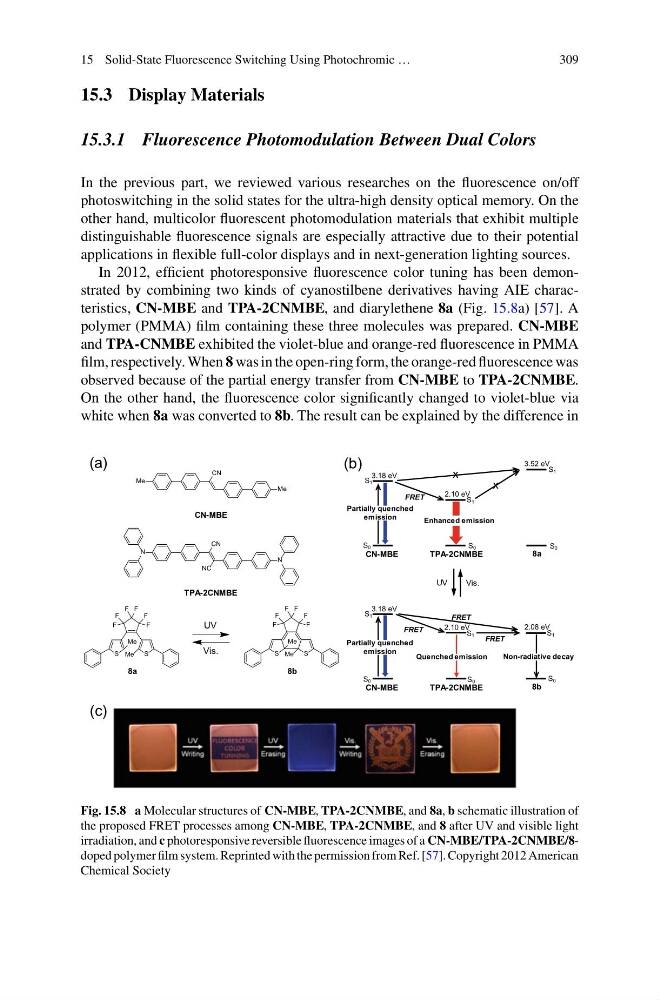
In 2012, efficient photoresponsive fluorescence color tuning has been demonstrated by combining two kinds of cyanostilbene derivatives having AIE characteristics, CN-MBE and TPA-2CNMBE, and diarylethene 8a (Fig. 15.8a) [57]. A
polymer (PMMA) film containing these three molecules was prepared. CN-MBE
and TPA-CNMBE exhibited the violet-blue and orange-red fluorescence in PMMA
film, respectively. When 8 was in the open-ring form, the orange-red fluorescence was
observed because of the partial energy transfer from CN-MBE to TPA-2CNMBE.
On the other hand, the fluorescence color significantly changed to violet-blue via
white when 8a was converted to 8b. The result can be explained by the difference in
Me
CN
Me
N
CN
N
NC
S
S
Me
Me
S
S
Me
Me
UV
Vis.
F
F
F F
F
F
F
F
F
F
F
F
8a
8b
CN-MBE
TPA-2CNMBE
(a)
(b)
(c)
8a
8b
UV
S0
S0
S0
S1
S1
S1
S0
S0
S0
S1
S1
S1
Vis.
x
x
3.18 eV
2.10 eV
TPA-2CNMBE
CN-MBE
3.52 eV
FRET
3.18 eV
2.10 eV
2.08 eV
FRET
FRET
FRET
TPA-2CNMBE
CN-MBE
Partially quenched
emission
Quenched emission
Non-radiative decay
Enhanced emission
Partially quenched
emission
Fig. 15.8 a Molecular structures of CN-MBE, TPA-2CNMBE, and 8a, b schematic illustration of
the proposed FRET processes among CN-MBE, TPA-2CNMBE, and 8 after UV and visible light
irradiation, and c photoresponsive reversible fluorescence images of a CN-MBE/TPA-2CNMBE/8doped polymer film system. Reprinted with the permission from Ref. [57]. Copyright 2012 American
Chemical Society
309
15.3 Display Materials
15.3.1 Fluorescence Photomodulation Between Dual Colors
In the previous part, we reviewed various researches on the fluorescence on/off
photoswitching in the solid states for the ultra-high density optical memory. On the
other hand, multicolor fluorescent photomodulation materials that exhibit multiple
distinguishable fluorescence signals are especially attractive due to their potential
applications in flexible full-color displays and in next-generation lighting sources.
In 2012, efficient photoresponsive fluorescence color tuning has been demonstrated by combining two kinds of cyanostilbene derivatives having AIE characteristics, CN-MBE and TPA-2CNMBE, and diarylethene 8a (Fig. 15.8a) [57]. A
polymer (PMMA) film containing these three molecules was prepared. CN-MBE
and TPA-CNMBE exhibited the violet-blue and orange-red fluorescence in PMMA
film, respectively. When 8 was in the open-ring form, the orange-red fluorescence was
observed because of the partial energy transfer from CN-MBE to TPA-2CNMBE.
On the other hand, the fluorescence color significantly changed to violet-blue via
white when 8a was converted to 8b. The result can be explained by the difference in
Me
CN
Me
N
CN
N
NC
S
S
Me
Me
S
S
Me
Me
UV
Vis.
F
F
F F
F
F
F
F
F
F
F
F
8a
8b
CN-MBE
TPA-2CNMBE
(a)
(b)
(c)
8a
8b
UV
S0
S0
S0
S1
S1
S1
S0
S0
S0
S1
S1
S1
Vis.
x
x
3.18 eV
2.10 eV
TPA-2CNMBE
CN-MBE
3.52 eV
FRET
3.18 eV
2.10 eV
2.08 eV
FRET
FRET
FRET
TPA-2CNMBE
CN-MBE
Partially quenched
emission
Quenched emission
Non-radiative decay
Enhanced emission
Partially quenched
emission
Fig. 15.8 a Molecular structures of CN-MBE, TPA-2CNMBE, and 8a, b schematic illustration of
the proposed FRET processes among CN-MBE, TPA-2CNMBE, and 8 after UV and visible light
irradiation, and c photoresponsive reversible fluorescence images of a CN-MBE/TPA-2CNMBE/8doped polymer film system. Reprinted with the permission from Ref. [57]. Copyright 2012 American
Chemical Society