

14 Luminescent Crystal–Control of Excited-State …
291
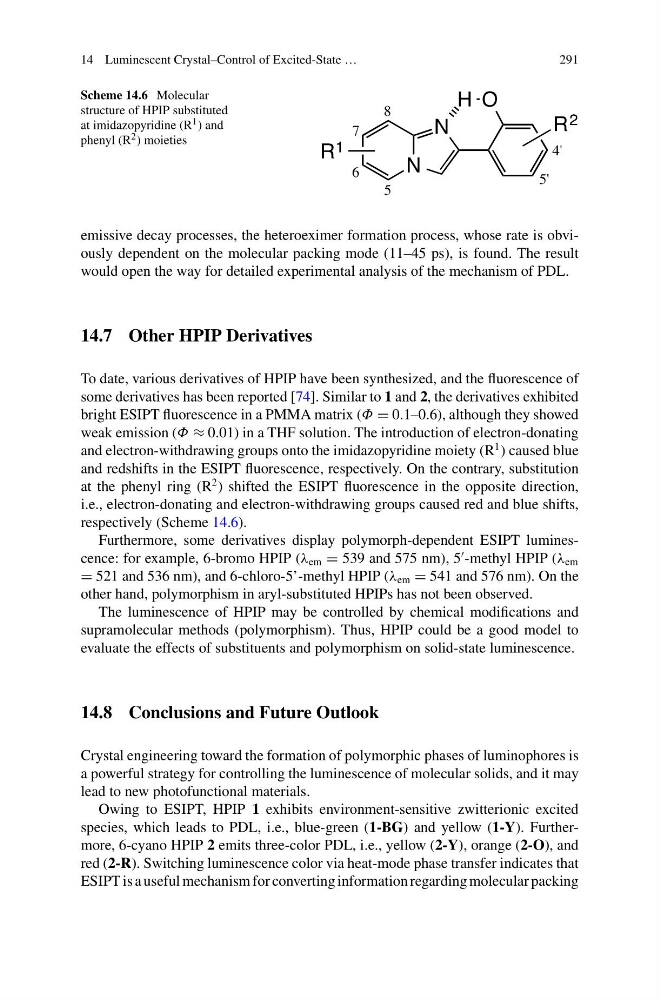
Scheme 14.6 Molecular
structure of HPIP substituted
at imidazopyridine (R 1 ) and
phenyl (R 2 ) moieties
emissive decay processes, the heteroeximer formation process, whose rate is obviously dependent on the molecular packing mode (11–45 ps), is found. The result
would open the way for detailed experimental analysis of the mechanism of PDL.
14.7 Other HPIP Derivatives
To date, various derivatives of HPIP have been synthesized, and the fluorescence of
some derivatives has been reported [74]. Similar to 1 and 2, the derivatives exhibited
bright ESIPT fluorescence in a PMMA matrix (Φ = 0.1–0.6), although they showed
weak emission (Φ ≈ 0.01) in a THF solution. The introduction of electron-donating
and electron-withdrawing groups onto the imidazopyridine moiety (R
1 ) caused blue
and redshifts in the ESIPT fluorescence, respectively. On the contrary, substitution
at the phenyl ring (R
2 ) shifted the ESIPT fluorescence in the opposite direction,
i.e., electron-donating and electron-withdrawing groups caused red and blue shifts,
respectively (Scheme 14.6).
Furthermore, some derivatives display polymorph-dependent ESIPT luminescence: for example, 6-bromo HPIP (λ em = 539 and 575 nm), 5
-methyl HPIP (λ em
= 521 and 536 nm), and 6-chloro-5’-methyl HPIP (λ em = 541 and 576 nm). On the
other hand, polymorphism in aryl-substituted HPIPs has not been observed.
The luminescence of HPIP may be controlled by chemical modifications and
supramolecular methods (polymorphism). Thus, HPIP could be a good model to
evaluate the effects of substituents and polymorphism on solid-state luminescence.
14.8 Conclusions and Future Outlook
Crystal engineering toward the formation of polymorphic phases of luminophores is
a powerful strategy for controlling the luminescence of molecular solids, and it may
lead to new photofunctional materials.
Owing to ESIPT, HPIP 1 exhibits environment-sensitive zwitterionic excited
species, which leads to PDL, i.e., blue-green (1-BG) and yellow (1-Y). Furthermore, 6-cyano HPIP 2 emits three-color PDL, i.e., yellow (2-Y), orange (2-O), and
red (2-R). Switching luminescence color via heat-mode phase transfer indicates that
ESIPT is a useful mechanism for converting information regarding molecular packing
291
Scheme 14.6 Molecular
structure of HPIP substituted
at imidazopyridine (R 1 ) and
phenyl (R 2 ) moieties
emissive decay processes, the heteroeximer formation process, whose rate is obviously dependent on the molecular packing mode (11–45 ps), is found. The result
would open the way for detailed experimental analysis of the mechanism of PDL.
14.7 Other HPIP Derivatives
To date, various derivatives of HPIP have been synthesized, and the fluorescence of
some derivatives has been reported [74]. Similar to 1 and 2, the derivatives exhibited
bright ESIPT fluorescence in a PMMA matrix (Φ = 0.1–0.6), although they showed
weak emission (Φ ≈ 0.01) in a THF solution. The introduction of electron-donating
and electron-withdrawing groups onto the imidazopyridine moiety (R
1 ) caused blue
and redshifts in the ESIPT fluorescence, respectively. On the contrary, substitution
at the phenyl ring (R
2 ) shifted the ESIPT fluorescence in the opposite direction,
i.e., electron-donating and electron-withdrawing groups caused red and blue shifts,
respectively (Scheme 14.6).
Furthermore, some derivatives display polymorph-dependent ESIPT luminescence: for example, 6-bromo HPIP (λ em = 539 and 575 nm), 5
-methyl HPIP (λ em
= 521 and 536 nm), and 6-chloro-5’-methyl HPIP (λ em = 541 and 576 nm). On the
other hand, polymorphism in aryl-substituted HPIPs has not been observed.
The luminescence of HPIP may be controlled by chemical modifications and
supramolecular methods (polymorphism). Thus, HPIP could be a good model to
evaluate the effects of substituents and polymorphism on solid-state luminescence.
14.8 Conclusions and Future Outlook
Crystal engineering toward the formation of polymorphic phases of luminophores is
a powerful strategy for controlling the luminescence of molecular solids, and it may
lead to new photofunctional materials.
Owing to ESIPT, HPIP 1 exhibits environment-sensitive zwitterionic excited
species, which leads to PDL, i.e., blue-green (1-BG) and yellow (1-Y). Furthermore, 6-cyano HPIP 2 emits three-color PDL, i.e., yellow (2-Y), orange (2-O), and
red (2-R). Switching luminescence color via heat-mode phase transfer indicates that
ESIPT is a useful mechanism for converting information regarding molecular packing