

22
K. D. M. Harris et al.
1.4.4 XBI Study of Materials Undergoing Molecular
Reorientational Dynamics
Finally, we consider the application of XBI in studies [24] of materials that
undergo anisotropic molecular dynamics, focusing on the urea inclusion compounds
containing 1,8-dibromooctane [1,8-DBrO; Br(CH 2 ) 8 Br] and 1,10-dibromodecane
[1,10-DBrD; Br(CH 2 ) 10 Br] guest molecules. As discussed below, uni-axial reorientational motion of the guest molecules in these materials is well established from a
range of experimental techniques.
Conventional urea inclusion compounds [25–27] contain a host tunnel structure [28, 29] constructed from a hexagonal hydrogen-bonded arrangement of urea
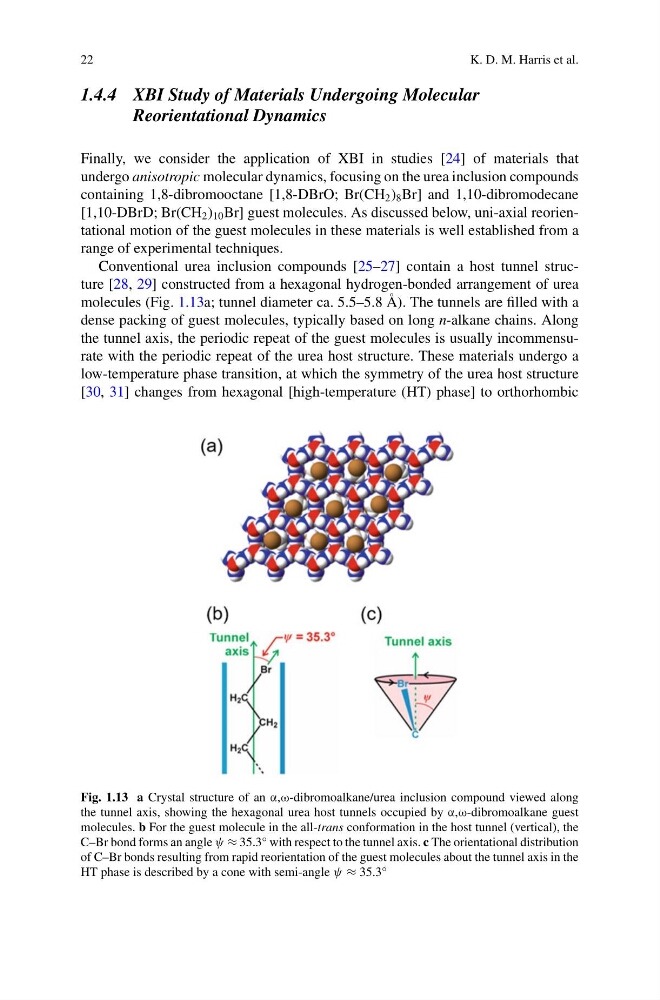
molecules (Fig. 1.13a; tunnel diameter ca. 5.5–5.8 Å). The tunnels are filled with a
dense packing of guest molecules, typically based on long n-alkane chains. Along
the tunnel axis, the periodic repeat of the guest molecules is usually incommensurate with the periodic repeat of the urea host structure. These materials undergo a
low-temperature phase transition, at which the symmetry of the urea host structure
[30, 31] changes from hexagonal [high-temperature (HT) phase] to orthorhombic
Fig. 1.13 a Crystal structure of an α,ω-dibromoalkane/urea inclusion compound viewed along
the tunnel axis, showing the hexagonal urea host tunnels occupied by α,ω-dibromoalkane guest
molecules. b For the guest molecule in the all-trans conformation in the host tunnel (vertical), the
C–Br bond forms an angle ψ ≈ 35.3° with respect to the tunnel axis. c The orientational distribution
of C–Br bonds resulting from rapid reorientation of the guest molecules about the tunnel axis in the
HT phase is described by a cone with semi-angle ψ ≈ 35.3°
K. D. M. Harris et al.
1.4.4 XBI Study of Materials Undergoing Molecular
Reorientational Dynamics
Finally, we consider the application of XBI in studies [24] of materials that
undergo anisotropic molecular dynamics, focusing on the urea inclusion compounds
containing 1,8-dibromooctane [1,8-DBrO; Br(CH 2 ) 8 Br] and 1,10-dibromodecane
[1,10-DBrD; Br(CH 2 ) 10 Br] guest molecules. As discussed below, uni-axial reorientational motion of the guest molecules in these materials is well established from a
range of experimental techniques.
Conventional urea inclusion compounds [25–27] contain a host tunnel structure [28, 29] constructed from a hexagonal hydrogen-bonded arrangement of urea
molecules (Fig. 1.13a; tunnel diameter ca. 5.5–5.8 Å). The tunnels are filled with a
dense packing of guest molecules, typically based on long n-alkane chains. Along
the tunnel axis, the periodic repeat of the guest molecules is usually incommensurate with the periodic repeat of the urea host structure. These materials undergo a
low-temperature phase transition, at which the symmetry of the urea host structure
[30, 31] changes from hexagonal [high-temperature (HT) phase] to orthorhombic
Fig. 1.13 a Crystal structure of an α,ω-dibromoalkane/urea inclusion compound viewed along
the tunnel axis, showing the hexagonal urea host tunnels occupied by α,ω-dibromoalkane guest
molecules. b For the guest molecule in the all-trans conformation in the host tunnel (vertical), the
C–Br bond forms an angle ψ ≈ 35.3° with respect to the tunnel axis. c The orientational distribution
of C–Br bonds resulting from rapid reorientation of the guest molecules about the tunnel axis in the
HT phase is described by a cone with semi-angle ψ ≈ 35.3°