

288
T. Mutai
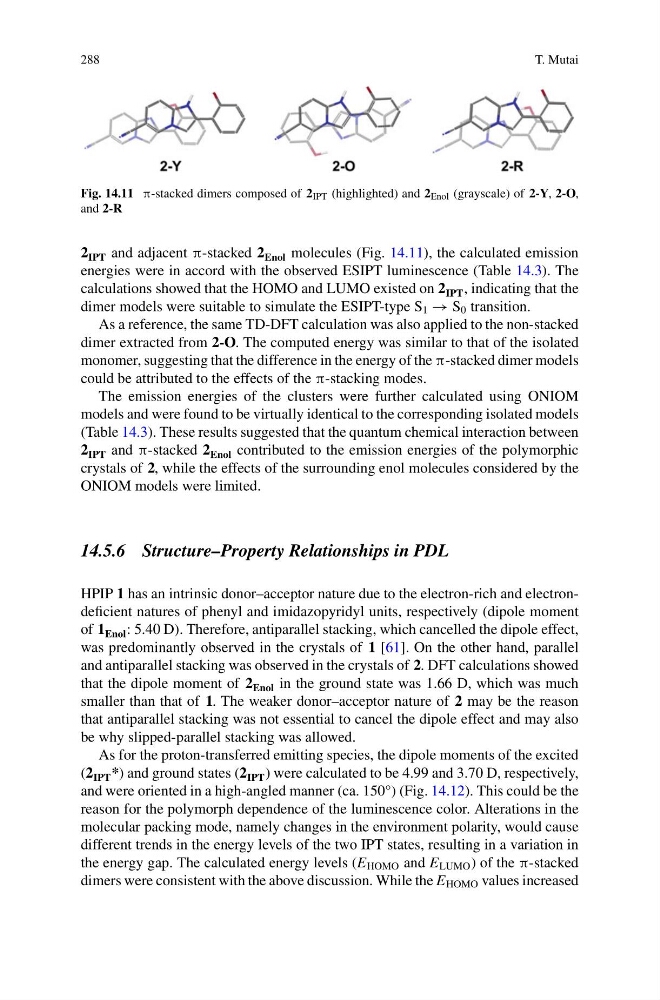
Fig. 14.11 π-stacked dimers composed of 2 IPT (highlighted) and 2 Enol (grayscale) of 2-Y, 2-O,
and 2-R
2 IPT and adjacent π-stacked 2 Enol molecules (Fig. 14.11), the calculated emission
energies were in accord with the observed ESIPT luminescence (Table 14.3). The
calculations showed that the HOMO and LUMO existed on 2 IPT , indicating that the
dimer models were suitable to simulate the ESIPT-type S 1 → S 0 transition.
As a reference, the same TD-DFT calculation was also applied to the non-stacked
dimer extracted from 2-O. The computed energy was similar to that of the isolated
monomer, suggesting that the difference in the energy of the π-stacked dimer models
could be attributed to the effects of the π-stacking modes.
The emission energies of the clusters were further calculated using ONIOM
models and were found to be virtually identical to the corresponding isolated models
(Table 14.3). These results suggested that the quantum chemical interaction between
2 IPT and π-stacked 2 Enol contributed to the emission energies of the polymorphic
crystals of 2, while the effects of the surrounding enol molecules considered by the
ONIOM models were limited.
14.5.6 Structure–Property Relationships in PDL
HPIP 1 has an intrinsic donor–acceptor nature due to the electron-rich and electrondeficient natures of phenyl and imidazopyridyl units, respectively (dipole moment
of 1 Enol : 5.40 D). Therefore, antiparallel stacking, which cancelled the dipole effect,
was predominantly observed in the crystals of 1 [61]. On the other hand, parallel
and antiparallel stacking was observed in the crystals of 2. DFT calculations showed
that the dipole moment of 2 Enol in the ground state was 1.66 D, which was much
smaller than that of 1. The weaker donor–acceptor nature of 2 may be the reason
that antiparallel stacking was not essential to cancel the dipole effect and may also
be why slipped-parallel stacking was allowed.
As for the proton-transferred emitting species, the dipole moments of the excited
(2 IPT *) and ground states (2 IPT ) were calculated to be 4.99 and 3.70 D, respectively,
and were oriented in a high-angled manner (ca. 150°) (Fig. 14.12). This could be the
reason for the polymorph dependence of the luminescence color. Alterations in the
molecular packing mode, namely changes in the environment polarity, would cause
different trends in the energy levels of the two IPT states, resulting in a variation in
the energy gap. The calculated energy levels (E HOMO and E LUMO ) of the π-stacked
dimers were consistent with the above discussion. While the E HOMO values increased
T. Mutai
Fig. 14.11 π-stacked dimers composed of 2 IPT (highlighted) and 2 Enol (grayscale) of 2-Y, 2-O,
and 2-R
2 IPT and adjacent π-stacked 2 Enol molecules (Fig. 14.11), the calculated emission
energies were in accord with the observed ESIPT luminescence (Table 14.3). The
calculations showed that the HOMO and LUMO existed on 2 IPT , indicating that the
dimer models were suitable to simulate the ESIPT-type S 1 → S 0 transition.
As a reference, the same TD-DFT calculation was also applied to the non-stacked
dimer extracted from 2-O. The computed energy was similar to that of the isolated
monomer, suggesting that the difference in the energy of the π-stacked dimer models
could be attributed to the effects of the π-stacking modes.
The emission energies of the clusters were further calculated using ONIOM
models and were found to be virtually identical to the corresponding isolated models
(Table 14.3). These results suggested that the quantum chemical interaction between
2 IPT and π-stacked 2 Enol contributed to the emission energies of the polymorphic
crystals of 2, while the effects of the surrounding enol molecules considered by the
ONIOM models were limited.
14.5.6 Structure–Property Relationships in PDL
HPIP 1 has an intrinsic donor–acceptor nature due to the electron-rich and electrondeficient natures of phenyl and imidazopyridyl units, respectively (dipole moment
of 1 Enol : 5.40 D). Therefore, antiparallel stacking, which cancelled the dipole effect,
was predominantly observed in the crystals of 1 [61]. On the other hand, parallel
and antiparallel stacking was observed in the crystals of 2. DFT calculations showed
that the dipole moment of 2 Enol in the ground state was 1.66 D, which was much
smaller than that of 1. The weaker donor–acceptor nature of 2 may be the reason
that antiparallel stacking was not essential to cancel the dipole effect and may also
be why slipped-parallel stacking was allowed.
As for the proton-transferred emitting species, the dipole moments of the excited
(2 IPT *) and ground states (2 IPT ) were calculated to be 4.99 and 3.70 D, respectively,
and were oriented in a high-angled manner (ca. 150°) (Fig. 14.12). This could be the
reason for the polymorph dependence of the luminescence color. Alterations in the
molecular packing mode, namely changes in the environment polarity, would cause
different trends in the energy levels of the two IPT states, resulting in a variation in
the energy gap. The calculated energy levels (E HOMO and E LUMO ) of the π-stacked
dimers were consistent with the above discussion. While the E HOMO values increased