

14 Luminescent Crystal–Control of Excited-State …
285
Similar to 2-Y, parallel slip-stacked columnar packing was observed in 2-R
(Fig. 14.9). The molecules were less slipped compared to 2-Y, and the same aromatic
moieties overlapped (Fig. 14.9a). Formation of an intermolecular hydrogen bond
could also be ruled out because of the large distance (3.53 Å) between oxygen atoms
and the nearest nitrogen atom of surrounding molecules. As for the intercolumnar
packing, the adjacent columns aligned in an antiparallel manner along the b- and
c-axes (Figs. 14.9b).
In the three polymorphic crystals, the molecular packing was remarkably different,
whereas the conformation of the molecules was nearly identical. Therefore, the intermolecular interactions that vary according to the different molecular packing modes
may be a dominant factor in the PDL of 2.
14.5.3 Luminescence of 2-Y, 2-O, and 2-R
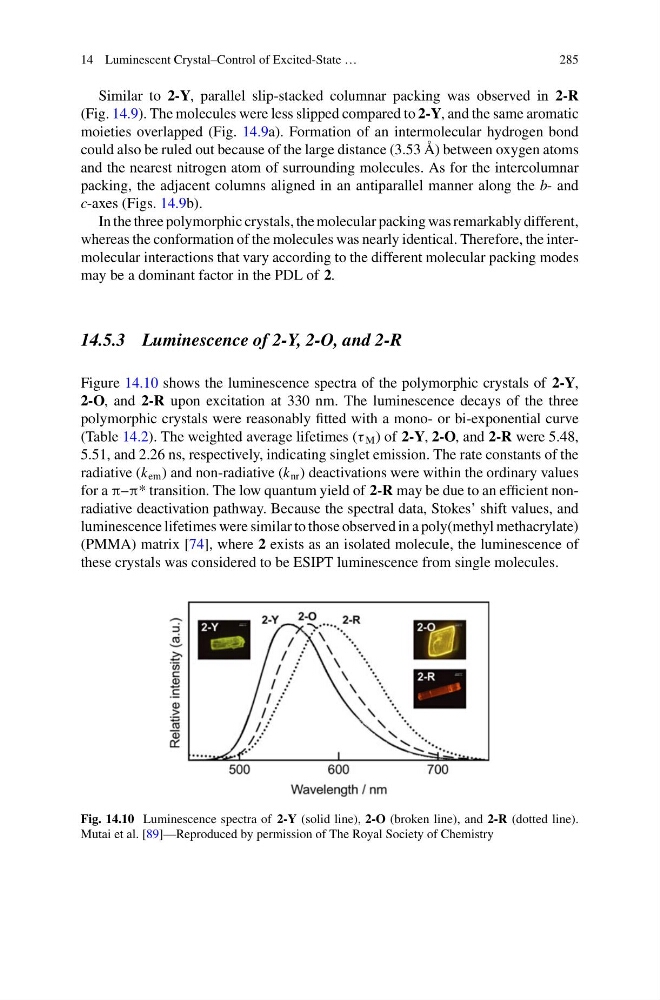
Figure 14.10 shows the luminescence spectra of the polymorphic crystals of 2-Y,
2-O, and 2-R upon excitation at 330 nm. The luminescence decays of the three
polymorphic crystals were reasonably fitted with a mono- or bi-exponential curve
(Table 14.2). The weighted average lifetimes (τ M ) of 2-Y, 2-O, and 2-R were 5.48,
5.51, and 2.26 ns, respectively, indicating singlet emission. The rate constants of the
radiative (k em ) and non-radiative (k nr ) deactivations were within the ordinary values
for a π–π* transition. The low quantum yield of 2-R may be due to an efficient nonradiative deactivation pathway. Because the spectral data, Stokes’ shift values, and
luminescence lifetimes were similar to those observed in a poly(methyl methacrylate)
(PMMA) matrix [74], where 2 exists as an isolated molecule, the luminescence of
these crystals was considered to be ESIPT luminescence from single molecules.
Fig. 14.10 Luminescence spectra of 2-Y (solid line), 2-O (broken line), and 2-R (dotted line).
Mutai et al. [89]—Reproduced by permission of The Royal Society of Chemistry
285
Similar to 2-Y, parallel slip-stacked columnar packing was observed in 2-R
(Fig. 14.9). The molecules were less slipped compared to 2-Y, and the same aromatic
moieties overlapped (Fig. 14.9a). Formation of an intermolecular hydrogen bond
could also be ruled out because of the large distance (3.53 Å) between oxygen atoms
and the nearest nitrogen atom of surrounding molecules. As for the intercolumnar
packing, the adjacent columns aligned in an antiparallel manner along the b- and
c-axes (Figs. 14.9b).
In the three polymorphic crystals, the molecular packing was remarkably different,
whereas the conformation of the molecules was nearly identical. Therefore, the intermolecular interactions that vary according to the different molecular packing modes
may be a dominant factor in the PDL of 2.
14.5.3 Luminescence of 2-Y, 2-O, and 2-R
Figure 14.10 shows the luminescence spectra of the polymorphic crystals of 2-Y,
2-O, and 2-R upon excitation at 330 nm. The luminescence decays of the three
polymorphic crystals were reasonably fitted with a mono- or bi-exponential curve
(Table 14.2). The weighted average lifetimes (τ M ) of 2-Y, 2-O, and 2-R were 5.48,
5.51, and 2.26 ns, respectively, indicating singlet emission. The rate constants of the
radiative (k em ) and non-radiative (k nr ) deactivations were within the ordinary values
for a π–π* transition. The low quantum yield of 2-R may be due to an efficient nonradiative deactivation pathway. Because the spectral data, Stokes’ shift values, and
luminescence lifetimes were similar to those observed in a poly(methyl methacrylate)
(PMMA) matrix [74], where 2 exists as an isolated molecule, the luminescence of
these crystals was considered to be ESIPT luminescence from single molecules.
Fig. 14.10 Luminescence spectra of 2-Y (solid line), 2-O (broken line), and 2-R (dotted line).
Mutai et al. [89]—Reproduced by permission of The Royal Society of Chemistry