

14 Luminescent Crystal–Control of Excited-State …
273
14.1.1 Polymorph-Dependent Luminescence (PDL)
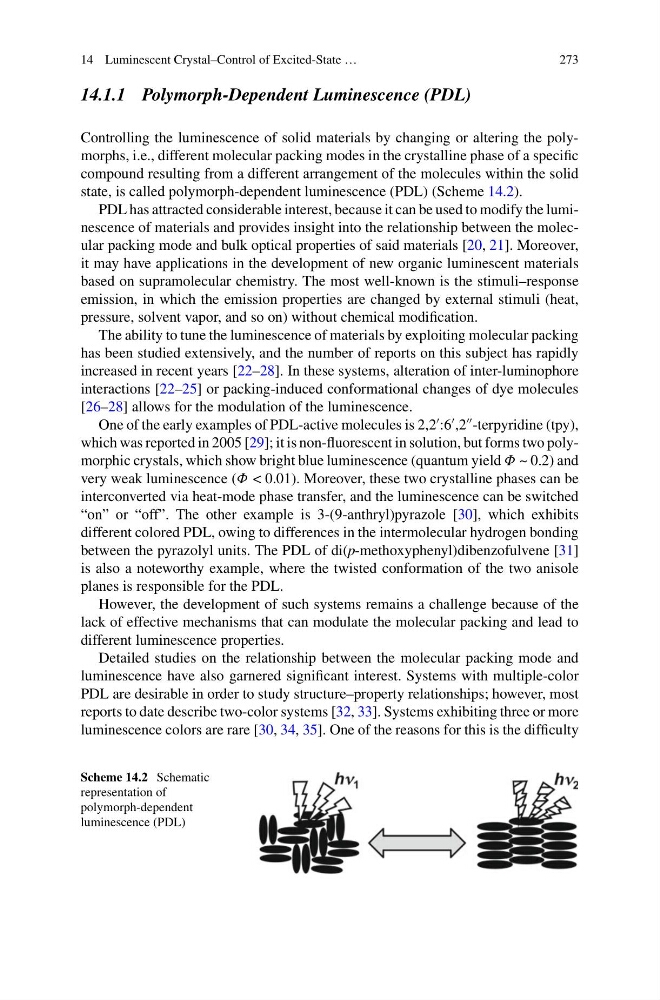
Controlling the luminescence of solid materials by changing or altering the polymorphs, i.e., different molecular packing modes in the crystalline phase of a specific
compound resulting from a different arrangement of the molecules within the solid
state, is called polymorph-dependent luminescence (PDL) (Scheme 14.2).
PDL has attracted considerable interest, because it can be used to modify the luminescence of materials and provides insight into the relationship between the molecular packing mode and bulk optical properties of said materials [20, 21]. Moreover,
it may have applications in the development of new organic luminescent materials
based on supramolecular chemistry. The most well-known is the stimuli–response
emission, in which the emission properties are changed by external stimuli (heat,
pressure, solvent vapor, and so on) without chemical modification.
The ability to tune the luminescence of materials by exploiting molecular packing
has been studied extensively, and the number of reports on this subject has rapidly
increased in recent years [22–28]. In these systems, alteration of inter-luminophore
interactions [22–25] or packing-induced conformational changes of dye molecules
[26–28] allows for the modulation of the luminescence.
One of the early examples of PDL-active molecules is 2,2
:6
,2
-terpyridine (tpy),
which was reported in 2005 [29]; it is non-fluorescent in solution, but forms two polymorphic crystals, which show bright blue luminescence (quantum yield Φ ~ 0.2) and
very weak luminescence (Φ < 0.01). Moreover, these two crystalline phases can be
interconverted via heat-mode phase transfer, and the luminescence can be switched
“on” or “off”. The other example is 3-(9-anthryl)pyrazole [30], which exhibits
different colored PDL, owing to differences in the intermolecular hydrogen bonding
between the pyrazolyl units. The PDL of di(p-methoxyphenyl)dibenzofulvene [31]
is also a noteworthy example, where the twisted conformation of the two anisole
planes is responsible for the PDL.
However, the development of such systems remains a challenge because of the
lack of effective mechanisms that can modulate the molecular packing and lead to
different luminescence properties.
Detailed studies on the relationship between the molecular packing mode and
luminescence have also garnered significant interest. Systems with multiple-color
PDL are desirable in order to study structure–property relationships; however, most
reports to date describe two-color systems [32, 33]. Systems exhibiting three or more
luminescence colors are rare [30, 34, 35]. One of the reasons for this is the difficulty
Scheme 14.2 Schematic
representation of
polymorph-dependent
luminescence (PDL)
273
14.1.1 Polymorph-Dependent Luminescence (PDL)
Controlling the luminescence of solid materials by changing or altering the polymorphs, i.e., different molecular packing modes in the crystalline phase of a specific
compound resulting from a different arrangement of the molecules within the solid
state, is called polymorph-dependent luminescence (PDL) (Scheme 14.2).
PDL has attracted considerable interest, because it can be used to modify the luminescence of materials and provides insight into the relationship between the molecular packing mode and bulk optical properties of said materials [20, 21]. Moreover,
it may have applications in the development of new organic luminescent materials
based on supramolecular chemistry. The most well-known is the stimuli–response
emission, in which the emission properties are changed by external stimuli (heat,
pressure, solvent vapor, and so on) without chemical modification.
The ability to tune the luminescence of materials by exploiting molecular packing
has been studied extensively, and the number of reports on this subject has rapidly
increased in recent years [22–28]. In these systems, alteration of inter-luminophore
interactions [22–25] or packing-induced conformational changes of dye molecules
[26–28] allows for the modulation of the luminescence.
One of the early examples of PDL-active molecules is 2,2
:6
,2
-terpyridine (tpy),
which was reported in 2005 [29]; it is non-fluorescent in solution, but forms two polymorphic crystals, which show bright blue luminescence (quantum yield Φ ~ 0.2) and
very weak luminescence (Φ < 0.01). Moreover, these two crystalline phases can be
interconverted via heat-mode phase transfer, and the luminescence can be switched
“on” or “off”. The other example is 3-(9-anthryl)pyrazole [30], which exhibits
different colored PDL, owing to differences in the intermolecular hydrogen bonding
between the pyrazolyl units. The PDL of di(p-methoxyphenyl)dibenzofulvene [31]
is also a noteworthy example, where the twisted conformation of the two anisole
planes is responsible for the PDL.
However, the development of such systems remains a challenge because of the
lack of effective mechanisms that can modulate the molecular packing and lead to
different luminescence properties.
Detailed studies on the relationship between the molecular packing mode and
luminescence have also garnered significant interest. Systems with multiple-color
PDL are desirable in order to study structure–property relationships; however, most
reports to date describe two-color systems [32, 33]. Systems exhibiting three or more
luminescence colors are rare [30, 34, 35]. One of the reasons for this is the difficulty
Scheme 14.2 Schematic
representation of
polymorph-dependent
luminescence (PDL)