

272
T. Mutai
However, the luminescence of organic compounds is often quenched in the solid
state, because the non-radiative deactivation pathway from the photoexcited state is
enhanced through molecular interactions [8]. Common strategies to overcome this
problem include the introduction of bulky groups [9–11] or design of non-planar
structures [12–14] in order to avoid unfavorable molecular interactions. Therefore,
these materials are primarily used as amorphous solids, and their luminescence is
generally a reflection of that of a single molecule.
The luminescence of bulk solids is regulated not only by that of single molecules,
but also by collective effects owing to the arrangement and interactions of small
molecules. In other words, the luminescence of solid materials could be controlled
by altering the molecular packing mode within the crystal structure, instead of by
chemical modification.
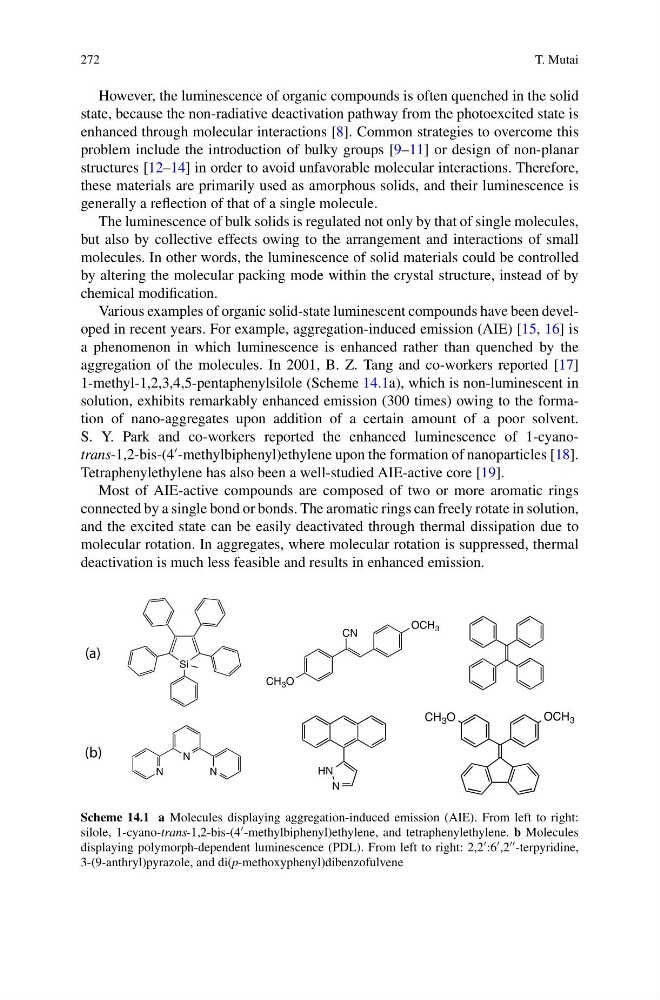
Various examples of organic solid-state luminescent compounds have been developed in recent years. For example, aggregation-induced emission (AIE) [15, 16] is
a phenomenon in which luminescence is enhanced rather than quenched by the
aggregation of the molecules. In 2001, B. Z. Tang and co-workers reported [17]
1-methyl-1,2,3,4,5-pentaphenylsilole (Scheme 14.1a), which is non-luminescent in
solution, exhibits remarkably enhanced emission (300 times) owing to the formation of nano-aggregates upon addition of a certain amount of a poor solvent.
S. Y. Park and co-workers reported the enhanced luminescence of 1-cyanotrans-1,2-bis-(4
-methylbiphenyl)ethylene upon the formation of nanoparticles [18].
Tetraphenylethylene has also been a well-studied AIE-active core [19].
Most of AIE-active compounds are composed of two or more aromatic rings
connected by a single bond or bonds. The aromatic rings can freely rotate in solution,
and the excited state can be easily deactivated through thermal dissipation due to
molecular rotation. In aggregates, where molecular rotation is suppressed, thermal
deactivation is much less feasible and results in enhanced emission.
(a)
(b)
Scheme 14.1 a Molecules displaying aggregation-induced emission (AIE). From left to right:
silole, 1-cyano-trans-1,2-bis-(4 -methylbiphenyl)ethylene, and tetraphenylethylene. b Molecules
displaying polymorph-dependent luminescence (PDL). From left to right: 2,2 :6 ,2 -terpyridine,
3-(9-anthryl)pyrazole, and di(p-methoxyphenyl)dibenzofulvene
T. Mutai
However, the luminescence of organic compounds is often quenched in the solid
state, because the non-radiative deactivation pathway from the photoexcited state is
enhanced through molecular interactions [8]. Common strategies to overcome this
problem include the introduction of bulky groups [9–11] or design of non-planar
structures [12–14] in order to avoid unfavorable molecular interactions. Therefore,
these materials are primarily used as amorphous solids, and their luminescence is
generally a reflection of that of a single molecule.
The luminescence of bulk solids is regulated not only by that of single molecules,
but also by collective effects owing to the arrangement and interactions of small
molecules. In other words, the luminescence of solid materials could be controlled
by altering the molecular packing mode within the crystal structure, instead of by
chemical modification.
Various examples of organic solid-state luminescent compounds have been developed in recent years. For example, aggregation-induced emission (AIE) [15, 16] is
a phenomenon in which luminescence is enhanced rather than quenched by the
aggregation of the molecules. In 2001, B. Z. Tang and co-workers reported [17]
1-methyl-1,2,3,4,5-pentaphenylsilole (Scheme 14.1a), which is non-luminescent in
solution, exhibits remarkably enhanced emission (300 times) owing to the formation of nano-aggregates upon addition of a certain amount of a poor solvent.
S. Y. Park and co-workers reported the enhanced luminescence of 1-cyanotrans-1,2-bis-(4
-methylbiphenyl)ethylene upon the formation of nanoparticles [18].
Tetraphenylethylene has also been a well-studied AIE-active core [19].
Most of AIE-active compounds are composed of two or more aromatic rings
connected by a single bond or bonds. The aromatic rings can freely rotate in solution,
and the excited state can be easily deactivated through thermal dissipation due to
molecular rotation. In aggregates, where molecular rotation is suppressed, thermal
deactivation is much less feasible and results in enhanced emission.
(a)
(b)
Scheme 14.1 a Molecules displaying aggregation-induced emission (AIE). From left to right:
silole, 1-cyano-trans-1,2-bis-(4 -methylbiphenyl)ethylene, and tetraphenylethylene. b Molecules
displaying polymorph-dependent luminescence (PDL). From left to right: 2,2 :6 ,2 -terpyridine,
3-(9-anthryl)pyrazole, and di(p-methoxyphenyl)dibenzofulvene