

244
H. Ohtsu et al.
19 kJ/mol more stable. In comparison, the singlet chemisorbed S 2 state is 113 kJ/mol
more stable relative to its isolated form and is in the order of a covalent bond. These
results unambiguously explain that the lower stability and generally weaker binding
of the chemisorbed sulfur dimer compared to the physisorbed species is due to the
energy of the spin transition. Therefore, the physisorption process is more favorable
for S 2 encapsulation in the pores.
In addition, the reaction pathway from the physisorbed triplet S 2 to the
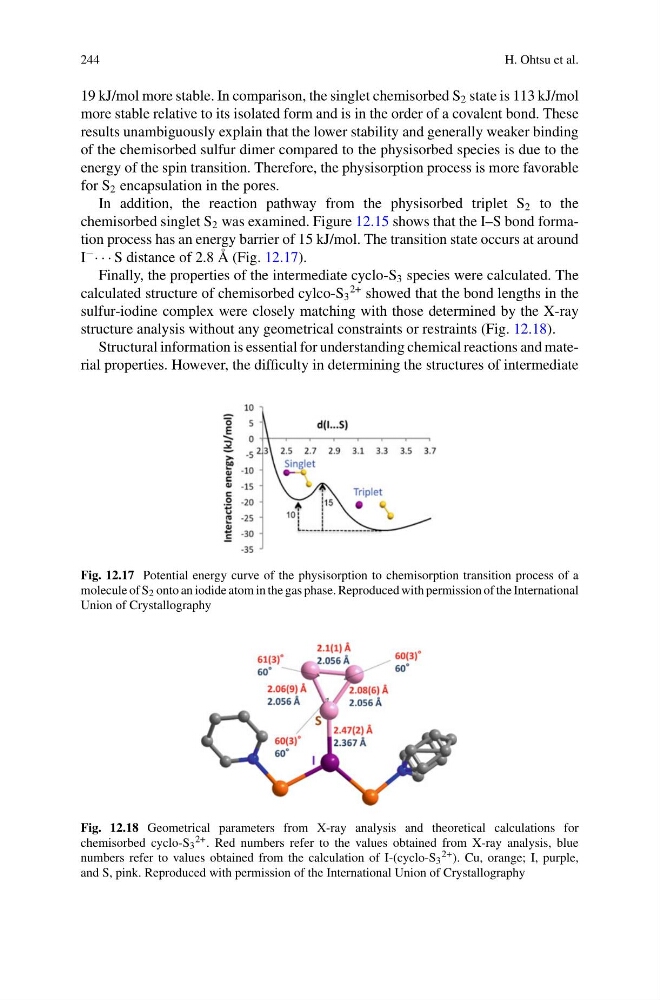
chemisorbed singlet S 2 was examined. Figure 12.15 shows that the I–S bond formation process has an energy barrier of 15 kJ/mol. The transition state occurs at around
I
−
· · · S distance of 2.8 Å (Fig. 12.17).
Finally, the properties of the intermediate cyclo-S 3 species were calculated. The
calculated structure of chemisorbed cylco-S 3
2+ showed that the bond lengths in the
sulfur-iodine complex were closely matching with those determined by the X-ray
structure analysis without any geometrical constraints or restraints (Fig. 12.18).
Structural information is essential for understanding chemical reactions and material properties. However, the difficulty in determining the structures of intermediate
Fig. 12.17 Potential energy curve of the physisorption to chemisorption transition process of a
molecule of S 2 onto an iodide atom in the gas phase. Reproduced with permission of the International
Union of Crystallography
Fig. 12.18 Geometrical parameters from X-ray analysis and theoretical calculations for
chemisorbed cyclo-S 3
2+ . Red numbers refer to the values obtained from X-ray analysis, blue
numbers refer to values obtained from the calculation of I-(cyclo-S 3
2+ ). Cu, orange; I, purple,
and S, pink. Reproduced with permission of the International Union of Crystallography
H. Ohtsu et al.
19 kJ/mol more stable. In comparison, the singlet chemisorbed S 2 state is 113 kJ/mol
more stable relative to its isolated form and is in the order of a covalent bond. These
results unambiguously explain that the lower stability and generally weaker binding
of the chemisorbed sulfur dimer compared to the physisorbed species is due to the
energy of the spin transition. Therefore, the physisorption process is more favorable
for S 2 encapsulation in the pores.
In addition, the reaction pathway from the physisorbed triplet S 2 to the
chemisorbed singlet S 2 was examined. Figure 12.15 shows that the I–S bond formation process has an energy barrier of 15 kJ/mol. The transition state occurs at around
I
−
· · · S distance of 2.8 Å (Fig. 12.17).
Finally, the properties of the intermediate cyclo-S 3 species were calculated. The
calculated structure of chemisorbed cylco-S 3
2+ showed that the bond lengths in the
sulfur-iodine complex were closely matching with those determined by the X-ray
structure analysis without any geometrical constraints or restraints (Fig. 12.18).
Structural information is essential for understanding chemical reactions and material properties. However, the difficulty in determining the structures of intermediate
Fig. 12.17 Potential energy curve of the physisorption to chemisorption transition process of a
molecule of S 2 onto an iodide atom in the gas phase. Reproduced with permission of the International
Union of Crystallography
Fig. 12.18 Geometrical parameters from X-ray analysis and theoretical calculations for
chemisorbed cyclo-S 3
2+ . Red numbers refer to the values obtained from X-ray analysis, blue
numbers refer to values obtained from the calculation of I-(cyclo-S 3
2+ ). Cu, orange; I, purple,
and S, pink. Reproduced with permission of the International Union of Crystallography