

12 Kinetic Assembly of Porous Coordination Networks …
243
Table 12.1 Stability and key structural parameters for the optimized I − ···S 2 complex in the triplet
and singlet spin states
I − ···S 2
Spin
Triplet
Singlet
Nature
Physisorption
Chemisorption
d(I–S) in Å
3.317
2.602
Wiberg I–S bond order
0.1943
0.9293
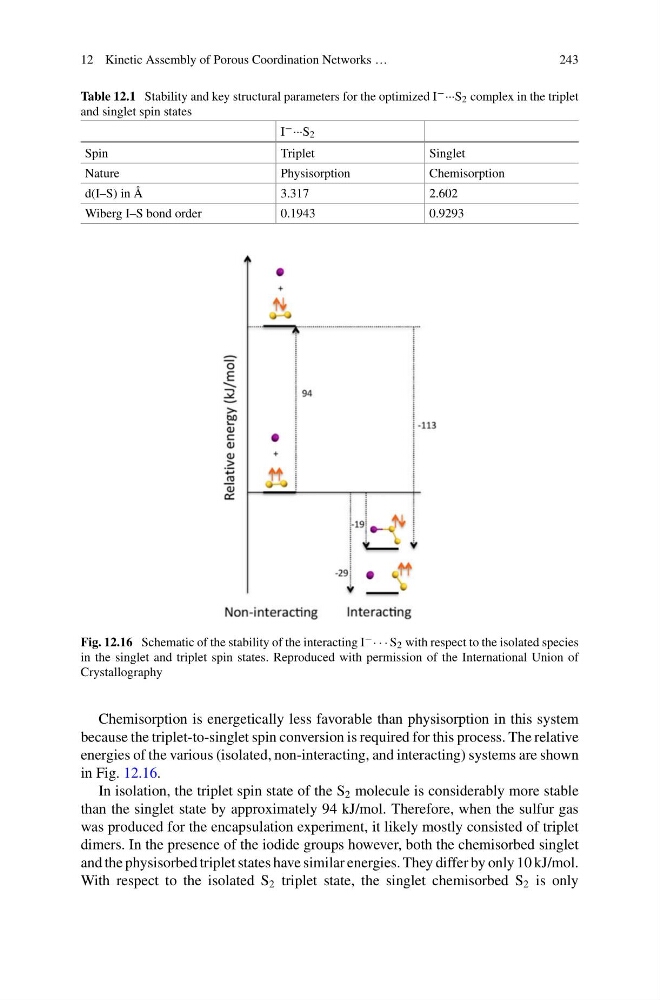
Fig. 12.16 Schematic of the stability of the interacting I − · · · S 2 with respect to the isolated species
in the singlet and triplet spin states. Reproduced with permission of the International Union of
Crystallography
Chemisorption is energetically less favorable than physisorption in this system
because the triplet-to-singlet spin conversion is required for this process. The relative
energies of the various (isolated, non-interacting, and interacting) systems are shown
in Fig. 12.16.
In isolation, the triplet spin state of the S 2 molecule is considerably more stable
than the singlet state by approximately 94 kJ/mol. Therefore, when the sulfur gas
was produced for the encapsulation experiment, it likely mostly consisted of triplet
dimers. In the presence of the iodide groups however, both the chemisorbed singlet
and the physisorbed triplet states have similar energies. They differ by only 10 kJ/mol.
With respect to the isolated S 2 triplet state, the singlet chemisorbed S 2 is only
243
Table 12.1 Stability and key structural parameters for the optimized I − ···S 2 complex in the triplet
and singlet spin states
I − ···S 2
Spin
Triplet
Singlet
Nature
Physisorption
Chemisorption
d(I–S) in Å
3.317
2.602
Wiberg I–S bond order
0.1943
0.9293
Fig. 12.16 Schematic of the stability of the interacting I − · · · S 2 with respect to the isolated species
in the singlet and triplet spin states. Reproduced with permission of the International Union of
Crystallography
Chemisorption is energetically less favorable than physisorption in this system
because the triplet-to-singlet spin conversion is required for this process. The relative
energies of the various (isolated, non-interacting, and interacting) systems are shown
in Fig. 12.16.
In isolation, the triplet spin state of the S 2 molecule is considerably more stable
than the singlet state by approximately 94 kJ/mol. Therefore, when the sulfur gas
was produced for the encapsulation experiment, it likely mostly consisted of triplet
dimers. In the presence of the iodide groups however, both the chemisorbed singlet
and the physisorbed triplet states have similar energies. They differ by only 10 kJ/mol.
With respect to the isolated S 2 triplet state, the singlet chemisorbed S 2 is only