

204
I. Hisaki et al.
11.2.1.1 Phenylene Triangle (PhT)
As described above, the PhT motif is a key structure for H-HexNet-based layered
HOFs. To confirm whether the PhT is a robust H-bonding motif in crystals, o-bis(4carboxyphenyl)benzene (8a), 4,5-dibromo-1,2-bis(4-carboxyphenyl)benzene (8b),
and 1,2,3,4-tetrakis(4-carboxyphenyl)benzene (9) were crystallized from a mixed
solution of DMF, 1,2,4-trichlorobenzene (124TCB) and 1,3,5-trichlorobenzene
(135TCB) at 50 °C. Pristine 8a yields zigzag-shaped 1D H-bonded chain as in
the case of the corresponding meta- and para-substituted derivatives. Brominated
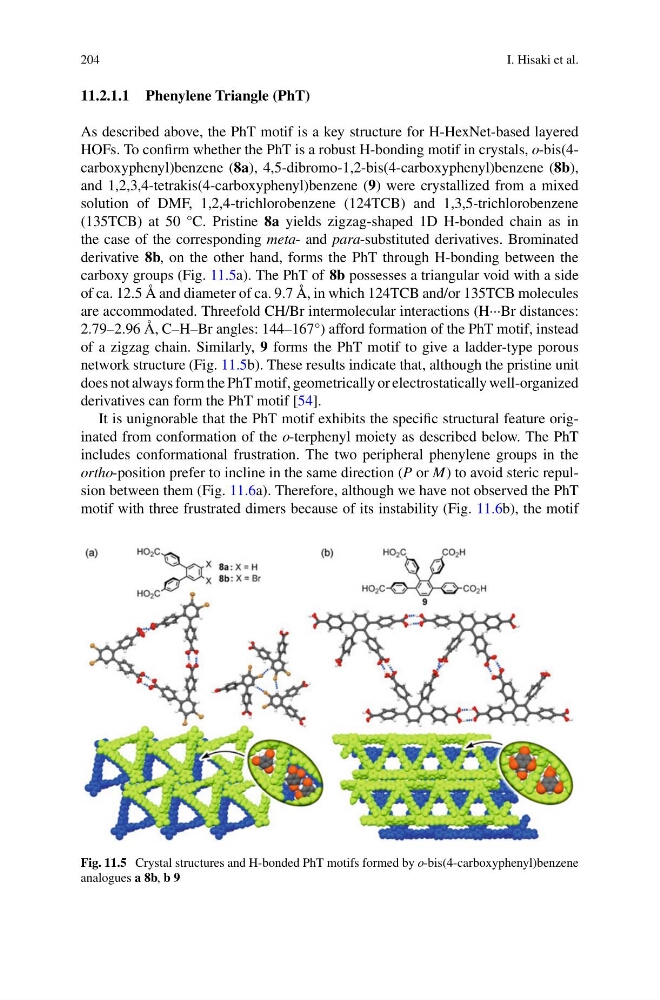
derivative 8b, on the other hand, forms the PhT through H-bonding between the
carboxy groups (Fig. 11.5a). The PhT of 8b possesses a triangular void with a side
of ca. 12.5 Å and diameter of ca. 9.7 Å, in which 124TCB and/or 135TCB molecules
are accommodated. Threefold CH/Br intermolecular interactions (H···Br distances:
2.79–2.96 Å, C–H–Br angles: 144–167°) afford formation of the PhT motif, instead
of a zigzag chain. Similarly, 9 forms the PhT motif to give a ladder-type porous
network structure (Fig. 11.5b). These results indicate that, although the pristine unit
does not always form the PhT motif, geometrically or electrostatically well-organized
derivatives can form the PhT motif [54].
It is unignorable that the PhT motif exhibits the specific structural feature originated from conformation of the o-terphenyl moiety as described below. The PhT
includes conformational frustration. The two peripheral phenylene groups in the
ortho-position prefer to incline in the same direction (P or M) to avoid steric repulsion between them (Fig. 11.6a). Therefore, although we have not observed the PhT
motif with three frustrated dimers because of its instability (Fig. 11.6b), the motif
Fig. 11.5 Crystal structures and H-bonded PhT motifs formed by o-bis(4-carboxyphenyl)benzene
analogues a 8b, b 9
I. Hisaki et al.
11.2.1.1 Phenylene Triangle (PhT)
As described above, the PhT motif is a key structure for H-HexNet-based layered
HOFs. To confirm whether the PhT is a robust H-bonding motif in crystals, o-bis(4carboxyphenyl)benzene (8a), 4,5-dibromo-1,2-bis(4-carboxyphenyl)benzene (8b),
and 1,2,3,4-tetrakis(4-carboxyphenyl)benzene (9) were crystallized from a mixed
solution of DMF, 1,2,4-trichlorobenzene (124TCB) and 1,3,5-trichlorobenzene
(135TCB) at 50 °C. Pristine 8a yields zigzag-shaped 1D H-bonded chain as in
the case of the corresponding meta- and para-substituted derivatives. Brominated
derivative 8b, on the other hand, forms the PhT through H-bonding between the
carboxy groups (Fig. 11.5a). The PhT of 8b possesses a triangular void with a side
of ca. 12.5 Å and diameter of ca. 9.7 Å, in which 124TCB and/or 135TCB molecules
are accommodated. Threefold CH/Br intermolecular interactions (H···Br distances:
2.79–2.96 Å, C–H–Br angles: 144–167°) afford formation of the PhT motif, instead
of a zigzag chain. Similarly, 9 forms the PhT motif to give a ladder-type porous
network structure (Fig. 11.5b). These results indicate that, although the pristine unit
does not always form the PhT motif, geometrically or electrostatically well-organized
derivatives can form the PhT motif [54].
It is unignorable that the PhT motif exhibits the specific structural feature originated from conformation of the o-terphenyl moiety as described below. The PhT
includes conformational frustration. The two peripheral phenylene groups in the
ortho-position prefer to incline in the same direction (P or M) to avoid steric repulsion between them (Fig. 11.6a). Therefore, although we have not observed the PhT
motif with three frustrated dimers because of its instability (Fig. 11.6b), the motif
Fig. 11.5 Crystal structures and H-bonded PhT motifs formed by o-bis(4-carboxyphenyl)benzene
analogues a 8b, b 9