

202
I. Hisaki et al.
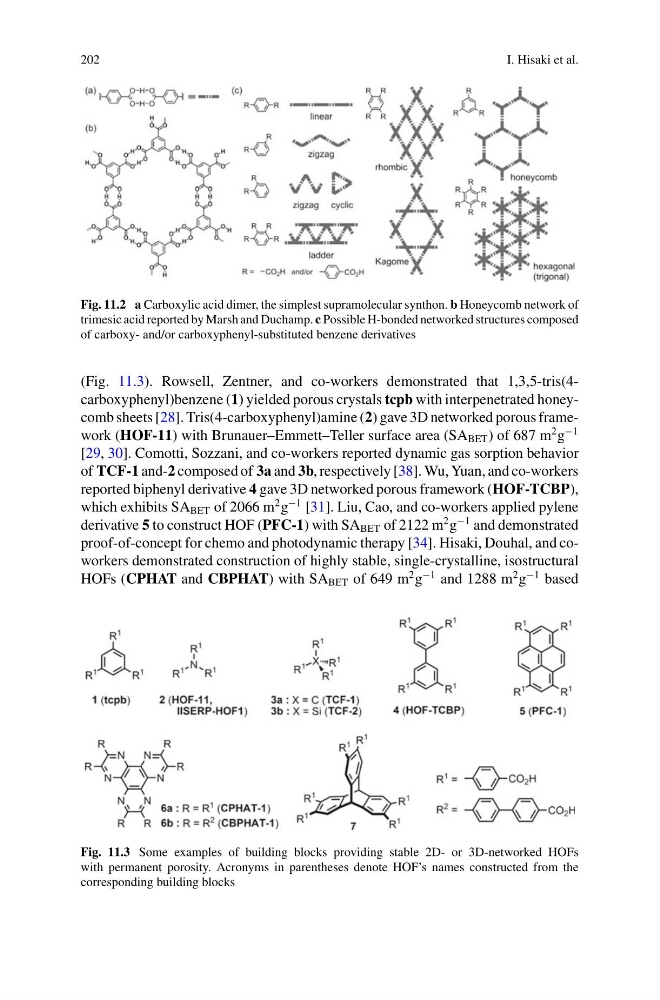
Fig. 11.2 a Carboxylic acid dimer, the simplest supramolecular synthon. b Honeycomb network of
trimesic acid reported by Marsh and Duchamp. c Possible H-bonded networked structures composed
of carboxy- and/or carboxyphenyl-substituted benzene derivatives
(Fig. 11.3). Rowsell, Zentner, and co-workers demonstrated that 1,3,5-tris(4carboxyphenyl)benzene (1) yielded porous crystals tcpb with interpenetrated honeycomb sheets [28]. Tris(4-carboxyphenyl)amine (2) gave 3D networked porous framework (HOF-11) with Brunauer–Emmett–Teller surface area (SA BET ) of 687 m
2 g
−1
[29, 30]. Comotti, Sozzani, and co-workers reported dynamic gas sorption behavior
of TCF-1 and-2 composed of 3a and 3b, respectively [38]. Wu, Yuan, and co-workers
reported biphenyl derivative 4 gave 3D networked porous framework (HOF-TCBP),
which exhibits SA BET of 2066 m
2 g
−1 [31]. Liu, Cao, and co-workers applied pylene
derivative 5 to construct HOF (PFC-1) with SA BET of 2122 m
2 g
−1 and demonstrated
proof-of-concept for chemo and photodynamic therapy [34]. Hisaki, Douhal, and coworkers demonstrated construction of highly stable, single-crystalline, isostructural
HOFs (CPHAT and CBPHAT) with SA BET of 649 m
2 g
−1 and 1288 m
2 g
−1 based
Fig. 11.3 Some examples of building blocks providing stable 2D- or 3D-networked HOFs
with permanent porosity. Acronyms in parentheses denote HOF’s names constructed from the
corresponding building blocks
I. Hisaki et al.
Fig. 11.2 a Carboxylic acid dimer, the simplest supramolecular synthon. b Honeycomb network of
trimesic acid reported by Marsh and Duchamp. c Possible H-bonded networked structures composed
of carboxy- and/or carboxyphenyl-substituted benzene derivatives
(Fig. 11.3). Rowsell, Zentner, and co-workers demonstrated that 1,3,5-tris(4carboxyphenyl)benzene (1) yielded porous crystals tcpb with interpenetrated honeycomb sheets [28]. Tris(4-carboxyphenyl)amine (2) gave 3D networked porous framework (HOF-11) with Brunauer–Emmett–Teller surface area (SA BET ) of 687 m
2 g
−1
[29, 30]. Comotti, Sozzani, and co-workers reported dynamic gas sorption behavior
of TCF-1 and-2 composed of 3a and 3b, respectively [38]. Wu, Yuan, and co-workers
reported biphenyl derivative 4 gave 3D networked porous framework (HOF-TCBP),
which exhibits SA BET of 2066 m
2 g
−1 [31]. Liu, Cao, and co-workers applied pylene
derivative 5 to construct HOF (PFC-1) with SA BET of 2122 m
2 g
−1 and demonstrated
proof-of-concept for chemo and photodynamic therapy [34]. Hisaki, Douhal, and coworkers demonstrated construction of highly stable, single-crystalline, isostructural
HOFs (CPHAT and CBPHAT) with SA BET of 649 m
2 g
−1 and 1288 m
2 g
−1 based
Fig. 11.3 Some examples of building blocks providing stable 2D- or 3D-networked HOFs
with permanent porosity. Acronyms in parentheses denote HOF’s names constructed from the
corresponding building blocks