

11 Layered Hydrogen-Bonded Organic …
201
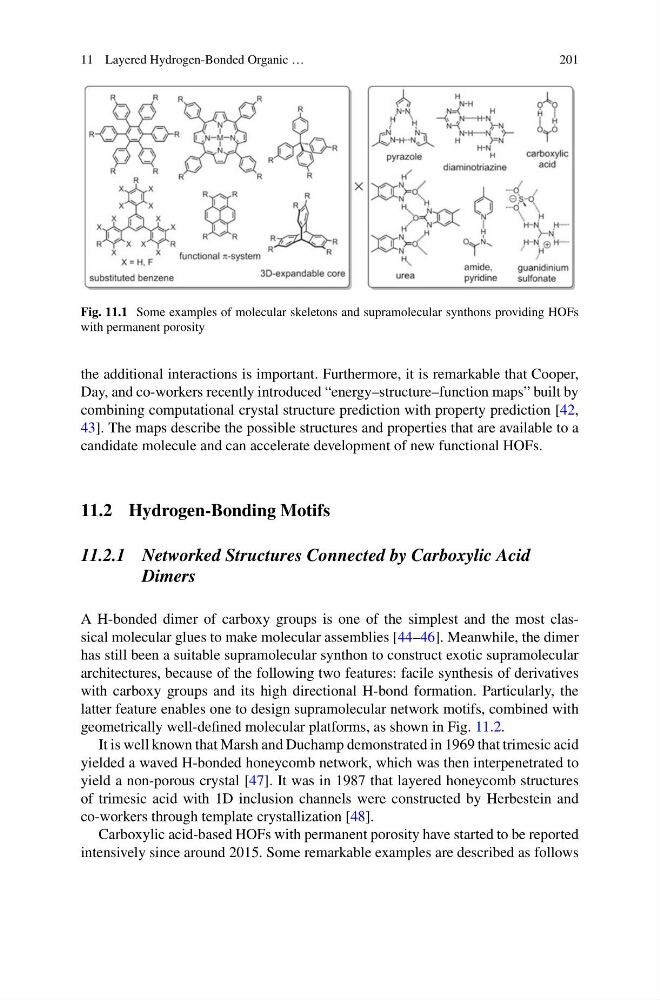
Fig. 11.1 Some examples of molecular skeletons and supramolecular synthons providing HOFs
with permanent porosity
the additional interactions is important. Furthermore, it is remarkable that Cooper,
Day, and co-workers recently introduced “energy–structure–function maps” built by
combining computational crystal structure prediction with property prediction [42,
43]. The maps describe the possible structures and properties that are available to a
candidate molecule and can accelerate development of new functional HOFs.
11.2 Hydrogen-Bonding Motifs
11.2.1 Networked Structures Connected by Carboxylic Acid
Dimers
A H-bonded dimer of carboxy groups is one of the simplest and the most classical molecular glues to make molecular assemblies [44–46]. Meanwhile, the dimer
has still been a suitable supramolecular synthon to construct exotic supramolecular
architectures, because of the following two features: facile synthesis of derivatives
with carboxy groups and its high directional H-bond formation. Particularly, the
latter feature enables one to design supramolecular network motifs, combined with
geometrically well-defined molecular platforms, as shown in Fig. 11.2.
It is well known that Marsh and Duchamp demonstrated in 1969 that trimesic acid
yielded a waved H-bonded honeycomb network, which was then interpenetrated to
yield a non-porous crystal [47]. It was in 1987 that layered honeycomb structures
of trimesic acid with 1D inclusion channels were constructed by Herbestein and
co-workers through template crystallization [48].
Carboxylic acid-based HOFs with permanent porosity have started to be reported
intensively since around 2015. Some remarkable examples are described as follows
201
Fig. 11.1 Some examples of molecular skeletons and supramolecular synthons providing HOFs
with permanent porosity
the additional interactions is important. Furthermore, it is remarkable that Cooper,
Day, and co-workers recently introduced “energy–structure–function maps” built by
combining computational crystal structure prediction with property prediction [42,
43]. The maps describe the possible structures and properties that are available to a
candidate molecule and can accelerate development of new functional HOFs.
11.2 Hydrogen-Bonding Motifs
11.2.1 Networked Structures Connected by Carboxylic Acid
Dimers
A H-bonded dimer of carboxy groups is one of the simplest and the most classical molecular glues to make molecular assemblies [44–46]. Meanwhile, the dimer
has still been a suitable supramolecular synthon to construct exotic supramolecular
architectures, because of the following two features: facile synthesis of derivatives
with carboxy groups and its high directional H-bond formation. Particularly, the
latter feature enables one to design supramolecular network motifs, combined with
geometrically well-defined molecular platforms, as shown in Fig. 11.2.
It is well known that Marsh and Duchamp demonstrated in 1969 that trimesic acid
yielded a waved H-bonded honeycomb network, which was then interpenetrated to
yield a non-porous crystal [47]. It was in 1987 that layered honeycomb structures
of trimesic acid with 1D inclusion channels were constructed by Herbestein and
co-workers through template crystallization [48].
Carboxylic acid-based HOFs with permanent porosity have started to be reported
intensively since around 2015. Some remarkable examples are described as follows