

10 The Design of Porous Organic Salts with Hierarchical Process
195
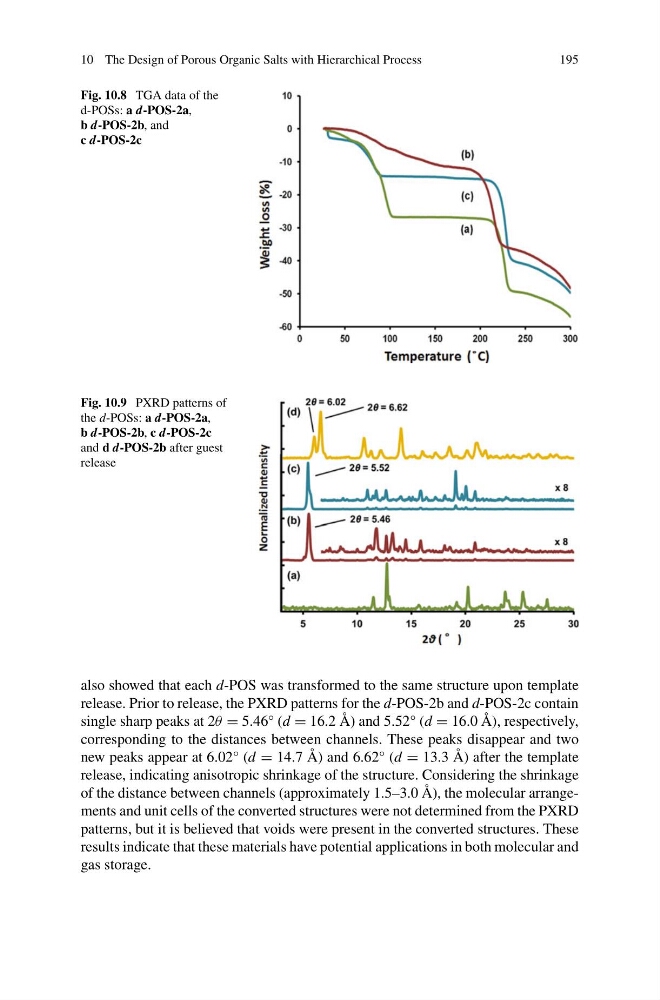
Fig. 10.8 TGA data of the
d-POSs: a d-POS-2a,
b d-POS-2b, and
c d-POS-2c
Fig. 10.9 PXRD patterns of
the d-POSs: a d-POS-2a,
b d-POS-2b, c d-POS-2c
and d d-POS-2b after guest
release
also showed that each d-POS was transformed to the same structure upon template
release. Prior to release, the PXRD patterns for the d-POS-2b and d-POS-2c contain
single sharp peaks at 2θ = 5.46° (d = 16.2 Å) and 5.52° (d = 16.0 Å), respectively,
corresponding to the distances between channels. These peaks disappear and two
new peaks appear at 6.02° (d = 14.7 Å) and 6.62° (d = 13.3 Å) after the template
release, indicating anisotropic shrinkage of the structure. Considering the shrinkage
of the distance between channels (approximately 1.5–3.0 Å), the molecular arrangements and unit cells of the converted structures were not determined from the PXRD
patterns, but it is believed that voids were present in the converted structures. These
results indicate that these materials have potential applications in both molecular and
gas storage.
195
Fig. 10.8 TGA data of the
d-POSs: a d-POS-2a,
b d-POS-2b, and
c d-POS-2c
Fig. 10.9 PXRD patterns of
the d-POSs: a d-POS-2a,
b d-POS-2b, c d-POS-2c
and d d-POS-2b after guest
release
also showed that each d-POS was transformed to the same structure upon template
release. Prior to release, the PXRD patterns for the d-POS-2b and d-POS-2c contain
single sharp peaks at 2θ = 5.46° (d = 16.2 Å) and 5.52° (d = 16.0 Å), respectively,
corresponding to the distances between channels. These peaks disappear and two
new peaks appear at 6.02° (d = 14.7 Å) and 6.62° (d = 13.3 Å) after the template
release, indicating anisotropic shrinkage of the structure. Considering the shrinkage
of the distance between channels (approximately 1.5–3.0 Å), the molecular arrangements and unit cells of the converted structures were not determined from the PXRD
patterns, but it is believed that voids were present in the converted structures. These
results indicate that these materials have potential applications in both molecular and
gas storage.