

190
N. Tohnai
group is much longer than the triphenylmethyl group, the cluster is tetrahedral and
the maximum distance between the sulfur and carbon atoms is 9.1 Å (Figs. 10.1b
and 10.2c). The maximum distance between the adjacent sides of the tetrahedral
cluster in this structure is approximately 26 Å. Subsequently, the anthracenyl groups
undergo π-π stacking and serve as linkers to arrange the clusters into a diamondoid
network (Fig. 10.2c) in which the average distance between the aromatic moieties
is 3.384 Å (Fig. 10.3b). This network contains very large voids associated with
35 × 36 Å hexagonal windows and three independent diamondoid networks penetrate one another to fill such voids. Nevertheless, the interpenetrating structure still
possesses one-dimensional (1D) voids containing TCB molecules from the recrystallization solvent that act as template molecules (Fig. 10.2c, a, right). The bulkiness of the supramolecular clusters at the tetrahedral nodes plays an important role
in creating the voids, and the diameter of the spherical core covered with triphenylmethyl groups in the clusters is approximately 16 Å. This bulkiness leads to
significant steric hindrance between the nodes that prevents the formation of highly
interpenetrating structures and inhibits complete filling of the voids (Fig. 10.3c).
Calculations using the PLATON/VOID software package established that the void
volume was 30% [16], the maximum void area was 10.7 × 10.7 Å, and the minimum
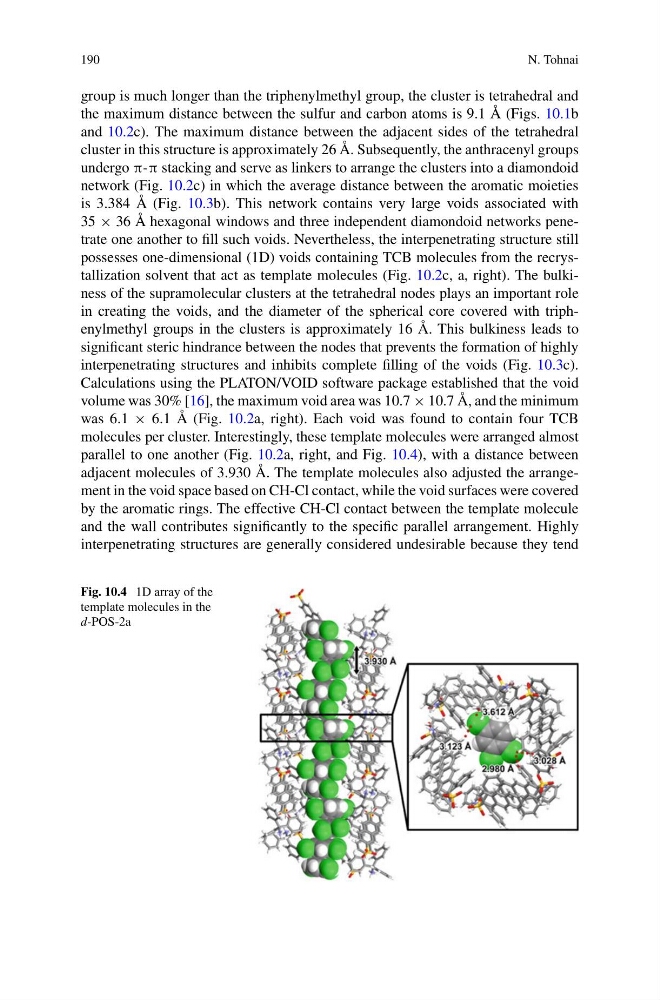
was 6.1 × 6.1 Å (Fig. 10.2a, right). Each void was found to contain four TCB
molecules per cluster. Interestingly, these template molecules were arranged almost
parallel to one another (Fig. 10.2a, right, and Fig. 10.4), with a distance between
adjacent molecules of 3.930 Å. The template molecules also adjusted the arrangement in the void space based on CH-Cl contact, while the void surfaces were covered
by the aromatic rings. The effective CH-Cl contact between the template molecule
and the wall contributes significantly to the specific parallel arrangement. Highly
interpenetrating structures are generally considered undesirable because they tend
Fig. 10.4 1D array of the
template molecules in the
d-POS-2a
N. Tohnai
group is much longer than the triphenylmethyl group, the cluster is tetrahedral and
the maximum distance between the sulfur and carbon atoms is 9.1 Å (Figs. 10.1b
and 10.2c). The maximum distance between the adjacent sides of the tetrahedral
cluster in this structure is approximately 26 Å. Subsequently, the anthracenyl groups
undergo π-π stacking and serve as linkers to arrange the clusters into a diamondoid
network (Fig. 10.2c) in which the average distance between the aromatic moieties
is 3.384 Å (Fig. 10.3b). This network contains very large voids associated with
35 × 36 Å hexagonal windows and three independent diamondoid networks penetrate one another to fill such voids. Nevertheless, the interpenetrating structure still
possesses one-dimensional (1D) voids containing TCB molecules from the recrystallization solvent that act as template molecules (Fig. 10.2c, a, right). The bulkiness of the supramolecular clusters at the tetrahedral nodes plays an important role
in creating the voids, and the diameter of the spherical core covered with triphenylmethyl groups in the clusters is approximately 16 Å. This bulkiness leads to
significant steric hindrance between the nodes that prevents the formation of highly
interpenetrating structures and inhibits complete filling of the voids (Fig. 10.3c).
Calculations using the PLATON/VOID software package established that the void
volume was 30% [16], the maximum void area was 10.7 × 10.7 Å, and the minimum
was 6.1 × 6.1 Å (Fig. 10.2a, right). Each void was found to contain four TCB
molecules per cluster. Interestingly, these template molecules were arranged almost
parallel to one another (Fig. 10.2a, right, and Fig. 10.4), with a distance between
adjacent molecules of 3.930 Å. The template molecules also adjusted the arrangement in the void space based on CH-Cl contact, while the void surfaces were covered
by the aromatic rings. The effective CH-Cl contact between the template molecule
and the wall contributes significantly to the specific parallel arrangement. Highly
interpenetrating structures are generally considered undesirable because they tend
Fig. 10.4 1D array of the
template molecules in the
d-POS-2a