

158
O. D. Putra and H. Uekusa
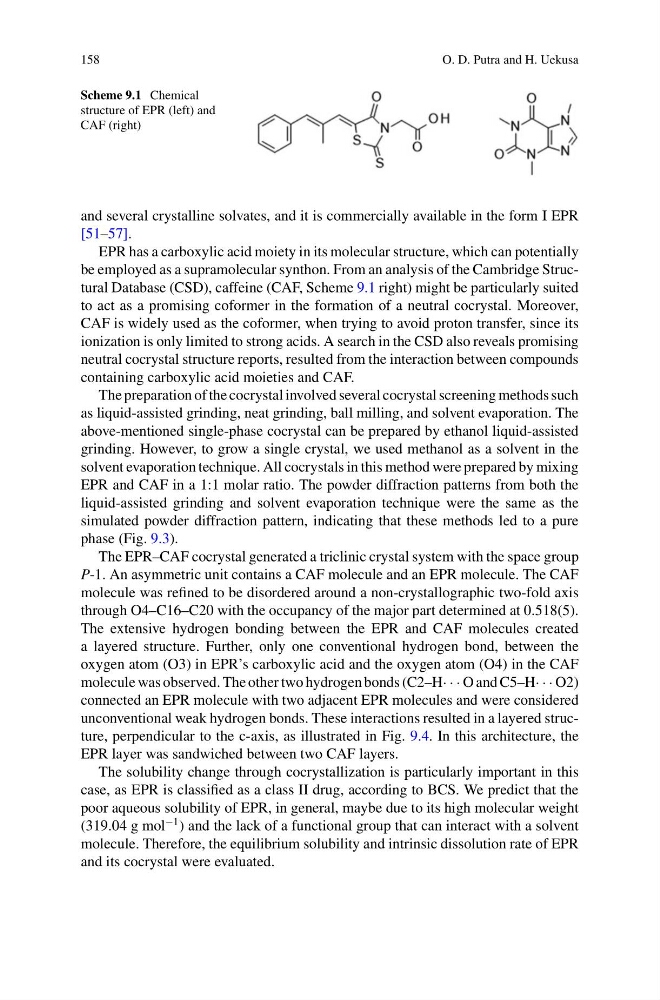
Scheme 9.1 Chemical
structure of EPR (left) and
CAF (right)
and several crystalline solvates, and it is commercially available in the form I EPR
[51–57].
EPR has a carboxylic acid moiety in its molecular structure, which can potentially
be employed as a supramolecular synthon. From an analysis of the Cambridge Structural Database (CSD), caffeine (CAF, Scheme 9.1 right) might be particularly suited
to act as a promising coformer in the formation of a neutral cocrystal. Moreover,
CAF is widely used as the coformer, when trying to avoid proton transfer, since its
ionization is only limited to strong acids. A search in the CSD also reveals promising
neutral cocrystal structure reports, resulted from the interaction between compounds
containing carboxylic acid moieties and CAF.
The preparation of the cocrystal involved several cocrystal screening methods such
as liquid-assisted grinding, neat grinding, ball milling, and solvent evaporation. The
above-mentioned single-phase cocrystal can be prepared by ethanol liquid-assisted
grinding. However, to grow a single crystal, we used methanol as a solvent in the
solvent evaporation technique. All cocrystals in this method were prepared by mixing
EPR and CAF in a 1:1 molar ratio. The powder diffraction patterns from both the
liquid-assisted grinding and solvent evaporation technique were the same as the
simulated powder diffraction pattern, indicating that these methods led to a pure
phase (Fig. 9.3).
The EPR–CAF cocrystal generated a triclinic crystal system with the space group
P-1. An asymmetric unit contains a CAF molecule and an EPR molecule. The CAF
molecule was refined to be disordered around a non-crystallographic two-fold axis
through O4–C16–C20 with the occupancy of the major part determined at 0.518(5).
The extensive hydrogen bonding between the EPR and CAF molecules created
a layered structure. Further, only one conventional hydrogen bond, between the
oxygen atom (O3) in EPR’s carboxylic acid and the oxygen atom (O4) in the CAF
molecule was observed. The other two hydrogen bonds (C2–H· · · O and C5–H· · · O2)
connected an EPR molecule with two adjacent EPR molecules and were considered
unconventional weak hydrogen bonds. These interactions resulted in a layered structure, perpendicular to the c-axis, as illustrated in Fig. 9.4. In this architecture, the
EPR layer was sandwiched between two CAF layers.
The solubility change through cocrystallization is particularly important in this
case, as EPR is classified as a class II drug, according to BCS. We predict that the
poor aqueous solubility of EPR, in general, maybe due to its high molecular weight
(319.04 g mol
−1 ) and the lack of a functional group that can interact with a solvent
molecule. Therefore, the equilibrium solubility and intrinsic dissolution rate of EPR
and its cocrystal were evaluated.
O. D. Putra and H. Uekusa
Scheme 9.1 Chemical
structure of EPR (left) and
CAF (right)
and several crystalline solvates, and it is commercially available in the form I EPR
[51–57].
EPR has a carboxylic acid moiety in its molecular structure, which can potentially
be employed as a supramolecular synthon. From an analysis of the Cambridge Structural Database (CSD), caffeine (CAF, Scheme 9.1 right) might be particularly suited
to act as a promising coformer in the formation of a neutral cocrystal. Moreover,
CAF is widely used as the coformer, when trying to avoid proton transfer, since its
ionization is only limited to strong acids. A search in the CSD also reveals promising
neutral cocrystal structure reports, resulted from the interaction between compounds
containing carboxylic acid moieties and CAF.
The preparation of the cocrystal involved several cocrystal screening methods such
as liquid-assisted grinding, neat grinding, ball milling, and solvent evaporation. The
above-mentioned single-phase cocrystal can be prepared by ethanol liquid-assisted
grinding. However, to grow a single crystal, we used methanol as a solvent in the
solvent evaporation technique. All cocrystals in this method were prepared by mixing
EPR and CAF in a 1:1 molar ratio. The powder diffraction patterns from both the
liquid-assisted grinding and solvent evaporation technique were the same as the
simulated powder diffraction pattern, indicating that these methods led to a pure
phase (Fig. 9.3).
The EPR–CAF cocrystal generated a triclinic crystal system with the space group
P-1. An asymmetric unit contains a CAF molecule and an EPR molecule. The CAF
molecule was refined to be disordered around a non-crystallographic two-fold axis
through O4–C16–C20 with the occupancy of the major part determined at 0.518(5).
The extensive hydrogen bonding between the EPR and CAF molecules created
a layered structure. Further, only one conventional hydrogen bond, between the
oxygen atom (O3) in EPR’s carboxylic acid and the oxygen atom (O4) in the CAF
molecule was observed. The other two hydrogen bonds (C2–H· · · O and C5–H· · · O2)
connected an EPR molecule with two adjacent EPR molecules and were considered
unconventional weak hydrogen bonds. These interactions resulted in a layered structure, perpendicular to the c-axis, as illustrated in Fig. 9.4. In this architecture, the
EPR layer was sandwiched between two CAF layers.
The solubility change through cocrystallization is particularly important in this
case, as EPR is classified as a class II drug, according to BCS. We predict that the
poor aqueous solubility of EPR, in general, maybe due to its high molecular weight
(319.04 g mol
−1 ) and the lack of a functional group that can interact with a solvent
molecule. Therefore, the equilibrium solubility and intrinsic dissolution rate of EPR
and its cocrystal were evaluated.