

9 Pharmaceutical Multicomponent Crystals: Structure, Design …
157
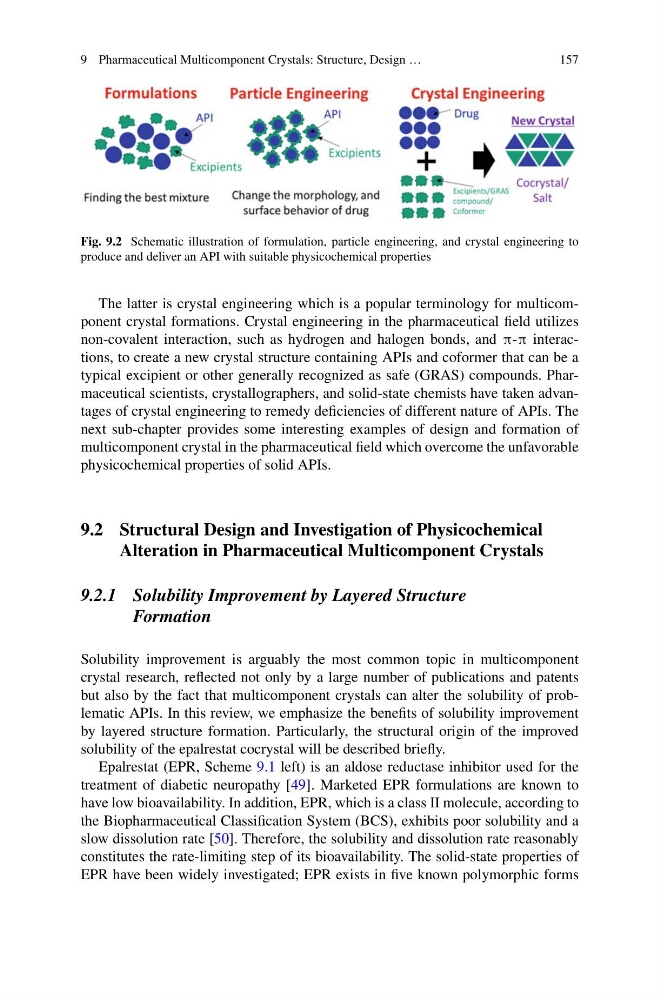
Fig. 9.2 Schematic illustration of formulation, particle engineering, and crystal engineering to
produce and deliver an API with suitable physicochemical properties
The latter is crystal engineering which is a popular terminology for multicomponent crystal formations. Crystal engineering in the pharmaceutical field utilizes
non-covalent interaction, such as hydrogen and halogen bonds, and π-π interactions, to create a new crystal structure containing APIs and coformer that can be a
typical excipient or other generally recognized as safe (GRAS) compounds. Pharmaceutical scientists, crystallographers, and solid-state chemists have taken advantages of crystal engineering to remedy deficiencies of different nature of APIs. The
next sub-chapter provides some interesting examples of design and formation of
multicomponent crystal in the pharmaceutical field which overcome the unfavorable
physicochemical properties of solid APIs.
9.2 Structural Design and Investigation of Physicochemical
Alteration in Pharmaceutical Multicomponent Crystals
9.2.1 Solubility Improvement by Layered Structure
Formation
Solubility improvement is arguably the most common topic in multicomponent
crystal research, reflected not only by a large number of publications and patents
but also by the fact that multicomponent crystals can alter the solubility of problematic APIs. In this review, we emphasize the benefits of solubility improvement
by layered structure formation. Particularly, the structural origin of the improved
solubility of the epalrestat cocrystal will be described briefly.
Epalrestat (EPR, Scheme 9.1 left) is an aldose reductase inhibitor used for the
treatment of diabetic neuropathy [49]. Marketed EPR formulations are known to
have low bioavailability. In addition, EPR, which is a class II molecule, according to
the Biopharmaceutical Classification System (BCS), exhibits poor solubility and a
slow dissolution rate [50]. Therefore, the solubility and dissolution rate reasonably
constitutes the rate-limiting step of its bioavailability. The solid-state properties of
EPR have been widely investigated; EPR exists in five known polymorphic forms
157
Fig. 9.2 Schematic illustration of formulation, particle engineering, and crystal engineering to
produce and deliver an API with suitable physicochemical properties
The latter is crystal engineering which is a popular terminology for multicomponent crystal formations. Crystal engineering in the pharmaceutical field utilizes
non-covalent interaction, such as hydrogen and halogen bonds, and π-π interactions, to create a new crystal structure containing APIs and coformer that can be a
typical excipient or other generally recognized as safe (GRAS) compounds. Pharmaceutical scientists, crystallographers, and solid-state chemists have taken advantages of crystal engineering to remedy deficiencies of different nature of APIs. The
next sub-chapter provides some interesting examples of design and formation of
multicomponent crystal in the pharmaceutical field which overcome the unfavorable
physicochemical properties of solid APIs.
9.2 Structural Design and Investigation of Physicochemical
Alteration in Pharmaceutical Multicomponent Crystals
9.2.1 Solubility Improvement by Layered Structure
Formation
Solubility improvement is arguably the most common topic in multicomponent
crystal research, reflected not only by a large number of publications and patents
but also by the fact that multicomponent crystals can alter the solubility of problematic APIs. In this review, we emphasize the benefits of solubility improvement
by layered structure formation. Particularly, the structural origin of the improved
solubility of the epalrestat cocrystal will be described briefly.
Epalrestat (EPR, Scheme 9.1 left) is an aldose reductase inhibitor used for the
treatment of diabetic neuropathy [49]. Marketed EPR formulations are known to
have low bioavailability. In addition, EPR, which is a class II molecule, according to
the Biopharmaceutical Classification System (BCS), exhibits poor solubility and a
slow dissolution rate [50]. Therefore, the solubility and dissolution rate reasonably
constitutes the rate-limiting step of its bioavailability. The solid-state properties of
EPR have been widely investigated; EPR exists in five known polymorphic forms