

8 Relationship Between Atomic Contact and Intermolecular …
149
about −0.5 kcal/mol [11]. On the other hand, a number of carbon atoms interact at
distances close to the sum of the van der Waals radii in the crystals of polycyclic
aromatic molecules and saturated hydrocarbon molecules (Fig. 8.9b), so that the
strong dispersion interactions exist between adjacent molecules. In this case, the
attractive interaction between each atom pair is weak, so the attractive interaction
can be balanced with exchange-repulsion even when the atoms do not contact at
short distance less than the sum of the van der Waals radii. For this reason, no short
atom–atom contact is observed, even if strong attraction owing to the dispersion
interactions exists between adjacent molecules.
8.9 Importance of Dispersion Interactions in Organic
Crystals
The dispersion interactions are famous as the origin of the weak attraction between
rare gas atoms. For this reason, it is often misunderstood that the dispersion interactions between organic molecules are also weak. However, the analysis of intermolecular interactions shows that the strong dispersion interactions exist between
adjacent molecules in the organic crystals. The polarizabilities of organic molecules
are significantly large compared with rare gas atoms such as neon and argon. For
this reason, the strong dispersion interactions exist between adjacent molecules in
the organic crystals.
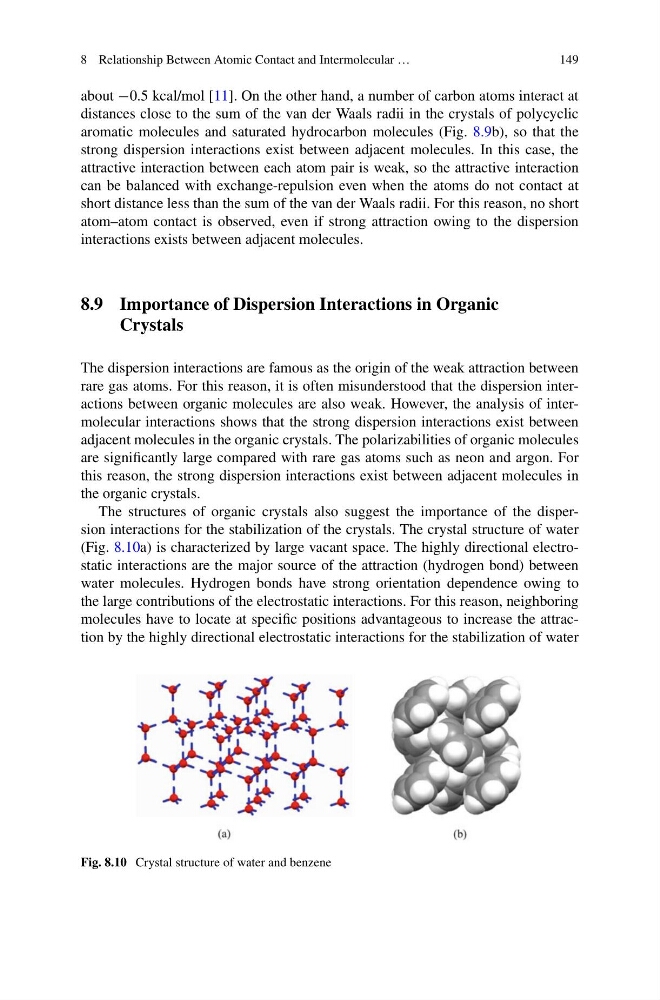
The structures of organic crystals also suggest the importance of the dispersion interactions for the stabilization of the crystals. The crystal structure of water
(Fig. 8.10a) is characterized by large vacant space. The highly directional electrostatic interactions are the major source of the attraction (hydrogen bond) between
water molecules. Hydrogen bonds have strong orientation dependence owing to
the large contributions of the electrostatic interactions. For this reason, neighboring
molecules have to locate at specific positions advantageous to increase the attraction by the highly directional electrostatic interactions for the stabilization of water
Fig. 8.10 Crystal structure of water and benzene
149
about −0.5 kcal/mol [11]. On the other hand, a number of carbon atoms interact at
distances close to the sum of the van der Waals radii in the crystals of polycyclic
aromatic molecules and saturated hydrocarbon molecules (Fig. 8.9b), so that the
strong dispersion interactions exist between adjacent molecules. In this case, the
attractive interaction between each atom pair is weak, so the attractive interaction
can be balanced with exchange-repulsion even when the atoms do not contact at
short distance less than the sum of the van der Waals radii. For this reason, no short
atom–atom contact is observed, even if strong attraction owing to the dispersion
interactions exists between adjacent molecules.
8.9 Importance of Dispersion Interactions in Organic
Crystals
The dispersion interactions are famous as the origin of the weak attraction between
rare gas atoms. For this reason, it is often misunderstood that the dispersion interactions between organic molecules are also weak. However, the analysis of intermolecular interactions shows that the strong dispersion interactions exist between
adjacent molecules in the organic crystals. The polarizabilities of organic molecules
are significantly large compared with rare gas atoms such as neon and argon. For
this reason, the strong dispersion interactions exist between adjacent molecules in
the organic crystals.
The structures of organic crystals also suggest the importance of the dispersion interactions for the stabilization of the crystals. The crystal structure of water
(Fig. 8.10a) is characterized by large vacant space. The highly directional electrostatic interactions are the major source of the attraction (hydrogen bond) between
water molecules. Hydrogen bonds have strong orientation dependence owing to
the large contributions of the electrostatic interactions. For this reason, neighboring
molecules have to locate at specific positions advantageous to increase the attraction by the highly directional electrostatic interactions for the stabilization of water
Fig. 8.10 Crystal structure of water and benzene