

148
S. Tsuzuki
between adjacent molecules without short atom–atom contact. Intermolecular interactions in crystals have been discussed mainly based on the presence or absence
of short atom–atom contacts in crystals. The short atom–atom contact is observed
mainly in the cases where single atom of one molecule is in contact with an atom or
atoms of another molecule such as the interactions of hydrogen bonds and halogen
bonds. By comparing with hydrogen bonds, we would like to discuss the reason why
short atom–atom contact is not observed between adjacent molecules even when
there exist strong dispersion interactions.
The interatomic distance between adjacent molecules is determined by the balance
between attractive and repulsive interactions acting between molecules. In hydrogen
bonds and halogen bonds, the major source of the attraction is the electrostatic
interactions, and therefore, strong attraction due to the electrostatic interactions acts
between positively charged atoms (hydrogen bond or halogen bond donor) and negatively charged atoms (hydrogen bond or halogen bond acceptor). The structure of the
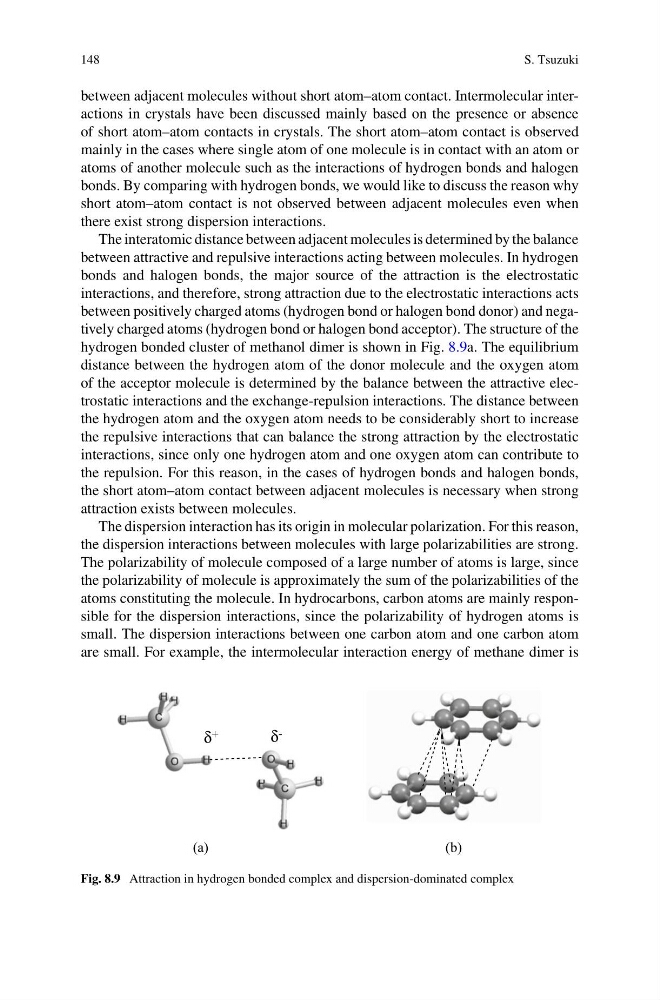
hydrogen bonded cluster of methanol dimer is shown in Fig. 8.9a. The equilibrium
distance between the hydrogen atom of the donor molecule and the oxygen atom
of the acceptor molecule is determined by the balance between the attractive electrostatic interactions and the exchange-repulsion interactions. The distance between
the hydrogen atom and the oxygen atom needs to be considerably short to increase
the repulsive interactions that can balance the strong attraction by the electrostatic
interactions, since only one hydrogen atom and one oxygen atom can contribute to
the repulsion. For this reason, in the cases of hydrogen bonds and halogen bonds,
the short atom–atom contact between adjacent molecules is necessary when strong
attraction exists between molecules.
The dispersion interaction has its origin in molecular polarization. For this reason,
the dispersion interactions between molecules with large polarizabilities are strong.
The polarizability of molecule composed of a large number of atoms is large, since
the polarizability of molecule is approximately the sum of the polarizabilities of the
atoms constituting the molecule. In hydrocarbons, carbon atoms are mainly responsible for the dispersion interactions, since the polarizability of hydrogen atoms is
small. The dispersion interactions between one carbon atom and one carbon atom
are small. For example, the intermolecular interaction energy of methane dimer is
(a)
(b)
δ +
δ -
Fig. 8.9 Attraction in hydrogen bonded complex and dispersion-dominated complex
S. Tsuzuki
between adjacent molecules without short atom–atom contact. Intermolecular interactions in crystals have been discussed mainly based on the presence or absence
of short atom–atom contacts in crystals. The short atom–atom contact is observed
mainly in the cases where single atom of one molecule is in contact with an atom or
atoms of another molecule such as the interactions of hydrogen bonds and halogen
bonds. By comparing with hydrogen bonds, we would like to discuss the reason why
short atom–atom contact is not observed between adjacent molecules even when
there exist strong dispersion interactions.
The interatomic distance between adjacent molecules is determined by the balance
between attractive and repulsive interactions acting between molecules. In hydrogen
bonds and halogen bonds, the major source of the attraction is the electrostatic
interactions, and therefore, strong attraction due to the electrostatic interactions acts
between positively charged atoms (hydrogen bond or halogen bond donor) and negatively charged atoms (hydrogen bond or halogen bond acceptor). The structure of the
hydrogen bonded cluster of methanol dimer is shown in Fig. 8.9a. The equilibrium
distance between the hydrogen atom of the donor molecule and the oxygen atom
of the acceptor molecule is determined by the balance between the attractive electrostatic interactions and the exchange-repulsion interactions. The distance between
the hydrogen atom and the oxygen atom needs to be considerably short to increase
the repulsive interactions that can balance the strong attraction by the electrostatic
interactions, since only one hydrogen atom and one oxygen atom can contribute to
the repulsion. For this reason, in the cases of hydrogen bonds and halogen bonds,
the short atom–atom contact between adjacent molecules is necessary when strong
attraction exists between molecules.
The dispersion interaction has its origin in molecular polarization. For this reason,
the dispersion interactions between molecules with large polarizabilities are strong.
The polarizability of molecule composed of a large number of atoms is large, since
the polarizability of molecule is approximately the sum of the polarizabilities of the
atoms constituting the molecule. In hydrocarbons, carbon atoms are mainly responsible for the dispersion interactions, since the polarizability of hydrogen atoms is
small. The dispersion interactions between one carbon atom and one carbon atom
are small. For example, the intermolecular interaction energy of methane dimer is
(a)
(b)
δ +
δ -
Fig. 8.9 Attraction in hydrogen bonded complex and dispersion-dominated complex