

7 Supramolecular, Hierarchical, and Energetical Interpretation …
133
C
IV
I
II
III
V
VI
C
IV
I
II
III
V
VI
IV
I
II
III
V
VI
C
IV
I
II
III
V
VI
C
IV
I
II
III
V
VI
C
C
I
II
III
IV
V
VI
b
d
f
a
c
e
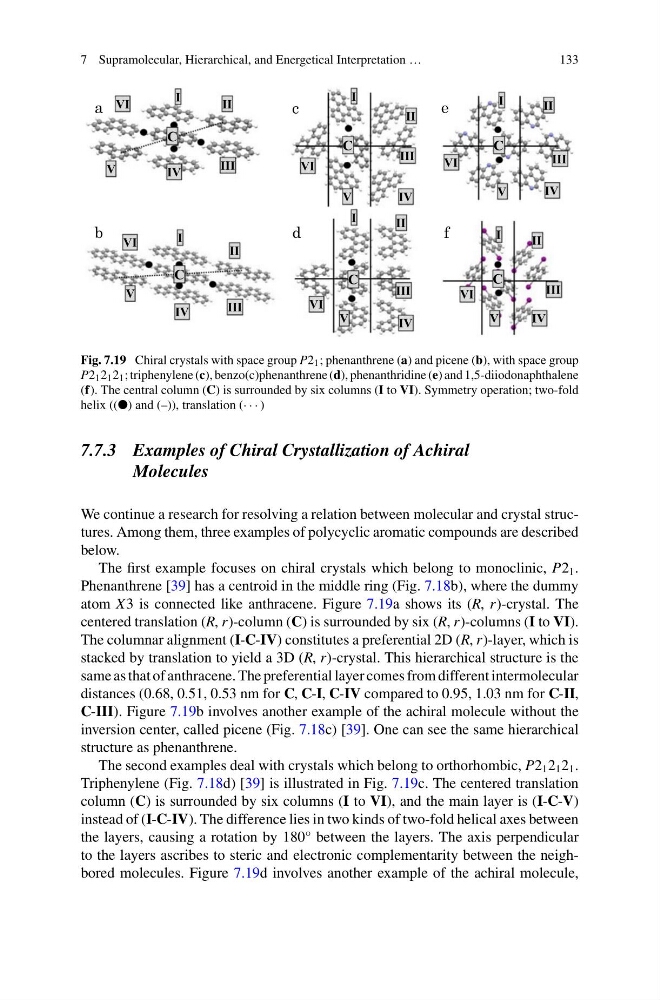
Fig. 7.19 Chiral crystals with space group P2 1 ; phenanthrene (a) and picene (b), with space group
P2 1 2 1 2 1 ; triphenylene (c), benzo(c)phenanthrene (d), phenanthridine (e) and 1,5-diiodonaphthalene
(f). The central column (C) is surrounded by six columns (I to VI). Symmetry operation; two-fold
helix ((●) and (–)), translation (· · · )
7.7.3 Examples of Chiral Crystallization of Achiral
Molecules
We continue a research for resolving a relation between molecular and crystal structures. Among them, three examples of polycyclic aromatic compounds are described
below.
The first example focuses on chiral crystals which belong to monoclinic, P2 1 .
Phenanthrene [39] has a centroid in the middle ring (Fig. 7.18b), where the dummy
atom X3 is connected like anthracene. Figure 7.19a shows its (R, r)-crystal. The
centered translation (R, r)-column (C) is surrounded by six (R, r)-columns (I to VI).
The columnar alignment (I-C-IV) constitutes a preferential 2D (R, r)-layer, which is
stacked by translation to yield a 3D (R, r)-crystal. This hierarchical structure is the
same as that of anthracene. The preferential layer comes from different intermolecular
distances (0.68, 0.51, 0.53 nm for C, C-I, C-IV compared to 0.95, 1.03 nm for C-II,
C-III). Figure 7.19b involves another example of the achiral molecule without the
inversion center, called picene (Fig. 7.18c) [39]. One can see the same hierarchical
structure as phenanthrene.
The second examples deal with crystals which belong to orthorhombic, P2 1 2 1 2 1 .
Triphenylene (Fig. 7.18d) [39] is illustrated in Fig. 7.19c. The centered translation
column (C) is surrounded by six columns (I to VI), and the main layer is (I-C-V)
instead of (I-C-IV). The difference lies in two kinds of two-fold helical axes between
the layers, causing a rotation by 180° between the layers. The axis perpendicular
to the layers ascribes to steric and electronic complementarity between the neighbored molecules. Figure 7.19d involves another example of the achiral molecule,
133
C
IV
I
II
III
V
VI
C
IV
I
II
III
V
VI
IV
I
II
III
V
VI
C
IV
I
II
III
V
VI
C
IV
I
II
III
V
VI
C
C
I
II
III
IV
V
VI
b
d
f
a
c
e
Fig. 7.19 Chiral crystals with space group P2 1 ; phenanthrene (a) and picene (b), with space group
P2 1 2 1 2 1 ; triphenylene (c), benzo(c)phenanthrene (d), phenanthridine (e) and 1,5-diiodonaphthalene
(f). The central column (C) is surrounded by six columns (I to VI). Symmetry operation; two-fold
helix ((●) and (–)), translation (· · · )
7.7.3 Examples of Chiral Crystallization of Achiral
Molecules
We continue a research for resolving a relation between molecular and crystal structures. Among them, three examples of polycyclic aromatic compounds are described
below.
The first example focuses on chiral crystals which belong to monoclinic, P2 1 .
Phenanthrene [39] has a centroid in the middle ring (Fig. 7.18b), where the dummy
atom X3 is connected like anthracene. Figure 7.19a shows its (R, r)-crystal. The
centered translation (R, r)-column (C) is surrounded by six (R, r)-columns (I to VI).
The columnar alignment (I-C-IV) constitutes a preferential 2D (R, r)-layer, which is
stacked by translation to yield a 3D (R, r)-crystal. This hierarchical structure is the
same as that of anthracene. The preferential layer comes from different intermolecular
distances (0.68, 0.51, 0.53 nm for C, C-I, C-IV compared to 0.95, 1.03 nm for C-II,
C-III). Figure 7.19b involves another example of the achiral molecule without the
inversion center, called picene (Fig. 7.18c) [39]. One can see the same hierarchical
structure as phenanthrene.
The second examples deal with crystals which belong to orthorhombic, P2 1 2 1 2 1 .
Triphenylene (Fig. 7.18d) [39] is illustrated in Fig. 7.19c. The centered translation
column (C) is surrounded by six columns (I to VI), and the main layer is (I-C-V)
instead of (I-C-IV). The difference lies in two kinds of two-fold helical axes between
the layers, causing a rotation by 180° between the layers. The axis perpendicular
to the layers ascribes to steric and electronic complementarity between the neighbored molecules. Figure 7.19d involves another example of the achiral molecule,