

132
M. Miyata and S. Tsuzuki
7.7 Chiral Crystallization of Achiral Molecules
7.7.1 New Understanding for Chiral Crystallization
From an isotropic viewpoint of symmetry theory, symmetry operations such as translation, two-fold rotation and two-fold helix do not enable us to discriminate handedness of the resultant assemblies. Nevertheless, from an anisotropic viewpoint, such
assemblies exhibit chirality and handedness according to 3D space geometry by
molecular graphics [14–16]. Furthermore, the latter anisotropic insight led us to the
hierarchical structures in organic crystals [16–18] as well as the linkage between
molecular and supramolecular chirality [33, 34].
The present article describes a new understanding for chiral crystallization of
achiral molecules, telling that the triangle method reasonably explains generation and
handedness of supramolecular chirality of the assemblies on the basis of positiondependent chirality. It still remains unclear to elucidate a relationship between
molecular structures and space group of their crystals. Hereafter one can find the
relation throughout a series of relative compounds, including polycyclic aromatic
compounds, chalcones, and so on.
It is noteworthy that chiral crystallization forms an equimolar amount of (R)and (S)-crystals. Their separation needs another insight. Recent crystal engineering
presents a great possibility for their separation [35, 36].
7.7.2 Connection of Organic Molecules via Their Centroids
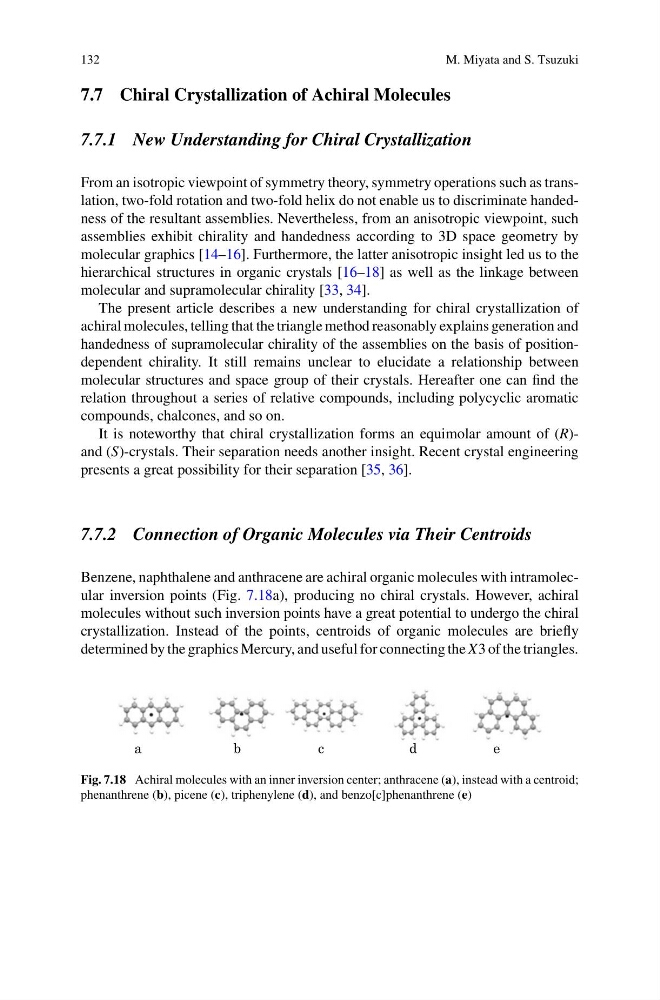
Benzene, naphthalene and anthracene are achiral organic molecules with intramolecular inversion points (Fig. 7.18a), producing no chiral crystals. However, achiral
molecules without such inversion points have a great potential to undergo the chiral
crystallization. Instead of the points, centroids of organic molecules are briefly
determined by the graphics Mercury, and useful for connecting the X3 of the triangles.
b
a
d
c
e
Fig. 7.18 Achiral molecules with an inner inversion center; anthracene (a), instead with a centroid;
phenanthrene (b), picene (c), triphenylene (d), and benzo[c]phenanthrene (e)
M. Miyata and S. Tsuzuki
7.7 Chiral Crystallization of Achiral Molecules
7.7.1 New Understanding for Chiral Crystallization
From an isotropic viewpoint of symmetry theory, symmetry operations such as translation, two-fold rotation and two-fold helix do not enable us to discriminate handedness of the resultant assemblies. Nevertheless, from an anisotropic viewpoint, such
assemblies exhibit chirality and handedness according to 3D space geometry by
molecular graphics [14–16]. Furthermore, the latter anisotropic insight led us to the
hierarchical structures in organic crystals [16–18] as well as the linkage between
molecular and supramolecular chirality [33, 34].
The present article describes a new understanding for chiral crystallization of
achiral molecules, telling that the triangle method reasonably explains generation and
handedness of supramolecular chirality of the assemblies on the basis of positiondependent chirality. It still remains unclear to elucidate a relationship between
molecular structures and space group of their crystals. Hereafter one can find the
relation throughout a series of relative compounds, including polycyclic aromatic
compounds, chalcones, and so on.
It is noteworthy that chiral crystallization forms an equimolar amount of (R)and (S)-crystals. Their separation needs another insight. Recent crystal engineering
presents a great possibility for their separation [35, 36].
7.7.2 Connection of Organic Molecules via Their Centroids
Benzene, naphthalene and anthracene are achiral organic molecules with intramolecular inversion points (Fig. 7.18a), producing no chiral crystals. However, achiral
molecules without such inversion points have a great potential to undergo the chiral
crystallization. Instead of the points, centroids of organic molecules are briefly
determined by the graphics Mercury, and useful for connecting the X3 of the triangles.
b
a
d
c
e
Fig. 7.18 Achiral molecules with an inner inversion center; anthracene (a), instead with a centroid;
phenanthrene (b), picene (c), triphenylene (d), and benzo[c]phenanthrene (e)