

130
M. Miyata and S. Tsuzuki
b
c
a
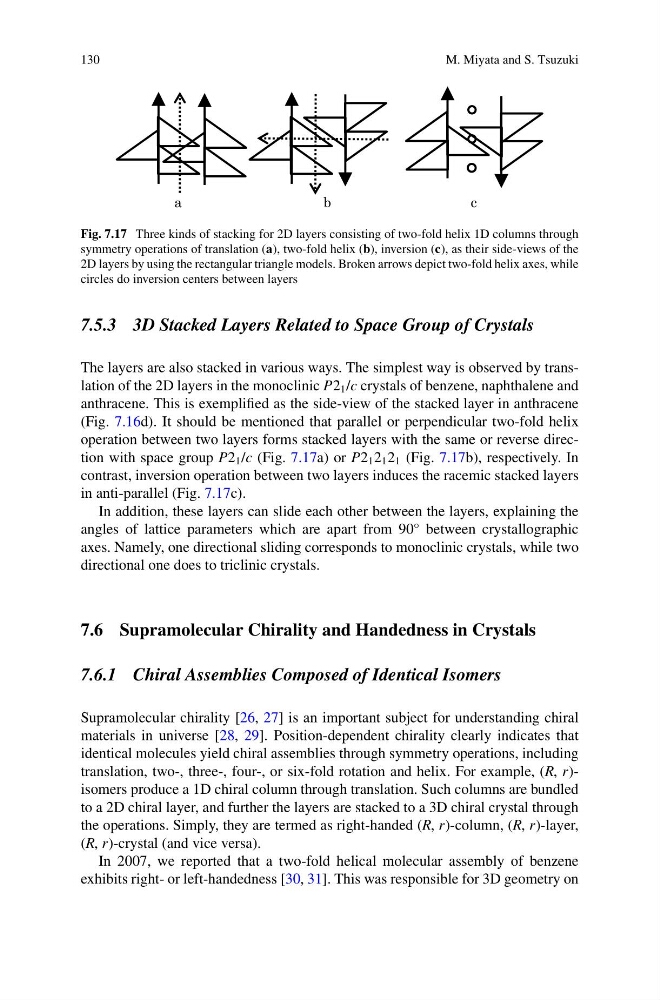
Fig. 7.17 Three kinds of stacking for 2D layers consisting of two-fold helix 1D columns through
symmetry operations of translation (a), two-fold helix (b), inversion (c), as their side-views of the
2D layers by using the rectangular triangle models. Broken arrows depict two-fold helix axes, while
circles do inversion centers between layers
7.5.3 3D Stacked Layers Related to Space Group of Crystals
The layers are also stacked in various ways. The simplest way is observed by translation of the 2D layers in the monoclinic P2 1 /c crystals of benzene, naphthalene and
anthracene. This is exemplified as the side-view of the stacked layer in anthracene
(Fig. 7.16d). It should be mentioned that parallel or perpendicular two-fold helix
operation between two layers forms stacked layers with the same or reverse direction with space group P2 1 /c (Fig. 7.17a) or P2 1 2 1 2 1 (Fig. 7.17b), respectively. In
contrast, inversion operation between two layers induces the racemic stacked layers
in anti-parallel (Fig. 7.17c).
In addition, these layers can slide each other between the layers, explaining the
angles of lattice parameters which are apart from 90° between crystallographic
axes. Namely, one directional sliding corresponds to monoclinic crystals, while two
directional one does to triclinic crystals.
7.6 Supramolecular Chirality and Handedness in Crystals
7.6.1 Chiral Assemblies Composed of Identical Isomers
Supramolecular chirality [26, 27] is an important subject for understanding chiral
materials in universe [28, 29]. Position-dependent chirality clearly indicates that
identical molecules yield chiral assemblies through symmetry operations, including
translation, two-, three-, four-, or six-fold rotation and helix. For example, (R, r)isomers produce a 1D chiral column through translation. Such columns are bundled
to a 2D chiral layer, and further the layers are stacked to a 3D chiral crystal through
the operations. Simply, they are termed as right-handed (R, r)-column, (R, r)-layer,
(R, r)-crystal (and vice versa).
In 2007, we reported that a two-fold helical molecular assembly of benzene
exhibits right- or left-handedness [30, 31]. This was responsible for 3D geometry on
M. Miyata and S. Tsuzuki
b
c
a
Fig. 7.17 Three kinds of stacking for 2D layers consisting of two-fold helix 1D columns through
symmetry operations of translation (a), two-fold helix (b), inversion (c), as their side-views of the
2D layers by using the rectangular triangle models. Broken arrows depict two-fold helix axes, while
circles do inversion centers between layers
7.5.3 3D Stacked Layers Related to Space Group of Crystals
The layers are also stacked in various ways. The simplest way is observed by translation of the 2D layers in the monoclinic P2 1 /c crystals of benzene, naphthalene and
anthracene. This is exemplified as the side-view of the stacked layer in anthracene
(Fig. 7.16d). It should be mentioned that parallel or perpendicular two-fold helix
operation between two layers forms stacked layers with the same or reverse direction with space group P2 1 /c (Fig. 7.17a) or P2 1 2 1 2 1 (Fig. 7.17b), respectively. In
contrast, inversion operation between two layers induces the racemic stacked layers
in anti-parallel (Fig. 7.17c).
In addition, these layers can slide each other between the layers, explaining the
angles of lattice parameters which are apart from 90° between crystallographic
axes. Namely, one directional sliding corresponds to monoclinic crystals, while two
directional one does to triclinic crystals.
7.6 Supramolecular Chirality and Handedness in Crystals
7.6.1 Chiral Assemblies Composed of Identical Isomers
Supramolecular chirality [26, 27] is an important subject for understanding chiral
materials in universe [28, 29]. Position-dependent chirality clearly indicates that
identical molecules yield chiral assemblies through symmetry operations, including
translation, two-, three-, four-, or six-fold rotation and helix. For example, (R, r)isomers produce a 1D chiral column through translation. Such columns are bundled
to a 2D chiral layer, and further the layers are stacked to a 3D chiral crystal through
the operations. Simply, they are termed as right-handed (R, r)-column, (R, r)-layer,
(R, r)-crystal (and vice versa).
In 2007, we reported that a two-fold helical molecular assembly of benzene
exhibits right- or left-handedness [30, 31]. This was responsible for 3D geometry on