

7 Supramolecular, Hierarchical, and Energetical Interpretation …
129
C
C-I(C-IV)
C-III(C-VI)
C-II(C-V)
(trala) (2 1 -helix)
(2 1 -helix)
(trala)
Distance: 0.60
0.52
0.99
1.12
Energy:
-5.5
-7.2
-2.0
-1.2
e
d
c
b
a
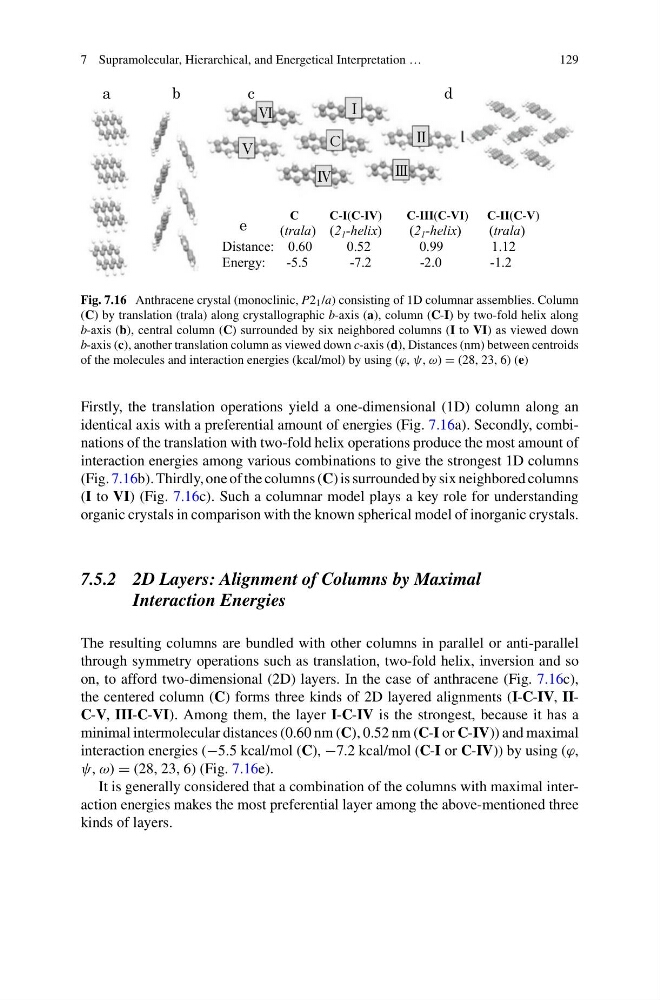
Fig. 7.16 Anthracene crystal (monoclinic, P2 1 /a) consisting of 1D columnar assemblies. Column
(C) by translation (trala) along crystallographic b-axis (a), column (C-I) by two-fold helix along
b-axis (b), central column (C) surrounded by six neighbored columns (I to VI) as viewed down
b-axis (c), another translation column as viewed down c-axis (d), Distances (nm) between centroids
of the molecules and interaction energies (kcal/mol) by using (ϕ, ψ, ω) = (28, 23, 6) (e)
Firstly, the translation operations yield a one-dimensional (1D) column along an
identical axis with a preferential amount of energies (Fig. 7.16a). Secondly, combinations of the translation with two-fold helix operations produce the most amount of
interaction energies among various combinations to give the strongest 1D columns
(Fig. 7.16b). Thirdly, one of the columns (C) is surrounded by six neighbored columns
(I to VI) (Fig. 7.16c). Such a columnar model plays a key role for understanding
organic crystals in comparison with the known spherical model of inorganic crystals.
7.5.2 2D Layers: Alignment of Columns by Maximal
Interaction Energies
The resulting columns are bundled with other columns in parallel or anti-parallel
through symmetry operations such as translation, two-fold helix, inversion and so
on, to afford two-dimensional (2D) layers. In the case of anthracene (Fig. 7.16c),
the centered column (C) forms three kinds of 2D layered alignments (I-C-IV, IIC-V, III-C-VI). Among them, the layer I-C-IV is the strongest, because it has a
minimal intermolecular distances (0.60 nm (C), 0.52 nm (C-I or C-IV)) and maximal
interaction energies (−5.5 kcal/mol (C), −7.2 kcal/mol (C-I or C-IV)) by using (ϕ,
ψ, ω) = (28, 23, 6) (Fig. 7.16e).
It is generally considered that a combination of the columns with maximal interaction energies makes the most preferential layer among the above-mentioned three
kinds of layers.
129
C
C-I(C-IV)
C-III(C-VI)
C-II(C-V)
(trala) (2 1 -helix)
(2 1 -helix)
(trala)
Distance: 0.60
0.52
0.99
1.12
Energy:
-5.5
-7.2
-2.0
-1.2
e
d
c
b
a
Fig. 7.16 Anthracene crystal (monoclinic, P2 1 /a) consisting of 1D columnar assemblies. Column
(C) by translation (trala) along crystallographic b-axis (a), column (C-I) by two-fold helix along
b-axis (b), central column (C) surrounded by six neighbored columns (I to VI) as viewed down
b-axis (c), another translation column as viewed down c-axis (d), Distances (nm) between centroids
of the molecules and interaction energies (kcal/mol) by using (ϕ, ψ, ω) = (28, 23, 6) (e)
Firstly, the translation operations yield a one-dimensional (1D) column along an
identical axis with a preferential amount of energies (Fig. 7.16a). Secondly, combinations of the translation with two-fold helix operations produce the most amount of
interaction energies among various combinations to give the strongest 1D columns
(Fig. 7.16b). Thirdly, one of the columns (C) is surrounded by six neighbored columns
(I to VI) (Fig. 7.16c). Such a columnar model plays a key role for understanding
organic crystals in comparison with the known spherical model of inorganic crystals.
7.5.2 2D Layers: Alignment of Columns by Maximal
Interaction Energies
The resulting columns are bundled with other columns in parallel or anti-parallel
through symmetry operations such as translation, two-fold helix, inversion and so
on, to afford two-dimensional (2D) layers. In the case of anthracene (Fig. 7.16c),
the centered column (C) forms three kinds of 2D layered alignments (I-C-IV, IIC-V, III-C-VI). Among them, the layer I-C-IV is the strongest, because it has a
minimal intermolecular distances (0.60 nm (C), 0.52 nm (C-I or C-IV)) and maximal
interaction energies (−5.5 kcal/mol (C), −7.2 kcal/mol (C-I or C-IV)) by using (ϕ,
ψ, ω) = (28, 23, 6) (Fig. 7.16e).
It is generally considered that a combination of the columns with maximal interaction energies makes the most preferential layer among the above-mentioned three
kinds of layers.